Author: admin

  • You wait two years for a funding round to complete, then two close at once

    Midland_family_tree.jpeg

    For the last couple of years, as you all know, I’ve been slowly but steadily raising the funds to publish Midland with Unbound. Thanks to your incredible kindness, patience and support, that day is finally here. It’s been one of the toughest things I’ve ever had to do, has taken twice as long as I thought it would, and has shown me what an incredible set of friends I have out there. 

    Thank you, all of you. You’re a very special group of people. Every pledge has meant so much. Times are incredibly tough in the publishing industry right now, as I’m sure you’re well aware. Many, many great writers and journalists are facing real crises in their careers. A pledge for an Unbound book is not just a pledge for me, it is a pledge for a new business model that can help writers and artists of all shades adapt to the financial realities of life in the internet age.

    And we’ve done it. We’ve raised the money to publish Midland. Save for a final polish, which I’ll be doing sometime within the next couple of months, the book is complete. As I’ve said to most of you individually already, I do hope you like it when it comes. I poured everything I had into it, and I really do think it is my best book to date.

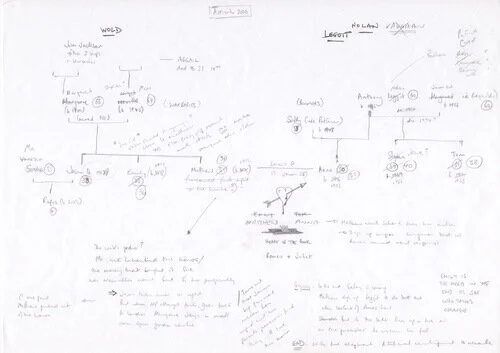
    It has been a risky book, too. Previously, I always crafted a careful plan and a plot for my books before sitting down to write them. Midland was different. I wanted to write a novel that flowed from the characters, not from some pre-ordained map of events – a map which always somehow seemed to stifle the characters’ ability to grow as believable people as the story got coloured in. So with this book, I tried a new approach. From beginning to end, during the ten years that I wrote it, my only plan was one single page of A4, pictured at the top of this post: the family tree of the Wolds and the Nolans.

    Details were tweaked here and there, names, dates and connections were adjusted and altered, but that was the whole outline, and beyond that the outline never altered. The book you’ll read sometime next year grew out of that one page, which was pinned on the wall above my computer for an entire decade. From this small square patch the whole book sprouted, much like the plants in my mothers’ Warwickshire garden: planted, nurtured, oftentimes pruned, sometimes dying, occasionally giving way to wild plants and weeds, but eventually coming together as a coherent – and I hope resplendent – whole.

    Well, of that, you will be the judge. That next stage in the book’s life belongs to you. In the meantime, as some of you will know, I’ll be getting involved in another project. Not a book (though there are more books in the pipeline), but a start-up. Because while I’ve been raising the money for Midland, I’ve also been raising money for  Hospify, a secure messaging platform for healthcare that hopes to revolutionise the way doctors, nurses and patients communicate.

    Just this week we’re completing a seed funding round for the company, and next week we start a regional trial in the West Midlands with the Unison public sector union (yes, more Midland connections). All this won’t be formally announced for another week or two yet, but you can visit hosify.com/news if you’d like to find out more about what we’re up to. As for Midland, I’ll be posting more updates here as the book gets prepared for printing, so keep an eye out for those.

    Thank you again. 2016 and 2017 have been the years of fundraising for me. 2018 will be the year of results.

    Onwards!

  • 81% funded – and a song to celebrate

    Well, we’re not far off now. Last week I did a big push out to all my connections on LinkedIn, and a lot of people were very generous and gave the campaign a big boost, carrying it over the 80% mark. It really feels like we’re getting some momentum now. I’m almost getting demob happy! 

    I wanted to post something suitable to celebrate, and I thought this video of Stephen and Hannah O’Driscoll playing one of their songs at a birthday party I went to a couple of weeks back would be just the thing.

    Stephen and Hannah played at the Midland Benefit gig (there’s a shorter clip of them playing in  the blog post  I wrote about that night). They’ve really got the most extraordinary sound, it sends tingles down my spine. I think I’m going to ask them to play at the Midland launch party, when it eventually happens. 

    In the meantime you can enjoy this tune, written by Stephen about his Irish grandfather (Hannah’s great-grandfather), who moved from Ireland to Poplar, and who loved to moan about things changing. 

    Sharing is caring, so do share it with anyone you think might want to pre-order a copy of Midland. I’m planning on closing the funding drive at the end of August and paying off any outstanding amount myself so that we can get the book into the publication schedule for early next year. So if you or anyone you know is thinking of pledging or upgrading a pledge, now’s the time to do it!

  • I knew that trading course I did would come in handy

    As you’ll know if you’ve read the opening section of Midland on my Unbound  homepage, one of book’s lead characters is an investment banker. Midland is in many ways a book about money – or debt, to be more precise – and the story is set shortly before the financial crash of 2008. So, in the interests of research, and because I’ve had a long-standing interest in the financial markets and found myself with the time on my hands to indulge it, a couple of years ago I did a course in futures trading.

    It wasn’t just curiosity. I’d been managing a small ISA of stocks since my father had died in, yes, 2008 – just months before the crash – and I’d had to sit and watch my already fairly meagre life savings get sliced in half more or less overnight. Shocked into doing something about my level of fiscal ignorance, over the ensuing six years I had taught myself the basics of portfolio management and – aided by a rising market, the work I was doing on the Finance pages of the Telegraph, and a subscription to the Motley Fool – I slowly managed to rebuild my capital and, indeed, to grow it well beyond the sum I’d had before disaster had struck.

    Emboldened by my success, out of a job following the sale of the video platform I’d found myself having to save from bankruptcy (long story), and in the throes of trying to bootstrap a new company with zero funds (longer story, still unfolding), I began to wonder if I could actually make at least part of a living trading stocks. Other people did it, right? How hard could it be?

    Not that easy, as I soon found out. I read some books and took some risks and discovered very quickly that a little knowledge can be a very dangerous thing. Despite my earlier successes I clearly didn’t know what I was doing. On the other hand, I’d been bitten by the bug – and was keen to learn more.

    Then one evening I saw a documentary about trading on the TV. The programme featured a company that ran full time courses for aspiring futures traders, and by bizarre coincidence its founders had been interviewed in the very restaurant in which I’d had dinner the previous night. This had to be karma (something that I now know bears a striking resemblance to the gambler’s fallacy), so the next day I called them up and asked them if I could pop in for a chat.

    Now there are a lot of crappy and over-priced trading courses out there, and I have no hesitation at all in saying that Amplify Trading is not one of them. I was very lucky to have found my way to one of the best futures training outfits that you can find outside of actually getting a job on a trading floor (and even then I imagine that Amplify quite often has the edge). Though they were still quite early stage when I was with them they’ve subsequently grown at a rapid clip and their clients now include universities and investment banks from the Middle East to Shanghai and back, and I heard recently that they now have the Financial Times on their books.

    The course itself was full-time, utterly rigorous, and a lot of fun and in the year of trading that followed it I lost a fair amount of money, came quite close to having a nervous breakdown, learned an enormous amount about the financial markets, learned even more about myself, and – eventually – mastered a few of the basics about how to trade. If I had to reduce it to one line, I think the most important thing I learned was when NOT to trade, which at the moment in my case is most of the time.

    If that sounds like a facile conclusion, believe me when I tell you that it really is not. That single piece of self-awareness – and, crucially, the ability to act on it –  came as the result of what is possibly the hardest personal battle I’ve ever fought: the ultimate showdown against my own particular brand of internal compulsion which, once all the bullshit and self-denial has been stripped away, is probably not all that different to your brand. If you’ve ever traded, or gambled, or been addicted to anything; or if you’ve ever read  Daniel Kahneman’s Thinking Fast and Slow, you’ll know what I mean. If you haven’t done any of those things, then I advise just reading the Kahneman. It could save you a whole world of pain.

    So the trading gurus are absolutely right when they tell you that trading is 70% psychological, 30% technical – if anything the psychological percentage is even higher. They will also tell you that everything in life is a trade, and increasingly they are right in that too. By the time I went to study with Amplify, I’d long since started to believe that my writing career was, quite literally, a gamble. Each of the four books I’d painstakingly fashioned over many years had proved little more, when it came to it, than chips on the roulette wheel of the publishing market, chips that were lost in at best three or four spins. Whether or not those chips had value in themselves, or any inherent quality at all, was a question that had started to seem not just irrelevant but naive. What counted was whether or not they paid out, and that in turn depended largely upon whether the ball of the world’s cultural attention happened to clatter down on them when the wheel span. And if it didn’t, then that was that, over and done, into the dustbin with it and onto the next – if I could stomach it.

    My career choice might have been particularly precarious, but it struck me that it wasn’t just me gambling like this, it was most of the people around me, whether they knew it or not. Economic realities have always dictated the development of societies, but it’s now a commonplace to remark that the current environment is more ludic, contingent and downright random than that in which our parents’ generation lived, where the rising post-war tide raised most ships and pushed them along relatively well-defined channels.

    Trading, given that it’s full of people who have accepted and internalised this existential state of risk (and even fuller of those who have not – a second category whose trades pay the wages of those in the first), looked to me like a good place to find out more about how to cope with this. And it did do that. It showed me how to invest less emotionally in decisions while committing to them utterly with every bit of my intellect. It stopped me looking for single big payoffs and taught me instead to run multiple strategies in parallel and de-risk those that were doing well instead of overextending them only to watch them go sour. It taught me how to be satisfied with the outcome of a plan well executed and not to hanker for more. And it taught me, as mentioned above, to be happy to sit on the sidelines when I’m not in the right frame of mind or general situation to commit sufficient mental and financial resources to the process of making a trade.

    Case in point: I’m not trading futures at the moment, haven’t done for over 18 months now, although I’m keeping my hand in with occasional forex trades that won’t cost me the month’s mortgage payment if I drink too much coffee and make an ill-timed decision. This has allowed me to get a little distance from it all. But I’m pleased to say I’m still able to spot a good trade when I see one, which I did earlier this year when bitcoin, which had been testing the $1000 handle, dipped to $750 or so. I’d not traded bitcoin before, but someone I work introduced me to a good broker so I was able to buy some of the blockchain-based currency. A couple of weeks ago I offloaded half of my stake when the price hit $1800. I’d made a profit of £1000 – money that I think the gods meant for Midland, so I’ve put it all into the book.

    Thanks to that, Midland is now 69% funded. No Unbound book that has hit the 70% mark has failed to get to 100%, so the next couple of pledges are crucial. Can you help tip me over that magic 70% level, perhaps by upgrading to from a hardback pledge to a Harry Harris CD, an extra copy of the book to give to a friend, a signed copy of the manuscript, or a invite to the launch party? Here’s an offer: if you pledge for the party I’ll invite you over to my place for lunch and tell you what I know about trading. It might not make you much money. But it might save you some.

  • Francis Upritchard returns to the Venice Biennale… and you can still pick up her work at a bargain price via Midland!

    Francis_Upritchard_biennale.jpeg

    I was really pleased to see an email from the  Kate MacGarry gallery  fly into my inbox yesterday, carrying the news that my friend and supporter the artist Francis Upritchard will be exhibiting at this year’s Venice Biennale  (I think Makiko, pictured above, will be part of the show). It will be Francis’s second appearance in Venice – she represented New Zealand at the 53rd Biennale in 2009 – and her work has grown enormously in range and depth since then, so I expect she’ll get a pretty rapturous reception. 

    Francis of course did me the enormous honour and favour of drawing (and donating!) the section artwork for Midland in order to help me fund the book. If you’re interested in her work you can read more about it in this  a nice interview  conducted in March last year by Rachael Vance for Ocula. And if you’re really interested in her work you should know that three of the drawings she did for me are still available to buy via the Midland “original artwork” pledge level. These days her sketches fetch around £900, so £550 for one of the ones she did for me – with a Midland hardback, two tickets to the Midland party, and a Harry Harris CD thrown in for good measure – really looks like a bit of a steal…

    Francis_Upritchard_pix_for_Midland.jpeg

  • Click here for prescience (with free shipping till Sunday)

    I’ve been thinking about prescience recently. Or maybe that should be: I was thinking presciently some time ago.

    One of the two. Or both.

    Two events combined to trigger this. The first was a cocktail-fuelled conversation with the latest maniac – ehm, I mean Midland supporter – to sign up for my crazy-arse “come fly with me”  parajet funding option. He lives in New York, and after the third Manhattan the conversation came round, as it does, to Elon Musk and, specifically, to whether or not Elon Musk is, basically, a complete chancer.

    The outcome of this chat is not relevant here, but during during discussion of Musk’s  Hyperloop  concept and his  Boring Company, I was reminded of a weird piece of underground railroad trivia I came across when living in New York myself and researching Habitus back in the pre-Internet dark ages of the very early 1990s.

    In those heathen times you had to actually to go to a library to find out shit, and perusing the dusty shelves of one such institution in Brooklyn I came across a book about the history of the subway. One of the things I learned from that book was that the very first underground train in New York was, in fact, a hyperloop-style experiment which used compressed air as a propellent to shunt its single carriage along its block-long tunnel, pre-empting Musk by around a century and a half. I you don’t believe me you can read up on the wondrous story of the Beach Pneumatic Transit without going to the trouble of schlepping down to your nearest civic centre and flipping through index cards, but by going to Wikipedia, where (of course) a potted history of  Alfred Beach’s incredible endeavour  awaits.

    Beach_Pneumatic_Transit_01.jpeg

    So that was one event: the recollected prescience of Alfred Beach. The second event was the remarked upon prescience of yours truly, James Flint, by another Midland supporter (they’re everywhere, these days), who had recommended that I listen to a  podcast interview  of tech “design ethicist” Tristan Harris by neuroscientist Sam Harris on the subject of the attention economy.

    “What is this attention economy,” I hear you stir from your slumber to cry? In a nutshell, it’s the thing that the Internet has become, the thing that has all checking our phones 150 times a day and reading all our news via Facebook and selling ourselves cheap to the most brazen, shameless clickbait bidder and voting for Trump and Brexit and abandoning all attempt to live in the rational, “real” world in which we used to live before the Internet came along, back when libraries were still a thing.

    Being a dutiful citizen I listened to said podcast (which I heartily recommend, as it is insightful and intelligent), and when I got to the point that Tristan started talking about how he used to be a magician and was intrigued by the way in which illusionist techniques had been routinely deployed by Silicon Valley’s user interface designers to promote ever more dopamine-driven engagement with apps such as Twitter, Facebook et al, I thought – hey, wait a sec. I wrote a book about exactly that, about a decade ago, during the dotcom boom, back when the Internet was young and we still real jobs and enough leisure time on our hands time to waste it wrapping our mouths around pointlessly long words like “applications”.

    Anyhoo, I told my friend (the Midland pledger) about this book, and he said that was pretty prescient of me to have written that, and I thought, you know what, it was! Especially since I then went on to write another book about the problems of nuclear waste storage before anyone had heard of Fukushima. Is there a pattern developing here? You tell me… (but only if you refer to me from now on as Jim the Oracle).

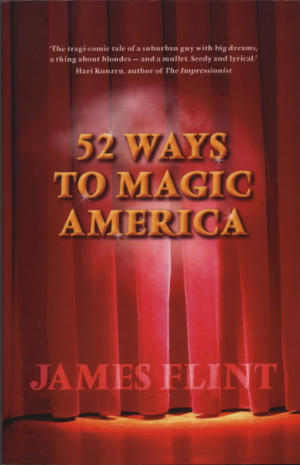
    Upshot: I’ve decided to celebrate this transitory acknowledgement of my Delphic powers by GIVING AWAY a free of copy of  52 Ways to Magic America  to the next three people that  pledge  – or upgrade their pledge – for Midland.

    52_Ways_original_UK_hardback_cover.png

    And if you hurry and pledge before midnight on Sunday, you can also take advantage of the free shipping offer being made by Unbound to celebrate its sixth birthday. That will save you £4 on a hardback. Just type the code FREE SHIPPING into the discount box when you check out.

    £4 off AND a free book!!!!!! What an offer!!! Jim the Oracle predicts that loads of you will race to  pledge  and upgrade and that Midland will be 60% funded by Sunday!

    Prove me right or I may just predict another round of fake news or nuclear problems. After all I haven’t yet given you my thoughts on Trump’s confrontation with North Korea or Elon Musk’s  Neuralink  project, have I…

  • The newsletter newsletter

    The news this week that HSBC has been involved in  laundering Russian money  will come as little surprise to any habituees of the Midland Shed who read the section of the novel (“Gull”) that I circulated to pledgers in February. “Gull” makes heavy reference to HSBC’s money laundering activities in the Caribbean, well-documented over the last few years by  Private Eye.

    Thinking about news – as I have to do quite a lot in my day job as a journalist – got me thinking about newsletters. As many of you will know, while I’ve been trying to bootstrap my start-up Hospify http://www.hospify.com/ over the last couple of years, I’ve been doing a kind of self-directed MBA to improve my business skills. My studies have taken me from  futures trading floors  to  business incubators  and currently see me writing about developments in artificial intelligence and robotics in the mornings www.curationcorp.com and studying  data science and machine learning  in the afternoons .

    My AI & robots briefings take the form of newsletters (you can read the most recent ones  here  and  here). But as well as producing newsletters, I read a lot of them too – in fact I’ve come to rely on them increasingly over the past few years as a key navigational aid in the vast information oceans through which we all now swim like whales (imagery which, if you’re paying attention, will tell you something key about the opening section of Midland – which like Gull has been sent to those who’ve kindly pledged…).

    Here then are some of my favourite whale songs – sorry, newsletters. This is not an exhaustive or ranked list; they’re just things I read regularly to help guide my passage through the data oceans of the world. They are all tech and business focussed, so if that’s not your bag, step off here. As I say, this post is more about the day job than about the novel-writing, though if you know me at all you’ll know that there’s always been a pretty symbiotic relationship between the two things – as the content of Midland itself I think demonstrates.

    1. The Exponential View: Veteran of The Economist, successful tech entrepreneur and, more importantly, my old pal from the heady days of the first dotcom boom and Wired UK, Azeem Azhar’s newsletter on cutting edge tech culture is fast-becoming an industry must-read.

    2. The Revolution: Another tech culture newsletter, from another dotcom boom veteran, though this time someone I knew from my time writing for Telegraph Connected, and this time focussed on the education sector.

    3. Cognition X News Briefing: OMG! More dotcom veterans, more friends of mine, and more tech culture stuff (this is the last of these, I promise!). This AI-focussed briefing from Tabitha Goldstaub and Charlie Muirhead, founders of London’s fastest growing AI & Data Science community, is just great.

    4. Zero Hedge: Time to put the tech stuff behind us now and head on over to the markets. Anyone who has done any trading at all will know Zero Hedge. I was introduced to this scourge of the indices during my time at Amplify Trading, and am still a regular reader. What goes in the markets stays in the markets… unless Zero Hedge gets to hear about it. Genius. http://amplifytrading.com/

    5. DB Reid: I can’t give a link to this one as it’s a subscription newsletter available only to Deutsche Bank’s clients. But I read Jim Reid’s morning briefing religiously every day for the year I was trading with Amplify, and it was simply the best market overview out there (as well as providing killer insights into how to train a small puppy and cope with the birth of your first child). The best substitute I have these days is Amplify’s own morning briefing on YouTube.

    6. Small Cap Network: Before Amplify taught me how to trade forex and futures properly, I spent several years buying and selling equities on my ISA, during which I was spared total financial disaster largely thanks to the ever-rising market tides post-2008. I read heaps of investor newsletters during that time, and paid for quite a few of them; this (free) one is the only one I still read regularly. It is filled with solid and thoughtful insight and advice. It won’t make you rich, but if you like buying and selling the odd stock and share it might save you from becoming poorer.

    7. Stratechery: From tech and trading we move to more general business writing, and there are few better practitioners out there than Ben Thompson. Formerly of Apple, Microsoft and the Kellogg School of Management and now based in Taipei, Ben’s clear, concise, data-driven blog posts bring genuine understanding to complex scenarios and are a genuine delight.

    8. Benedict Evans: From Taipei to Californ-i-a (that’s a segu-e, okay?), and a newsletter that comes out of Andreessen Horowitz, one of the VC firms right at the heart of the Silicon Valley beast. Sometimes an essay, sometimes just links, Ben Evans’s missives are the product of a very bright mind dropped into a very bright place, and are full of top notch nuggets.

    9. MIT Technology Download: We leap from west coast to east coast, where MIT rules the tech roost. The Download is nothing more than the best of the MIT Technology Review website, but because it’s MIT it has great access to all the best research that’s about to break through – like Wired without the hype, for PhDs.

    10. CB Insights: Also on the east coast (I think – I’m not completely sure) is this fantastic market intelligence platform. Its founder Anand Sanwal writes a newsletter highlighting the best of the company’s research, and his irreverent humour combines with the general brilliance of CB Insight’s research to produce a killer read. Look out for dispatches from the frontlines of Sanwal’s righteous war on pie charts.

    11. Muhr’s Must Reads: Well, that was 10 of the best, and if you’ve still got time in your week left after all that,, you might want to subscribe to MMR, which curates and summarises longer pieces of quality journalism from around the web.

    Enjoy. I know I do.

  • We had a night of incredible music, got to look astonishingly moody and cool – and raised £100!

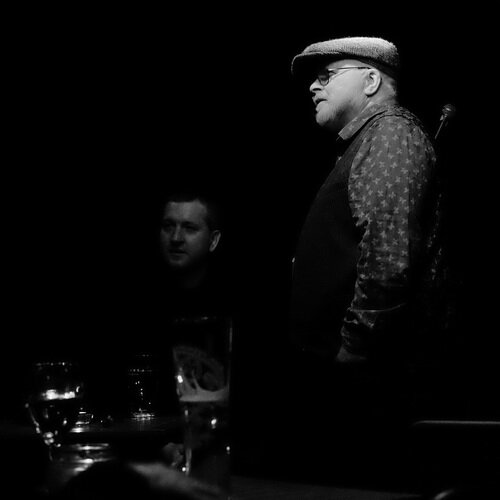
    What a night! I’m in awe of the incredible musicians who turned out to help support Midland at  Ryan’s Bar  in Stoke Newington on Saturday – and in awe of the audience who turned out, bought entry tickets (and raffle tickets) and generally gave their support. 

    First up was singer-songwriter Jeremy Tuplin, who laced the little basement venue with a series of darkly funny ballads.

    Jim_-_Midland_event-5.jpeg

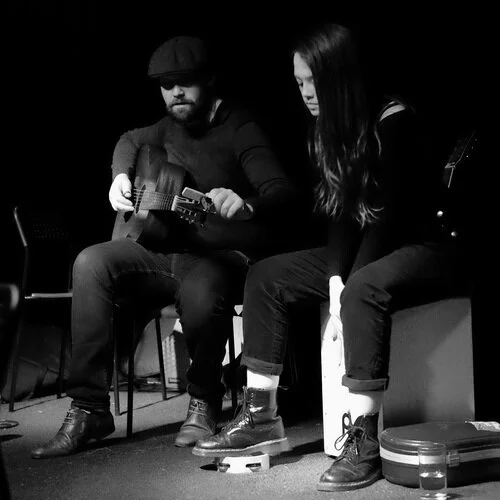
    The next act to grace the stage was the extraordinary father and daugher duo, Stephen and Hannah O’Driscoll. Their unique vocal harmonies and quirky lyrics (you can hear a snippet on the video included with this post) held us spellbound.

    Jim_-_Midland_event-6.jpeg

    After that Will Phipps stunned us with some guitar virtuosity and a song from his wonderful album Fly Away, Crazy Days, which is available on Bandcamp and which I highly recommend.

    Jim_-_Midland_event-15.jpeg

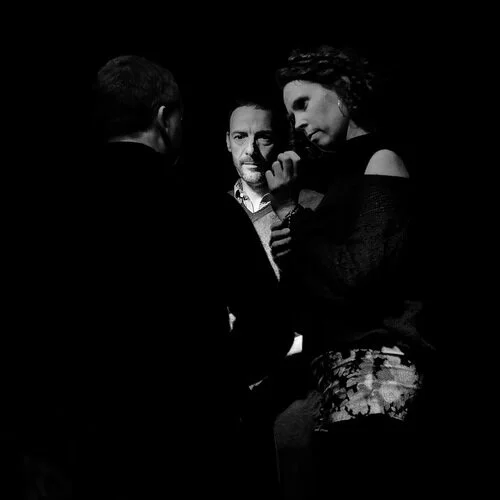
    Then we all stood around looking cool for a bit:

    Jim_-_Midland_event-12.jpeg

    Jim_-_Midland_event-1.jpeg

    or checked out Molly’s fabulous knees:

    Jim_-_Midland_event-2.jpeg

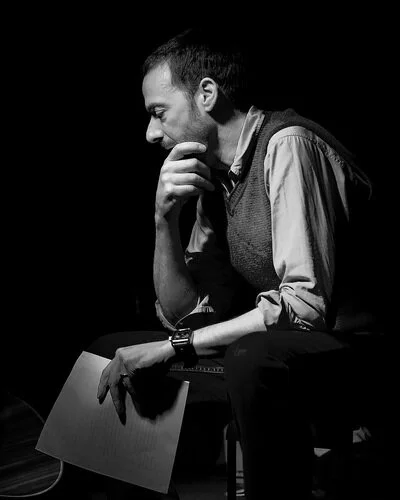
    and when we got bored of that I gave a reading from Midland. It must’ve been good because this shot of it makes me look like it happened between Miles Davis sets at the Village Vanguard in 1955 (am I pleased by being able to make that comparison? Yes, I am – I am really, really pleased… I’ve actually lived my whole life just for this precise moment):

    Jim_-_Midland_event-16.jpeg

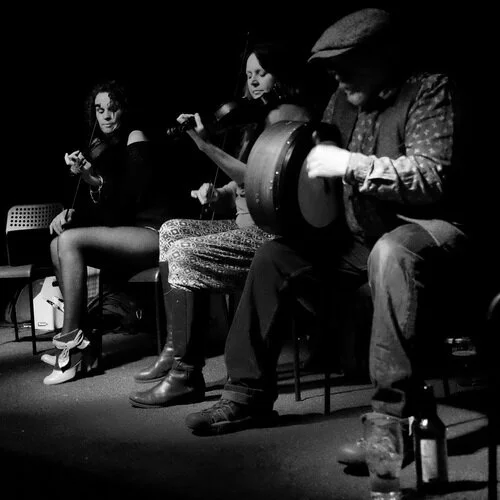
    Once the angst was out of the way the estimable Mulready sisters, Nora and Molly – who had organised the whole evening (THANK YOU GUYS!) – livened things up with some serious fiddle music.

    Jim_-_Midland_event-10.jpeg

    Which brought us to the climax of the night, a set by Paul Maddog Guinness, who was accompanied by Nora and Molly and an outstanding flautist by the name of Monique. Paul even sang Dirty Old Town, which brought the house down.

    20170304_224835.jpeg

    It was all really very special, and I still can’t quite believe that it happened. Thank you SO MUCH once again to all who took part, to Ryan’s Bar for hosting, and to Sean Geer for taking all these wonderful photographs – apart from the colour one at the end, which I snapped on my sister-in-law’s phone because I’d left my own phone behind Monique’s seat on the stage.

    No matter! Sean’s pictures were far superior to mine, you can see all the ones he took  here, and there are some other short musical clips to give you a flavour in this  playlist  I whacked up on YouTube.

    And you know what? It was so good, we should do it again sometime. Just for the pure joy of it. 

    Jim_-_Midland_event-13.jpeg

  • Midland Benefit Gig, Saturday 4th March: The Full SP

    William_Phipps_album_cover.jpeg

    This picture is from the cover of Will Phipps’ wonderful new album  Fly Away, Crazy Days. It would also make a pretty good cover for Midland, given the book’s themes of flying, loss and escape.

    Fitting then, that Will is going to playing the Midland benefit gig at the excellent  Ryan’s Bar  in Stoke Newington on Saturday March 4th.

    And it’s not just Will. He’ll be joined by singer-songwriter Jeremy Tuplin, described by the Telegraph Culture section as having “a distinctive, deep vocal that has hints of Leonard Cohen and Bill Callahan… Stunningly candid.”

    Also performing will be father/daughter Anglo-Irish folk singing duo Stephen and Hannah O’Driscoll, who don’t have a website but whom I’m assured are absolutely amazing.

    Top of the bill (and I can’t believe I’m writing this, I’m that excited about it) will be Paul Maddog McGuinness, long-time collaborator of  Shane MacGowan in The Popes.

    maddog.jpeg

    I’ll be doing a reading from Midland (that’s a picture of Paul McGuinness, not me, by the way); we’ll be holding a classy little raffle (oh yeah) to raise some extra dosh; and the whole evening will be hosted by Nora Mulready and Molly Mulready-Jones from the superlative Hackney School of Folk, who have also put the whole thing together and to whom I owe an enormous debt of thanks (as I do all the participating musicians – thank you!).

    Come, have a drink or three, hear some great music, maybe win a prize, and show these wonderful performers that it’s all been worth it. One hundred percent of the proceeds will of course go towards paying down the costs of publishing Midland. The arrow on our fund-o-meter is currently pointing at 54% – that’s £6,169 raised so far, only another £5,224 to go! If we have enough of a knees-up on the 4th, we could easily push the needle a fair few degrees further on.


    MIDLAND BENEFIT GIG
    Featuring performances by: Paul Maddog McGuiness, Stephen and Hannah O’Driscoll, Jeremy Tuplin, Will Phipps & James Flint

    • When? Saturday 4th March, 20:00 to 23:00 (but you can come for a drink and food in the bar upstairs before hand, and Ryan’s is open till midnight)

    • How much? £5 on the door

    • Where? Ryan’s Bar (Basement venue), 181 Stoke Newington Church Street, London N16 0UL

  • Alternative Valentine’s Day now confirmed for Saturday March 4th

    It’s on, it’s off, it’s on again… is it one of Donald Trump’s executive orders? NO! It’s the “Midland Alternative Valentine’s Day Benefit Gig in partnership with (which is to say, completely organised by) Hackney School of Folk” (to give it its full title).

    And it is now absolutely definitely 100% confirmed to take place on Saturday March 4th at the lovely Ryan’s Bar in Stoke Newington Church Street, norf London.

    Tickets will be available on the door and will probably be a fiver, there’ll be quality live music from various quality performers, there’ll be a reading from me, there’ll be a fundraising auction, and best of all there’ll be atmosphere, laughs and love a-plenty. All proceeds will of course go straight into the Midland publishing kitty and help carry it closer to that magical 100%.

    As threatened previously (but it’ll really happen this time) I’ll post more info here as the Doomsday hour draws near, and I’ll also shove up an event thing on Facebook so some kind of automated bot can pester you about it on my behalf and make sure you have absolutely no excuse for missing it.

    Do come. Really. Especially since not a single one of you took up my I thought rather generous Christmas offer of buying a second copy of Midland (two for the price of two!) to give to the loved one in your life. Don’t miss out again #FOMO! The book upgrade is still available, but the Benefit Gig will be the kind a once-in-a-lifetime never-to-be-repeated event that you’ll tell your grandchildren about, when you sit them down to warn them about the dangers of making friends with writers.

    See you in March!

  • The canal that led me to the real Harry Potter and a small pot of gold

    This post is dedicated to the memory of Tim Edsall, a Midland pledger whose energy and enthusiasm helped me to get this funding project underway, and a very dear friend of both my father and myself. Tim passed away last weekend. He will be sorely missed.

    This is the story of two great grandfathers but it was precipitated, as stories about the past so often are, with a new beginning. Back in October I started a new job in Here East, an enormous building that was the press centre for the 2012 Olympic Games and is currently being repurposed into a gigantic start-up hub which will, in theory, soon be home to all kinds of fledgling tech companies, all part of legacy transformation of the Queen Elizabeth Park.

    Here East is in the northeastern corner of the park. I live in Hackney, so to get there I cycle through Victoria Park (what is it with naming parks after royalty?) to the junction of the Grand Union and Hertford Union Canals on the park’s southern border. The Grand Union links Limehouse Basin with Birmingham, and was completed in its current form in 1929 to simplify the transport of coal from the Midlands to the capital. The Hertford Union connects the Grand Union (or the bit of it also known as the Regent’s Canal) to the navigable stretch of the River Lea.

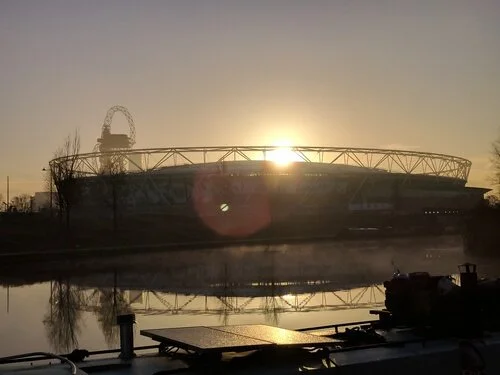
    In the mornings I bike along the Hertford branch until it hits the river, which if I’m lucky gets marked by this spectacular view of sunrise over the Olympic stadium…

    Sunrise_over_Olympic_Stadium.jpeg

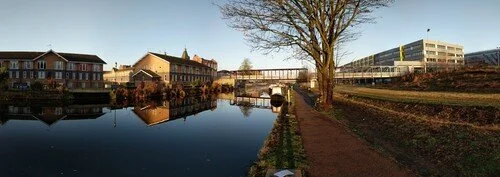
    … and then cross a bridge and turn north along the Lea’s towpath river until I reach my office: the gray and yellow box that looks like it belongs in a science park on the far right in the pic below.

    River_Lea_at_Here_East.jpeg

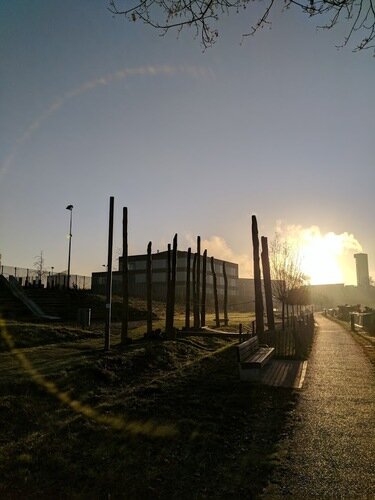
    It’s a blissful commute – only 10 minutes or so – and when the weather’s right, as it was on the morning I took these pictures, the views can be quite sublime. Here’s a third shot I took that day, looking south along the Lea, past a newly opened adventure playground and primary school, just to prove the point.

    Primary_school_by_Here_East.jpeg

    But this Shed post isn’t about my photos, nice though they are. It’s about the strange coincidence that I’m now working next to a canal, a canal directly connected to the canal on which my great grandfather made his living back in the 1930s. If I commandeered one of the narrowboats I can see from my office window, raised the Jolly Roger, and piloted it down the Lea, through the Hertford and up the Grand Union I would eventually, after a week or so of winding my way through a couple of hundred locks, arrive at Lime Wharf, Rolfe Street in Birmingham’s Smethwick.

    Today Lime Wharf is a scrubbed-up Enterprise Centre, but back in the early twentieth century it the site of the ominously titled Cooper & Swindler’s coal merchant’s, as attested by the large lettering on the high green gates that stood across the roadside entrance – lettering that was replaced with the single name “A. Cooper” after the Coopers and the Swindlers fell out. Whatever the cause of this ancient falling out, the yard was from then on the domain of Arthur Cooper, my maternal paternal great grandfather. (And in case you’re thinking that the Swindlers lived up to their moniker and were the cause of this rupture, by all accounts they were in fact very nice, honest people. What that says about my blood, the Coopers, I’m not altogether sure).

    In the early 1970s when I was very young my mother used to take me to Lime Wharf, still a coal merchants at that time. One of my earliest memories is of eating Bird’s trifle in a peculiar little glassed-in parlour, its window boxes filled with straggly geraniums, which looked out soot-blackened brick walls and the oily trench of a canal that felt as if it was heading into the bowels of the earth. For a long time I thought that this was actually a constructed memory, fashioned with impressions and imagery from Bleak House and Eraserhead, but I called my mother today and she told me that it was an accurate description of my great aunt Elsie’s parlour.

    Elsie was Arthur Cooper’s second child. She had two brothers: one younger, named Henry, who married a farm girl called Mary and moved out to the countryside near Sutton Coldfield; and an older one named Arthur Charles, after his coal-hauling Pa. Arthur Charles was my grandfather, although he died long before I was born. Although I never knew him I knew his wife – my granny – the evocatively christened Violet Olive, very well, as she lived with my parents for much of my childhood.

    Knowing vaguely that Violet’s family had come to Smethwick from Bow, via Surrey, I asked my mother if the Arthur Charles and Violet Olive’s romance had somehow been brokered by the Grand Union itself. Had he perhaps met her while running coal down to Limehouse Basin?

    Alas no. My novelist’s imagination was getting carried away again. The truth was, as the truth generally is, far darker and weirder. Arthur Cooper almost certainly never took his boats that far. Violet Olive met Arthur Charles because her mother, Florence Slade, had made a terrible choice of husband.

    Florence had had her own rather successful laundry business and had been doing a good trade stiffening corsets and bleaching petticoats when for reasons best known to herself,, she fell for my maternal great grandfather, a labourer with (presumably) a gift for the gab and a winning smile – and a useless ne’er-do-well to boot.

    Once married the cad ran through all Florence’s money and caused such problems that her business collapsed and the family was forced to move, and move again, tumbling north up the Grand Union and down the social ladder until they came to rest in a tiny, terrible house in the appropriately named Suffrage Street in Smethwick where to add to Florence’s torment, Violet Olive’s sister Ivy died, aged 13, of peritonitis.

    The name of the author of all these misfortunes? He was called, if you can believe it, Harry Potter. And the name of the park at the end of Suffrage Street? You guessed it: Victoria Park, just like the one I now live alongside in London.

    History doesn’t repeat itself. But it certainly rhymes.

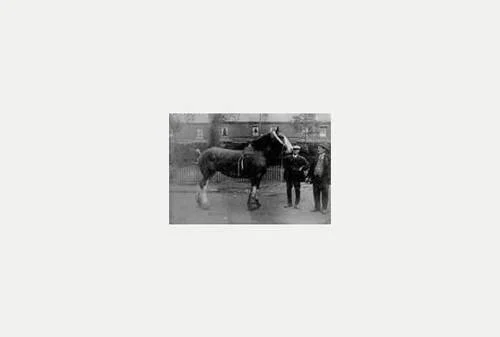
    I don’t have any pictures of Harry Potter, but  here’s a picture of Arthur Cooper, with one of the horses that were his obsession. There were stables in Lime Wharf, and the horses pulled his barges. He won prizes with them, and the oiled iron range in that parlour in which I sat eating trifle was covered with the trophy horse brasses that he’d picked up in his time.

    Arthur_Cooper_with_horse.jpeg

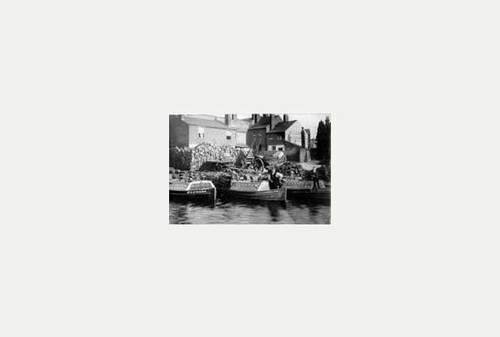
    And here’s a picture of the wharf itself. It’s a tiny image, but you can clearly see the coal barges moored out front – the same design as the ones I remember from my visits. In the yard great blocks of coal are stacked up against the walls. In front of them a wagon is lying tipped back, shafts pointing skyward, and behind that I think – though I need to check it with my mother – is the Cooper’s house, the one with the whitewash around the door and the windows.

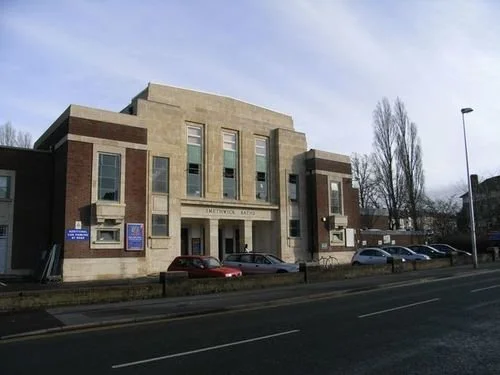
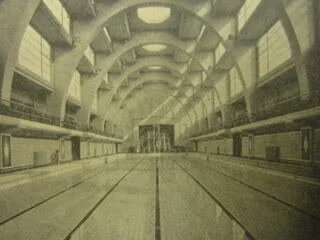
    It was amazing that Elsie kept the house as clean as she did. It had no bathroom so the family washed the coal dust off at the nearby Smethwick Baths, opened in 1933 and still standing today thanks to its art deco stylings and distinctive vaulted ceiling.

    Smethwick-Baths.jpeg

    SmethwickBathsInside.jpeg

    There wasn’t just coal dust to contend with. The pollution from the nearby metalworks of  Guest, Keen and Nettlefolds Limited, the company part-founded by Joseph Chamberlain that by the end of the First World War was producing almost  half the screws and a quarter of the nuts and bolts for the entire country, was so bad that by the 1960s it was said to be puckering the paintwork on cars parked nearby. It had expanded even further by that time though, and was better known by then – as it still is now – by its acronym: GKN.

    Living and working in the midst of all of this, it’s no surprise that the Coopers had a reputation for being rough. But then they also had a reputation for being tough and – by the measure of the area – established and successful. From these coal yards and metalworks elements of the British motor industry would grow, and Arthur Charles counted mechanics and racing drivers among his friends, including Smethwick’s world-famous hill climber Ken Wharton, later killed in fatal crash at the  New Zealand Grand Prix in 1952  – at a point when the car industry in Birmingham was pretty much the equivalent of what the internet industry was in Silicon Valley in the 1990s.

    Maybe that’s what attracted Violet to him. I was always told that she was anything but shrinking – as a young woman she had own motorbike at a stage when it was considered most unladylike, from which she’d removed the silencer just to make sure everyone knew what she was about.

    She saw Arthur Charles as her ticket out of Suffrage Street and, indeed, out of Smethwick altogether. By the time my mother was going to school Violet had leap-frogged Lime Wharf and had scored herself a modest new build – with a bathroom – in the desirable suburban enclave of Alvechurch, where she taught the piano and bred budgerigars in a long flight cage in the garden. In fact, that’s where she taught me the piano, though sad to say she also rather put me off it, by balancing two pence pieces on the backs of my hands to make me bend my fingers and thwacking me across the knuckles with a wooden ruler whenever they fell off.

    The Nolan family in Midland comes out of this milieu. Tony Nolan is a confluence of some of the industrial Black Country streams from which mighty multinationals would flow. And Midland itself came out of a decision I took around the time my own father was dying of leukaemia to write something about my own hinterlands of Birmingham and Warwickshire. Which makes the last coincidence I have to report the strangest of all.

    To finish Midland I had to quit my job at the Telegraph and take more flexible employment with a start-up which soon crashed and burned. This left me with enough time to get the book into good enough shape to cut a deal with Unbound, but it also left me in fairly dire financial straits. To finish the book to the satisfaction of my editor, the estimable Rachael Kerr, it still needed about three months’ of solid work. But I had no money left to support myself or my family while I did this.

    Then, completely out of the blue – and as if out of the pages of someone else’s novel – I got a letter from a private investigator (these people do, it seems, exist). In some kind of karmic acknowledgement of the ten years I’d spent trying to haul some of this out of my subconscious, he told me that a life insurance policy in Elsie’s name had been discovered, more than a quarter of a century after she’d died. As she’d name my sister and I in her will, and we were to each inherit a small chunk of the pay out that was due.

    It wasn’t riches beyond the dreams of avarice, but it was exactly the amount of cash I needed to calm my financial nerves, finish the book, and find a new job. Good old aunt Elsie. Who knew she’d hidden a golden ticket in the bottom of that trifle – a ticket that would ensure, all these years later, that her story would get told.