Welcome to WordPress. This is your first post. Edit or delete it, then start writing!
Author: admin
-
A tech evangelist with soul
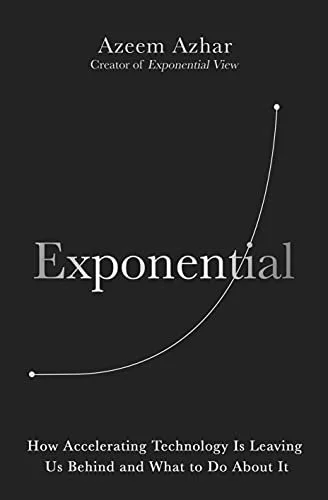
A review of “Exponential: How Accelerating Technology Is Leaving Us Behind and What to Do About It” by Azeem Azhar
Azeem Azhar’s “Exponential” starts out like many a techno-boosting tome: a smart, well-informed and optimistic account of current trends in and impacts of technology, a thesis about how we could better track this progress by using Wright’s Law than the more commonly used Moore’s Law, and a catchy concept – “that we’re living in the Exponential Age” – to hang it all off, perhaps in the hope of coining a term that will be deemed to have been definitive by posterity.
As the book progresses, however, it soon becomes apparent that there is more to Azhar than this first impression suggests. As consumers of his excellent weekly “Exponential View” newsletter (and its accompanying podcast) will know, Azhar is not your average tech evangelist. While he has extensive hands-on experience as both tech journalist and tech entrepreneur – and thus a deep command of his subject – he also has a deep concern for and interest in the real impact that all this tech is having on society. Democratic society, in particular.
He’s not afraid to say it, either. As early as Chapter 1 we find him castigating digital engineers for their culturally dominant view that “technology is neutral”. “Technologies are not just neutral tools to be applied (or misapplied) by their users,” Azhar insists. “They are artefacts built by people. And these people direct and design their inventions according to their own preferences […] And that means that our technologies often recreate the systems of power the exist in the rest of society.” After several decades’ worth of Silicon Valley hubris this is a breath of fresh air.
Azhar proceeds to walk a neat line between indulging his admiration for and excitement about the incredible gains that technology is bringing and his awareness of its potential downsides and impact on the structures of power. He allows himself to be enthralled by the idea that “between these four key areas – computing, energy, biology and manufacturing – it is possible to make out the contours of a wholly new era of human society” while remaining continually alert to the very real possibility that such a new era could, if we are not proactive and careful, very easily turn out to be a place in which we wouldn’t want to live.
As the book goes on Azhar becomes increasingly critical of the monopolist behaviour of the current tech giants, the manner in which the homophily encouraged by social media is atomising our culture, the fact that AI systems can just as easily embody society’s prejudices and offer new and insidious means of social control as they can transform business and science, and the way in which drone warfare is driving extreme asymmetries in military conflict.
All these points are made well and loudly elsewhere, for sure. But what’s so refreshing about “Exponential” is that Azhar makes them without losing his enthusiasm for the positive transformations that technology promises, and he uses them to develop a continued and determined case for governments and other social organisations to evolve policies and mechanisms of governance that are equal to the task that this new technological era presents. He even advances a case for more and more effective collective action by workers, a view that is guaranteed to raise hackles at Amazon, Google and Tesla, the point being that if we don’t haul our political structures out of the twentieth century and reform them to be equal to the challenge of controlling technology, it’s a pretty foregone conclusion already that technology and its overlords are going to control us.
Whether or not the era in which this battle rages will end up being known as “the exponential age” remains to be seen. What’s certain is that we need more writers and entrepreneurs of Azhar’s calibre around if we’re all going to share in its benefits.
-
A quick sketch of consciousness
Last weekend I was flicking through some TWIML AI podcasts, something I haven’t done since the Covid-19 pandemic kicked and I got busy with other things. Spoiled for choice as ever, I opted to listen to Sam Charrington’s interview with Yoshua Bengio.
It doesn’t need me to tell you that Bengio is something of a legend, one of the world’s leading AI researchers; but what’s great about this interview is the succinctness with which Bengio brings together some of the major strands in contemporary thought about consciousness and the mind in a way that I have been trying and failing to do myself, or at least failing to do with any kind of clarity that I was able to communicate.
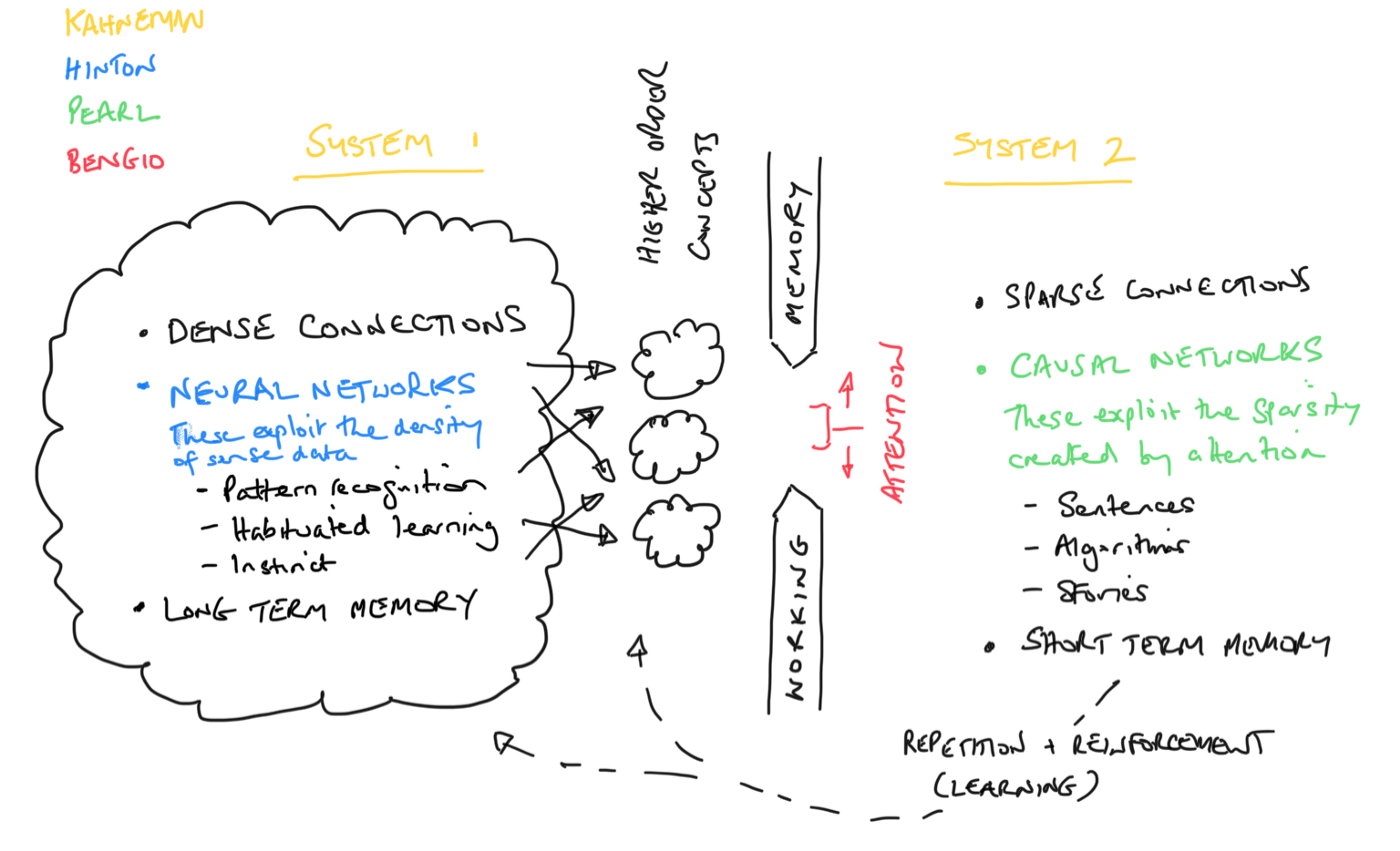
The strands I’m talking about are those characterised by the work of Geoffrey Hinton (deep learning), Daniel Kahneman (System 1 & System 2 thinking), and Judea Pearl (causal inference), .
I’m not going to give a potted summary of the work in question; the principles of deep learning as developed by Hinton and colleagues are well known enough now; Kahneman’s work with Andreas Tversky won him the Nobel prize in Economics and his book Thinking Fast & Slow was an international bestseller, and I wrote about Pearl’s work in this blog last year.
What’s so cool about the TWIML interview with Bengio is that after listening to it I was suddenly felt able to reconcile all these insights into different mental mechanisms into what at least seems like a coherent whole, bound together by Bengio’s insights about working memory and attention, which I already knew was something that he and others (Hinton too, I think) have been working on.
I sat right down and sketched out this diagram to explain it to myself, and I thought I’d share it hear and ask for comments:
My quick sketch of consiousness, pace Yoshua Bengio, Geoffrey Hinton, Judea Pearl & Daniel Kahneman
Now doubt some of this confuses more than it simplifies, but once I’ve had more time to consider it and had some feedback I’ll see if I can improve it and maybe write something a little more detailed about what I’m trying to get it here, in case it isn’t actually as obvious as I’m intending it to be!Now doubt some of this confuses more than it simplifies, but once I’ve had more time to consider it and had some feedback I’ll see if I can improve it and maybe write something a little more detailed about what I’m trying to get it here, in case it isn’t actually as obvious as I’m intending it to be!
-
Why AI is not AI until it wonders why
Reflections on Judea Pearl’s science of causal reasoning
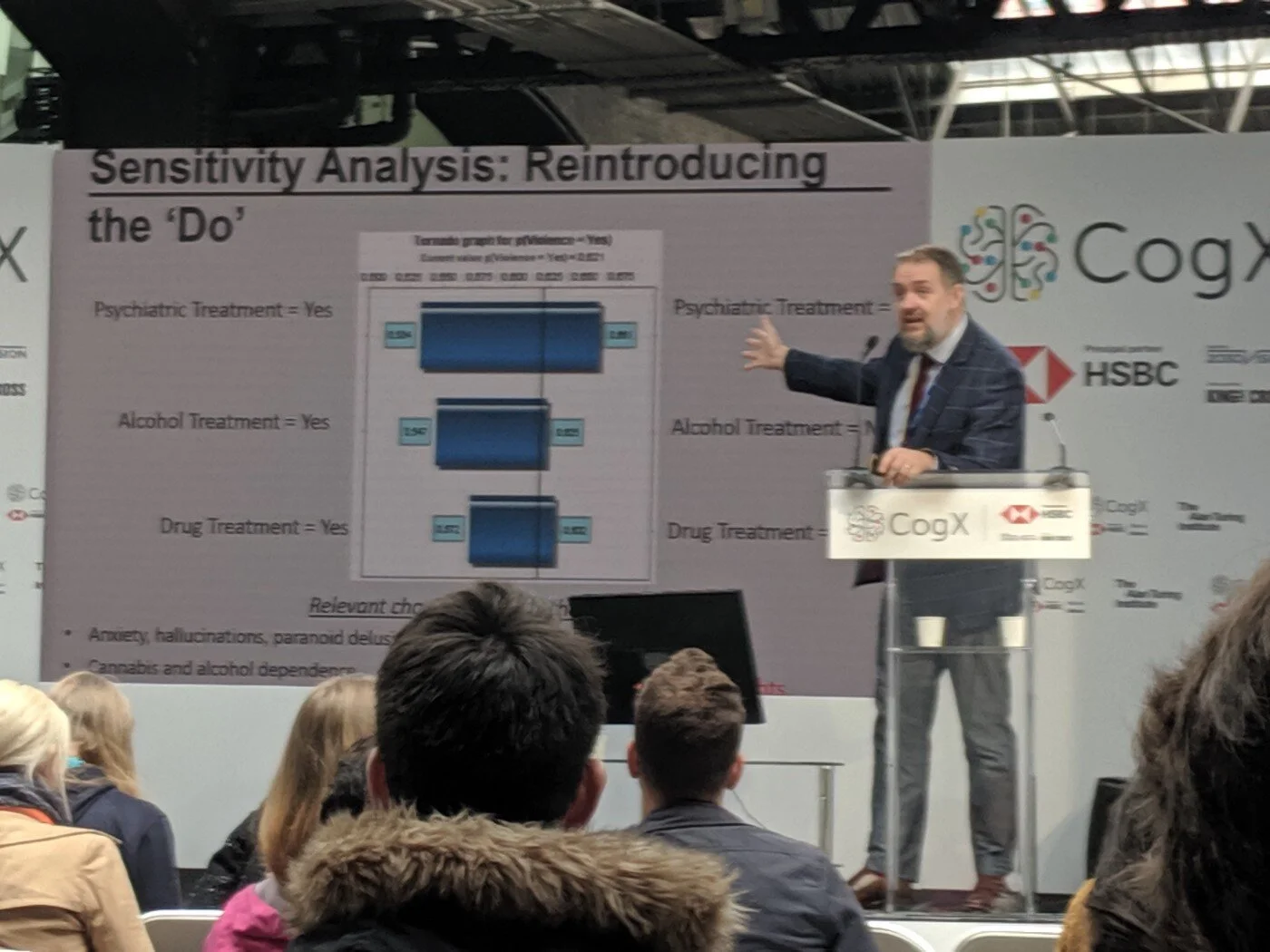
Dr. Mark Freestone lecturing on the Alan Turing stage at CogX19.
Back in June I was lucky enough to attend (indeed, exhibit at) this year’s CogX Festival of AI and Emerging Technology in London. It’s a fantastic event stuffed full of fascinating presentations— I urge you to come next year if you can — but of all the great talks I saw and encounters I had, one in particular stood out enough to make me want to sit down and write a blog post about it.
The presentation in question was by Dr. Mark Freestone. Freestone is a Senior Lecturer in the Centre for Psychiatry at the Wolfson Institute for Preventive Medicine; he’s also an Alan Turing fellow. What he had to say chimed powerfully with the contents of a book I’d read just a few weeks before, and which for my money sits alongside Daniel Kahneman’s “Thinking, Fast and Slow” as one of the books of the decade.
This was Judea Pearl’s “The Book of Why” (co-written with Dana Mackenzie), which is about cause and effect in statistics. As a student of philosophy and psychology and a part-time data scientist I’ve spent a fair chunk of my intellectual life pondering these things, which is why I picked it up and read it in the first place. And what a revelation it proved to be.
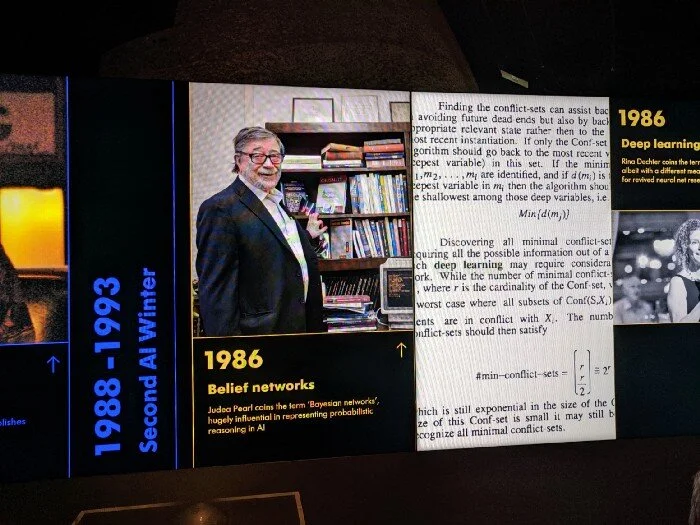
A historical timeline info board about the importance of Judah Pearl and Bayesian networks in the history of AI, from the “AI: More than Human” exhibition at London’s Barbican Centre, August 2019
Statistics tells us an enormous amount about the world, and now — thanks to analytical techniques of various flavours (from logistical regression to neural nets)— we’re baking statistical analysis at scale into the extraordinary data structures we’ve been building since the invention of the micro-processor and, more recently, the Internet.
We’ve now, with our usual hubris (and usual slavish adherence to the dictates of marketing), decided to call this development artificial intelligence, despite the fact that it’s not really intelligence at all but is, rather, pattern recognition and statistical analysis.
I don’t mean to demean the achievements that have been made in these sectors. But when compared to the processes at work in human or animal brains, they are akin to those at the “automated function” end — object persistence or facial recognition in vision, for example. Closer, therefore, to sensory perception than to the abstract cortical processing and decision-making that we generally refer to as “intelligence” (unless you work in marketing).
As every statistician knows, you see, “correlation is not causation.” But as Pearl points out in “The Book of Why”:
>
“Unfortunately, statistics has fetishized this commonsense observation. It tells us that correlation is not causation, but it does not tell us what causation is…. Student [of statistics] are not allowed to say that X is the cause of Y — only that X & Y are “related” or “associated”.”
— Judea Pearl, “The Book of Why” Even more than that, statisticians have maintained for decades that correlation was enough, that causation was either unfathomable or not required. So perhaps it’s no surprise that, as the crowning achievement of the discipline that has produced it, correlation is what the current crop of AI technology does, and does very well indeed.
This is fine if we want an AI to tell an image of a dog from an image of a cat; to recognise a face or a voice or a word or a cancer cell in the midst of healthy tissue; to calculate routes and identify cars and pedestrians; even to work at how to win at video games. Iterated pattern recognition of labelled data with backward propagation for error correction bolstered by a range of other techniques to simulate the contributions of human memory or the layering function of the mammalian visual cortex can handle all of this admirably. If you ally the techniques to more traditional AI techniques like decision trees and other higher order logics, you can start beating grandmasters at chess or Go and start building (or attempting to build) self-driving cars.
The trouble starts when we want to ask why something happened or predict what might happen if in systems as unconfined and messy as the untrammelled physical world rather than in closed and rule-bound environments such as a Go board or the neatly laid out traffic grid of the average mid-Western US town. Observational data sets of the kind used to train neural networks in pattern recognition do not contain the answers to these kinds of questions, you see (q.v. “correlation is not causation”). When it comes to causal or predictive questions (predictive in the sense of predicting the future, rather than predicting the likelihood of a classification), “data are profoundly dumb”.
In other words, in the realm of actual thinking, rather than the processing that our visual cortices perform on the patterns of light that play across our retinae, these processes do not replicate what is going on in our heads. We do not use correlation to work out what might happen next. It’s part of the toolkit we might deploy, but it isn’t by any stretch the core mechanic of how we think.
When it comes to figuring out causation, we instead use scenarios and counterfactuals. We use fictions, not facts (a point that appeals to the novelist in me, as you might well guess). These fictions have their basis in fact (well, most of the time), but even so they are built on relatively few immediate data points. They are instead largely constructed from multiple reconstituted examples from our experience — what we call “common sense”. They also inherently probabilistic — something they have in common with correlation. What they don’t share with correlation, however, is the ability “to predict the effects of an intervention without actually enacting it,” as Pearl puts it in his book.
Well, I hear you say, doesn’t AlphaGo do exactly that? And the answer is, no, it does not. AlphaGo enacts millions of virtual scenarios along multiple forking paths of action to produce highly complex statistical analyses of possible outcomes, which are then encoded into the weights of its deep neural nets. This is incredibly effective and even capable of producing previously unappreciated insight into Go’s game mechanic (AlphaGo’s now famous move 37 and, subsequently, Sedol’s move 78). And it may even be, in the broadest sense, akin to what Lee Sedol himself is doing when he’s playing Go. But it’s not what Lee Sedol is doing when he’s trying to work out what he should buy his daughter for her birthday.
When Lee Sedol does that, he is spinning up various counterfactual scenarios involving various versions of his daughter and himself, various gift options, and a whole range of family scenarios possibly stretching well into the future, scenarios that “reflect the very structure of [his] world model.” None of these scenarios will have happened in the past, and none of them will happen in the future, but he will make a choice dependent on whichever of them conforms most closely with his world model. And then, when he sees his daughter’s (and his wife’s) reaction to the gift, he’ll perhaps embellish his world model according to the difference between his prediction and the perceived reality, thus deploying a training set, not of AlphaGo’s millions of examples, but of just one.
What’s strange about this is that the empirical observation can never fully confirm or refute the counterfactual. And yet counterfactuals are the primary tools we have for guiding our journey through the world in a cybernetic fashion, and thus are “the building blocks of moral behaviour as well as scientific thought.”
Current AI does not benefit from this mode of human thought. The importance of Pearl’s work, as encapsulated in “The Book of Why”, is that over the last three decades he has developed a method, a “causal calculus”, to enable the “algorithmization of counterfactuals”, and thus make them available to use by thinking machines.
What is causal calculus? In essence, it’s a way of modelling the probability (P) of an event (L) happening if an action (X) takes place, while taking into account both mediating variables (so enabling the calculus to model of indirect as well as direct relationships between action and outcome) and influencing variables (so enabling the calculus to quantify and/or isolate other factors that may confuse, complexify or obscure the key relationship being interrogated much as the paragon of this form, the randomised control trial, seeks to do).
Pearl and his collaborators have developed a visual vernacular for mapping the causal relationships between these various elements for any given situation. These causal graphs in turn allows the construction of counterfactuals: how the mapped causal calculus if an influencing variable impinged on this node instead of that node, or if a mediating relationship should turn out to be reciprocal instead of just one way, for example. Once the pathways have been mapped, it then becomes possible to take data generated in one scenario and test its validity or plausibility in another, apparently comparable, scenario.
This is much more than a Bayesian prior, though priors play an important role in estimating the initial conditions for any given do-calculus, as Pearl terms his graphs. But the do-calculus itself goes far beyond Bayesian techniques in its power and implications as it compartmentalises and tracks conditions that comprise the system under study, rather than taken a global probability snapshot at a given stage and feeding it back into the evolving prediction calculation. (For a nice summary of the technique — and a second recommendation of the book — check out this Medium post by data scientist Ken Tsui).
As you’d expect, in “The Book of Why” Pearl gives plenty of good toy examples of the do-calculus; what’s particularly interesting about these is the way that even a very simple causal graphs with only five or six nodes can help unpick incredibly thorny issues like the demonstration of causal relationship between smoking and lung cancer, or the comparative impacts of nature and nuture on personality.
It’s in these test cases, too, that we are able to see the profound impact of this approach on the entire discipline of statistics. It means no less than:
>
“the mantra “Correlation does not imply causation” should give way to “Some correlations do imply causation.””
— Judea Pearl, “The Book of Why” The do-calculus is the technique that allows us — or our computers — to interrogate situations and their counterfactuals to work out which correlations those are.
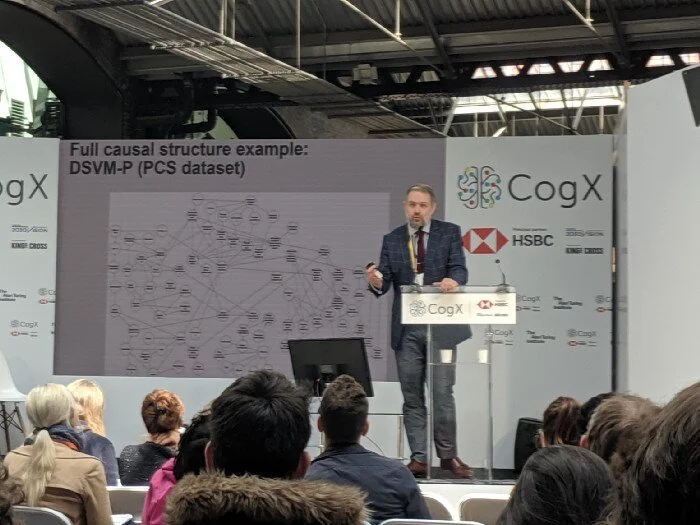
Dr. Freestone continues his lecture at CogX19, with an example of a full causal graph.
So now, I hope, it should be apparent why Mark Freestone’s talk at CogX 2019 excited me so much. It was the first example I’d come across since reading Pearl’s book of someone applying the do-calculus in the wild. As you can see from the photograph above, the causal graph of actions, outcomes, influences and mediators gets pretty crazy pretty fast when you’re trying to understand cause and effect in a situation as complex as the development of risk models for prediction and management of violence in mental health services (the focus of Freestone’s study).
The approach is also already beginning to make an impact on robotics. Start-up Realtime Robotics is making great progress on enabling interactive movement in machines by using counterfactual causal models, creating a specialised processor and scripting language (Indigolog) specifically to enable it. DeepMind has been mucking about in this area too, as you’d expect. Check out some of their research findings here.
I don’t pretend to be an expert in the do-calculus by any stretch. I’m writing this post partly to celebrate Pearl’s work, partly to tell you that it’s worthy of your attention if you haven’t come across it before, and partly to help me explain it to myself. To really grasp it I need to reread the whole book then start working through some trial examples; if I manage to get round to this while trying to close Hospify’s seed round (which is keeping me pretty busy), I’ll let you know.
In the meantime, do go and read “The Book of Why” for yourself. I promise you it’s worth it.
-
Ads are coming to WhatsApp
The move reveals Facebook’s intention to harvest yet more of your personal data for gain.
So, finally, the inevitable has happened. Facebook has completed its mission to turn the world’s greatest private, ad-free communications platform into a massive pipe to suck up the personal data of billions of people and sell it on to advertisers.
This is what we now know as “surveillance capitalism”, as defined in the best-selling book of the same name by Soshana Zuboff. And we also know, thanks to a recent announcement by Facebook at its recent Annual Marketing Summit in the Netherlands, that the ads will look like this:
How WhatsApp ads will look within the app, photographed by head of media at Be Connect digital marketing agency, Olivier Ponteville.
And in case you’re thinking that this whole surveillance capitalism thing is just a conspiracy theory, you should check out last Sunday’s Commencement address by Apple CEO Tim Cook at Stanford University:
“Too many [in tech] seem to think that good intentions excuse away harmful outcomes,” says Cook [timecode 6:26], “but whether you like it or not, what you build and what you create define who you are. It feels a bit crazy that anyone should have to say this. But if you’ve built a chaos factory, you can’t dodge responsibility for the chaos.”
Or for the ultimately numbing effect it will have on our society. “In a world without digital privacy, even if you have done nothing wrong but think differently, you begin to censor yourself. … The chilling effect of digital surveillance is profound, and it touches everything.”
This is why Apple has just announced a “private log in” feature, that will allow people to register with websites in a way that will prevent those sites from garnering and exploiting their data. And it’s why, here at Hospify, we’ve spent the last few years designing and building an alternative to WhatsApp that allows doctors, nurses and patients to communicate with each other about health matters without their privacy being compromised.
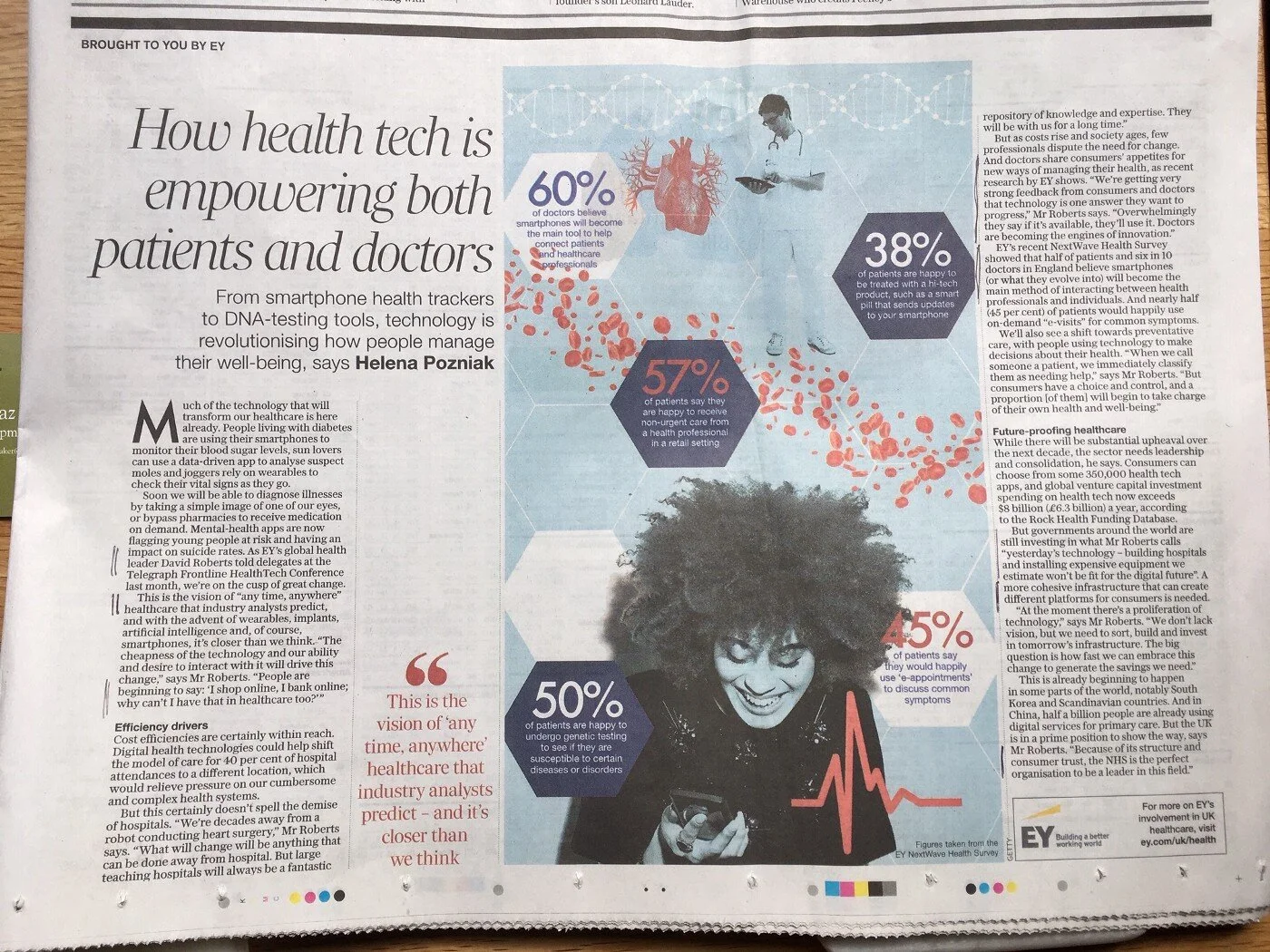
According to a survey recently conducted by EY and announced at the Telegraph Frontline HeathTech Conference in May, 60% of doctors “believe that smartphones will become the main tool to help connect patients and healthcare professionals” within the next few year.
EY survey finds that 60% of doctors “believe that smartphones will become the main tool to help connect patients and healthcare professionals”
It is therefore clearly more important than ever for the 600,000 or so clinicians in the UK currently using tools like WhatsApp and Facebook Messenger to communicate, to switch to using tools like Hospify.
So if you work in health and you haven’t done it already, what are you waiting for! Hospify is free and is available right now in the Android and Apple app stores. It’s a messaging tool that looks and feels like WhatsApp, but it doesn’t serve you ads or monetise your data, it doesn’t even store your data, it’s compliant with GDPR, UK data protection and NHS information governance, and the mobile app is free for anyone to use. Go and check it out today.
An open letter to Extinction Rebellion
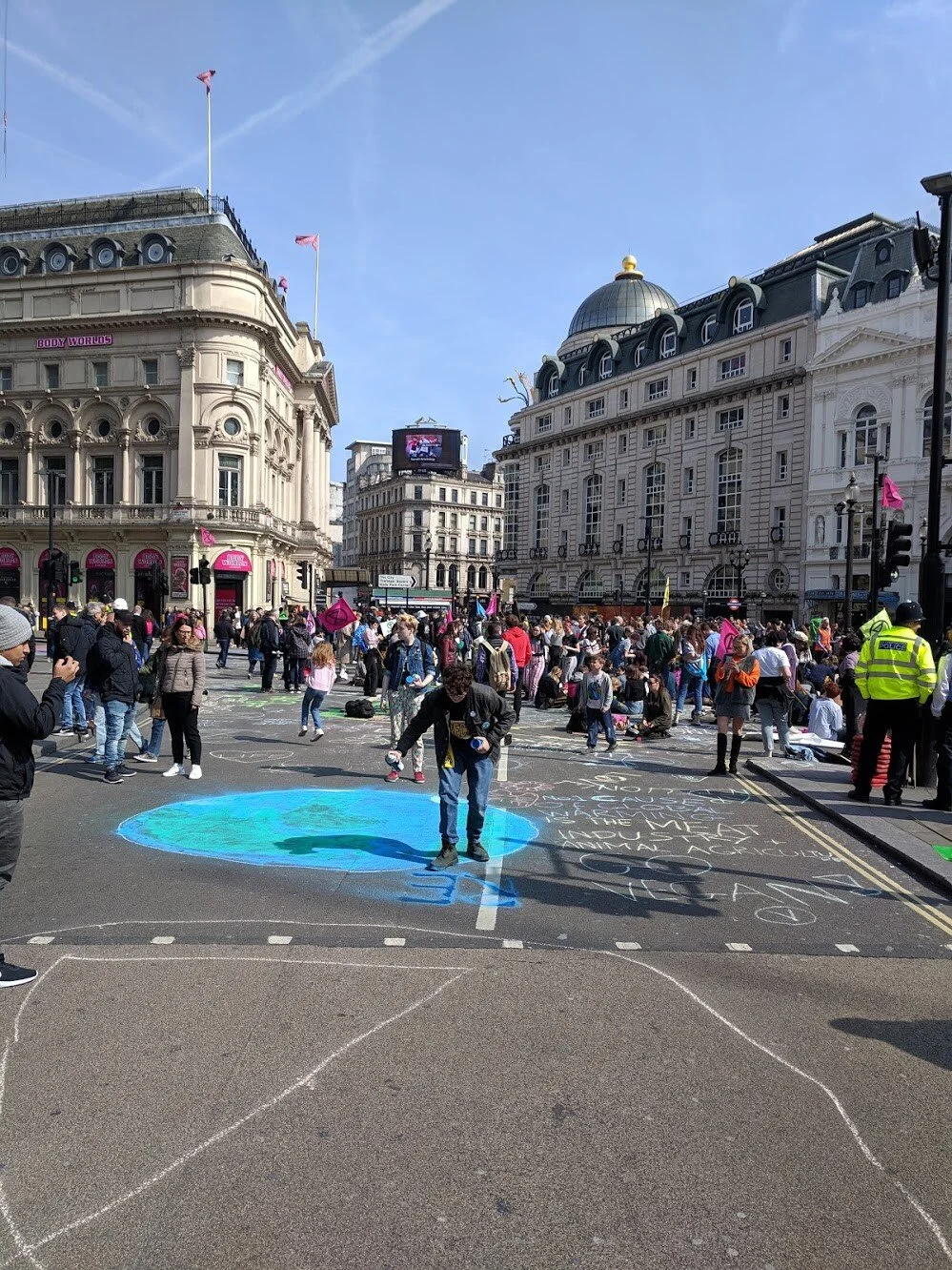
Extinction Rebellion protest, Piccadilly Circus, 15th April 2019 (JAMES FLINT)
Dear Extinction Rebellion,
I’m going to start by quoting from my new book, Midland. Because it’s relevant, and because I can:
>
“We’ve been trying to get someone to make a documentary about one of our EcoPath projects.”
“How have you got on?”
“I’ve been to see people at a few production companies.”
“And?”
“It’s extraordinary. This environment is front-page news these days. But unless it’s got a celebrity attached or you can get sex in the title, no one wants to know.”
“Sex, fame and property. That’s what it’s all about.”
“The whole thing’s been a colossal waste of time. This one guy, I went in to see him, and do you know what he said? He just glanced at first page of the outline and said, ‘Oh yeah, global warming, we’ve had hundreds of pitches like this the last couple of years. They’re like confetti.’”
“That’s encouraging.”
“So I said, well, if there’s so much interest in the subject, why didn’t you make any of them?”
Caitlin smiled. “I bet he liked that. What did he say?”
“I don’t know. I’d already walked out.”
“Brilliant. You’re going to go far in telly, Matthew. I can tell.”
— Midland by James Flint This anecdote, told by my environmentalist character Matthew Wold, is drawn from life. I know this, because the life it’s drawn from is mine. It happened to me.
Back in the early 2000s I was an unhappy technology writer. I should have been over the moon. I’d just had my first novel published and been awarded a handsome advance. And I had cred as a journalist too, having been lucky enough to pick up a dream editorial job on Wired magazine’s UK edition during the first dotcom boom. That job had vanished when Wired ran into financial difficulties in the late 90s, but it had left me with a bunch of skills and contacts, a healthy portfolio of published articles, and that book deal. And this was before social media had damaged the publishing industry, so freelance work was pretty easy to come by… and you usually got paid for it, too.
So why the glum face? Reader, I was worried. The other day I was listening to Greta Thunberg talk about how, aged 11, she got depressed about climate change, and in 1999 that was me (but without the pigtails). What I was finding particularly disheartening was the mainstream media’s failure to take the subject seriously, and all but ignore warning after warning made by the world’s leading scientists. I wrote an article about it, Five Years, and I published it in mute magazine, a magazine which I had helped to found, and which therefore had a progressive editorial policy. I didn’t seem able to publish this kind of article any place else.
This was twenty years ago. Twenty years. Around twenty years before that, I have my first strong memory of becoming environmentally aware. This was as a result of a campaign to ban leaded petrol that was being promoted by my school. It was an issue had particular resonance for children. The impact of even tiny amounts of lead of the development of the brain was becoming well understood, and the political pressure to remove it from petrol — to which it was added to prevent a phenomenon called “knocking” — was mounting. I remember the leaflets and badges, and what a self-evidently good idea the campaign seemed. Why wouldn’t you want to take lead out of petrol if it was damaging children’s brains, and all it meant was a slight adjustment to your car that any decent mechanic could make?
I found out why not on a trip into my Dad’s office in Birmingham during the school holidays. Armed with a fistful of leaflets and my newly discovered eco-warrior attitude, I sallied out to spread the word among the solicitors, articled clerks and legal secretaries. Most took the literature and uttered soothing grown-up words of support and admiration for my principles and crusading valour. One of them, however, got quite upset with me.
“Oh, I couldn’t possibly do this,” she said dismissively. “I’ve just spent a fortune getting my car working properly. I’m not having anything else done to it!”
Her recalcitrance shocked me, and I still clearly recall it, and the feeling it gave me, 40 years on. At the time, in my naivety, I thought she was an outlier — how could anyone be that stubborn? But as I grew older I discovered that she was entirely normal, and that indeed most people reacted this way when presented with a choice that might inconvenience them slightly and yet be better for the environment, even though they didn’t always come out and say so quite as bluntly as she did.
Whether the decision being taken is whether to use a 5p plastic bag, take an unnecessary flight, clear an area of rainforest for a palm oil plantation, or build a new oil refinery, we all behave like this. The decision to do otherwise than economic inertia dictates generally feels like a total inconvenience. What it generally is, in fact, is a failure of imagination.
Being an adult, I’ve discovered as I’ve become one myself, is hard. You have to make choices. If, like that lady in the solicitor’s office, you have both a family and a job you’re likely in a situation where your car is a necessity. Without it you can’t get the kids the school, get to work, do the shopping. Yet another trip to the garage costs you time, money and a lot of strain and hassle. Why take the word of some ten-year-old that you should do that, because of something you can’t see, touch, taste or smell, something that never did you any harm?
This is why change on any major scale tends to take at least a generation. Although levels of lead were reduced and CLEAR campaign was wound up 1989, It wasn’t until 1st January 2000 that unleaded petrol was finally completely banned in Britain. The leaflets I’d helped hand out in 1981 took two decades to finish their mission (and they were only printed a decade after the chemist Derek Bryce-Smith first sounded the alarm back in the late 1960s).
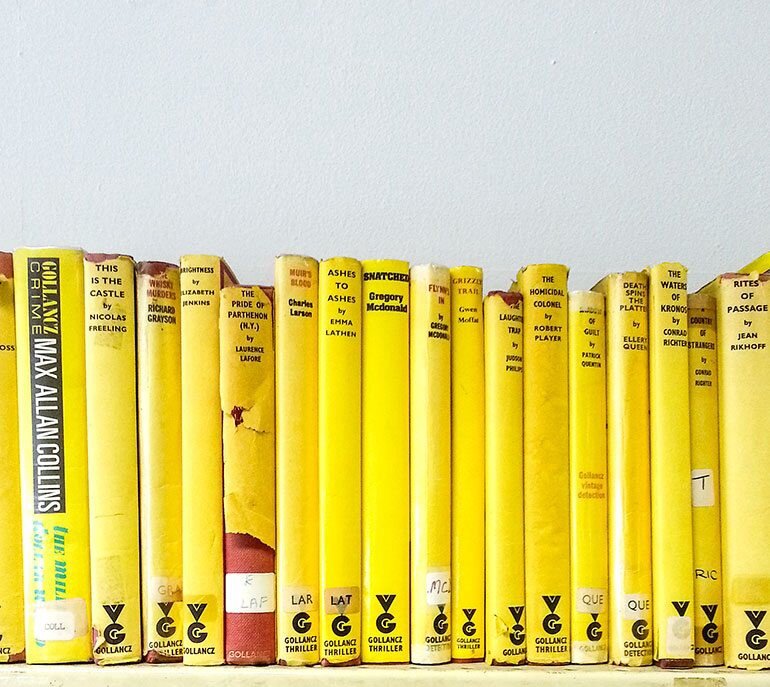
Gollancz yellow book jackets
Another moment of environmental awareness I had around that time came from science fiction. I’d discovered the genre in Stratford library, where my mother used to drop me off while she went shopping; bored by the contents of the children’s shelves I’d wandered into the adult section where my eye was caught by the sunflower yellow jackets of the Gollancz hardbacks ( that yellow is still my among favourite colours, and is the colour of my kitchen), which I started pulling off the shelves at random. Reading those books taught me to think about systems — social, geologic, climatic — on a planetary — or interplanetary — scale. Most of what I read I don’t remember now, but one story that stands out from about the death of the sea through over-pollution. I don’t recall the title or the author, just the conversation it relayed between a man and his son about how it used to be possible to swim in the sea before it became toxic, and the overwhelming feeling of existential sadness it engendered.
I went on from there to fall in love with the apocalyptic fiction of J. G. Ballard, Kurt Vonnegut and their ilk, writers who rang the bell of environmental doom as a way to examine the logics of human social psychology. I inhabited these stories as a teenager, probably more fully than I inhabited the physical world around me, a world from which I’d been forced to beat something of a retreat as a result of a bad car accident and the sudden degradation of my eyesight.
When I came to study economics, then, as a sixth-former, I couldn’t get past the discipline’s failure to price environmental externalities into the cost of doing business. (The assumption of the rational actor maximising utility and the simple linear equations of classical theory bugged me too, but that’s another story). At university, watching the first Gulf War break out on the TV in the student union, I remember being more concerned about the carbon footprint from all the burning oil wells than any other aspect of the war. When I heard a report on the radio that the Chinese were abandoning the bicycle and turning to the car instead, I was depressed for weeks (in fact, I think I’m still depressed about that). China’s famous devotion to two wheels instead of four had always given me, as it would have done H.G. Wells, hope for humanity. Now that hope was gone. This was long before I knew about the country’s terrible environmental record on other fronts: its decimation of the bird population during the Cultural Revolution to its destructive dam building, its terrible chemical spills, its penchant for coal-fired power stations… as I learned about those I periodically lost what little remained of any faith I had that as an individual that anything I did would do anything at all to slow our descent into a global environmental maelstrom.
Even when I worked at Wired, that exemplar of technological utopianism, I was worried about the environmental impact of computing, from the mining of minerals to the chemical footprint of processor manufacture to the electrical overhead of all those servers and screens, a concern we’ve now seen reach public consciousness thanks to the vast power requirements of the blockchain (an externality that is not priced in to Bitcoin, of course).
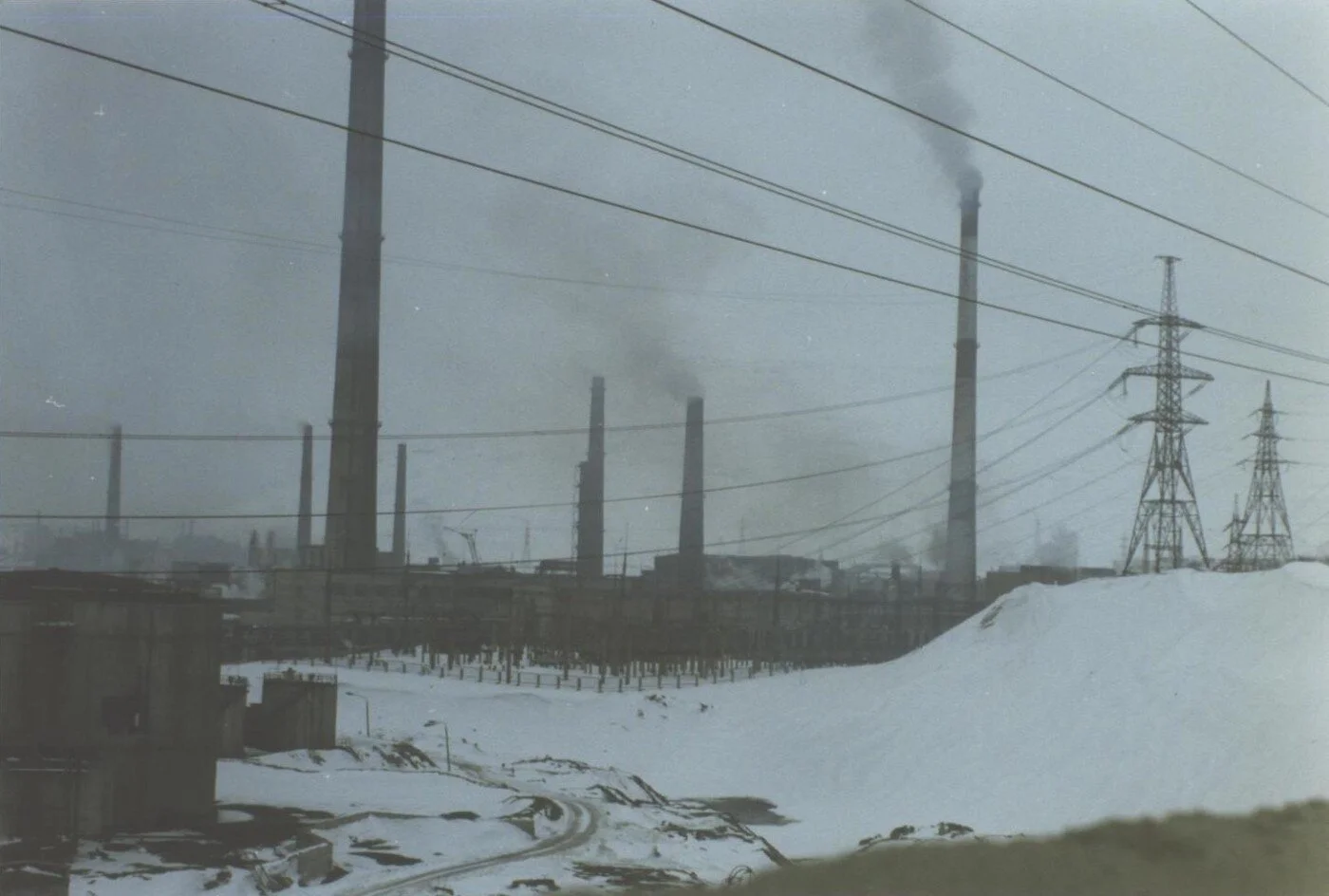
Wired had hippy roots too, though, and I was able to persuade my editor to let me travel to Russia’s Kola Peninsula to do a feature on the “digital curtain” of sensors being built across Europe to detect radioactive emissions from any future Chernobyls. A prime candidate was the reactor at Apatity, which was built to the same design. While visiting it, however, I also got to see first-hand the shocking environmental devastation caused by the aluminium smelter at Monchegorsk, which had dumped so much pollution into the atmosphere that for miles around the factory not only plants but even metals could not survive, and average human life expectancy in its dormitory town was reduced to 45.
The Severonikel Kombinat nickel and copper plant at Monchegorsk, Kola Peninsula, Russia. (JAMES FLINT)
All these thoughts were channelled into the hyperreal world of technical-ecological connectivity imagined in my first novel Habitus, and — in a more structured fashion — into its follow-up, The Book of Ash, based on the true story of the sculptor James Acord’s to make art out of nuclear waste.
Ash was a direct outcome of that trip to Russia. In the wake of it I’d taken a long hard look at the digital revolution and asked myself, well, if computers are going to change the world, what’s going to power them? Wind and solar weren’t anything liked as developed as they are now and battery technology was still very ropey, for one reason or another fossil fuels weren’t a realistic option (all the talk at the time was of carbon trading and, also, “peak oil”), so that left nuclear. Could nuclear fill the gap? I interviewed James Lovelock, the author of the Gaia hypothesis. He thought so. Was he right? I didn’t know, and what writers do when they don’t know the answer to a question, is they write a book in order to find out.
My publishers were not as enamoured of this idea as I was. Indeed, they rejected my early drafts and I had to write another book — more mainstream, about the dotcom boom — to get out of my contract. By the time I finished that, boom had turned to bust, George W. Bush had kept Al Gore out of the White House on the back of hanging chads, 9/11 had happened, and the second Gulf War had begun. The world was being drawn into broad spectrum conflict again and environmental concerns were being swept aside. They wouldn’t be back on the mainstream media agenda until Gore’s film An Inconvenient Truth put them back there in 2006.
My nuclear book was eventually published in 2004 to a deafening silence, except in France, where I’ve always had more of an audience and where nuclear power is a somewhat bigger deal than it is here in the UK. As a work of fiction I was really pleased with it, but writing it hadn’t answered my original question about the cost/benefits of nuclear energy given the onset of climate change. Something had struck me, though, while I’d been researching it, and that was the difficulty of getting hold of coherent, properly sourced and non-politicised information about energy and climate in general.
Since I’d started the book the internet had gone completely mainstream and was even starting to make people series money, but in an early bellwether of the “fake news” problem that we’re very consciously living through now, this hadn’t helped the environmental cause. Much of the information found online was partial or plain false — “greenwashing” by vested interests was a growing phenomenon, and the net was turning out to be an easy place to push out misinformation of all kinds. One of the few sites with any kind of traceability and peer review was Wikipedia, which was maturing as an operation but still quite distinctly lacking on information on environmental issues in general.
Thinking I might have spotted a gap in the market and frustrated at the failure of The Book of Ash to excite even the faintest public debate, I decided to set up a site devoted to providing reliable, scientifically-sourced information on the subject. It would be called WikiClimate, it would be built on the open-source version of the wiki software that underpinned Wikipedia, and unlike Wikipedia it would be funded by advertising — but only from environmentally-friendly products and brands.
As a freelance journalist and novelist I lived hand-to-mouth and I had no free cash or savings at all. So much so that over the previous decade I’d suffered the humiliation of being investigated by HMRC twice because they couldn’t believe how little I earned while still managing to live in central London (I cycled a lot and ate a lot of home-made falafel). I did however have a financially-solid father who was delighted that I was at least trying to finally do something as sensible as start a business, even if the core idea behind it, given that he could barely operate a computer, made no sense at all to him.
He donated a couple of thousand pounds to the cause and showed me how to set up a company and register a trademark (he was a lawyer, and so knew about such things). With some technical help and donated server space from the carbon data supremo Gavin Starks, founder of Amee and the Open Data Institute, to whom I’d been introduced to by a friend of a friend, and the brand design genius of Damian Jaques, an old pal back from my days at mute magazine, WikiClimate was born.
WikiClimate logo, by Damien Jaques
So I now had a climate change website, but no content. My basic — and totally naive — strategy was “if they build it they will come”, but they weren’t going to come without any content there at all, so I started writing some articles myself and began to hunt down various opportunities for publishing bundles of relevant information. Before I got very far, however, the site got discovered, not by hundreds of climate scientists looking for an outlet, but by hundreds of porn spam bots engineered specifically to exploit the vulnerability of self-publishing sites like mine. Soon, all my energies were spent, not generating content, but deleting in-appropriate links and pages and trying to wrap my head around complex strategies for spam filtering and cyber-security.
It was obvious I needed technical help — and therefore money — so I started casting around for investors. This was hard: in the mid-2000s, the financial community was still reeling from the double whammy of the dotcom crash and 9/11, and it wasn’t at all apparent that digital media was going to be the economic powerhouse that it subsequently has become. There was no start-up culture or community to speak of and very little narrative to reassure early stage investors other than the recent horror stories from 1999. To cut a long story I short, I ran out of money and had to go and find a job.
In the way of these things, my experience with WikiClimate helped me to find one. A contact at the Telegraph had noticed what I was doing and had recommended me. The Telegraph website was growing fast and needed someone to handle the burgeoning online team and launch new products, products which were to include an environmental channel, Telegraph Earth.
The Telegraph wasn’t exactly my spiritual home — I’m a lifelong Guardian reader, with politics to match — but in those days it was a much broader church than currently and there were some excellent science writers — including Roger Highfield and Charles Clover — on the Features staff. I’m also a long-term believer that there’s only so much value in preaching to the converted: trying to take the climate debate to the sceptical breakfast tables of the traditional Telegraph readership seemed like a worthy challenge. I applied, my unusual mix of literary, journalistic, digital and environment experience made me a good fit for the position, and I got the job.
In the beginning, it went pretty well. Once I’d got my bearings in the new role, I launched Telegraph Earth on the website to some fanfare and much support from the paper; this, after all, was the year that Tory poster boy & PM David Cameron took a trip to the Arctic, so hugging polar bears was on message. We commissioned some interesting articles and columns and built some cool digital tools, including an online carbon calculator powered by data from the Amee project. It all felt pretty good and I convinced myself that we were contributing in a small but meaningful way to what seemed to be a growing awareness of green issues in society at large. But it was an illusion, a false dawn. Nothing of the sort was going on.
In my innocence, I’d assumed that the Telegraph was getting into climate stuff because it believed in the growing importance of the subject for its readers and was trying to grow that constituency within its existing ranks as well as attract a younger readership. But the truth was that the project had been dreamt up by the marketing department to attract the “green pound”, and when it failed to do that within a few months or so of launch, Telegraph Earth’s already limited budget got slashed to, well, to nothing.
Editorial agenda versus marketing agenda… in many ways they are the same; they’re both kinds of economically motivated self-promotion. But the detail of the respective motivation differs substantially. As an editor I took a long-term view, allied to my belief that the public opinion was changing — and had to change; that we, at the Telegraph, should help drive that change; and that in doing that we would, ultimately, find ways to make it pay. The marketing department, however, took the short-term view. They were capitalising on a trend for “eco” they’d spotted within the Telegraph’s existing demographic. For them, Telegraph Earth was a way to grab some of the money swirling round it as it swirled, and then move on. Theirs was the approach that prevailed.
I don’t offer this as a particularly cynical comment on marketing departments in general or the Telegraph’s in particular, though it can certainly be read that way (and please do feel free to avail yourself of the undisputed pleasure of doing that). I offer it more as a reminder that we’ve seen waves of climate enthusiasm wash through society before and seen them morph into exercises in bad faith before the ink on the banners was dry.
If had just been Telegraph Earth, then maybe that would have been okay, just one of those things. But the episode turned out to be an early victory for anti-science and reactionary forces in the Telegraph in general. As the paper’s management, in thrall to wave after wave of opportunist consultants, lost its grip on what had started out as pretty successful digital strategy, and as the company has subsequently began to lose advertising market share to Facebook and Google, editorial budgets were slashed and slashed again. Many of the best journalists were made redundant or forced out, Highfield and Clover included, and in their place climate deniers such as James Delingpole were promoted.
The quality of reporting in the paper declined across the board, with the result of course that the readership declined still further, and to fill the void the owners and senior management began to align increasingly closely with the gathering forces of UKIP and Brexit, with Boris Johnson as their highly visible — and highly compensated — mouthpiece. I was the editor of the Telegraph Weekly by that point, but even from that relatively privileged position my budgets were so tight and my few staff so stretched that I found myself powerless to do anything about it other than avoid publishing Johnson and Delingpole and put environmental issues on my front page as often as I could. But it felt increasingly hopeless, and when the news came through that the Weekly was to be shut down altogether — in what I now might wonder could have been a political savvy attempt to help disenfranchise the paper’s expatriate audience ahead of the Brexit referendum, if the paper’s C-suite hadn’t repeatedly shown itself to lack any kind of strategic foresight — I myself took voluntary redundancy, and left.
Midland is my howl of anguish at those years of frustration, the years when we all knew perfectly well about the realities of climate change but failed as a society to take them with the seriousness they deserved. Hence my tale set in 2006, on the eve of the financial crisis, in which middle class personal issues play out against a backdrop of growing financial and environmental debt, the latter illustrated by a motif of dying whales and poisoned seabirds and despairing activists and the transformation of the natural world into a mechanised contraption peddled — inefficiently — by men.
“What’s the biggest breakthrough in climate science since 1979?” goes the joke, the punchline been that there hasn’t been one, that we’ve known pretty much what we know now for the last thirty years. The difference now, of course, is that we’re starting to actually experience it here in the coddled West. Now it’s our weather that’s becoming unstable and breaking all records, it’s our property and populations that hurricanes and floods and fires are destroying, and our insurers and central bankers that are starting to wring their hands in alarm. And now, finally, the climate deniers are becoming regarded as about as crazy as flat Earthers and are starting to being denied the privileged access to mainstream media they’ve enjoyed for far too long.
And so Extinction Rebellion feels different too, feels like it’s being taken more seriously than climate protests of the past, but I thought that about the Kyoto Earth Summit in 1997 and then we had George W. Bush and the second Gulf War, and I thought that about An Inconvenient Truth and Telegraph Earth, and then we had the Trump administration and the distraction from making any sensible decisions about anything at all that is Brexit.
On the other hand, we are now being helped by our technology: wind and solar power have come of age and are beginning to be deployed at scale; batteries are bring electricity from everything from cars to grids; the Internet continues to evolve as a political tool and while it has created filter bubbles that have promoted ignorance and denial, it is capable of bursting such bubbles too.
The social context is changing, now, as well. The feelings I had as a younger person about environmentally damaging events do not feel weird and fringe any more. They feel normal. No one laughs now if, for environmental reasons, you carry your own coffee cup or don’t fly or cycle everywhere or stop eating meat or put solar panels on your house. They used to laugh, but now they catch your eye and nod and try to bond by saying they haven’t done that but they’ve made some other change because we all need to do something because it’s getting serious now and they’re worried about the world we’re leaving our kids and it’s just too overwhelming now to continue to ignore.
So now’s the time for protest. Because when protestors express the prevailing opinion, then protest works, the forces get focused, and things start to change. Working through acceptable channels, as I’ve tried to do in my lame-ass way and as many other more focused and more savvy and more capable journalists, film-makers, lawyers and activists than me have done for decades, has not been enough. Sure, it has helped. But now we are out of time.
Despite carbon credit systems and international agreements and promises and good intentions of every kind, our governments have not followed through and our economies have failed to price environmental externalities into the price of the goods, services and energy sources that we all enjoy. We either change our habits now, or many if not all of us and a good proportion of the species we share the planet with — particularly the ones we’re most fond of — are going to die. “Business as usual” needs to have these costs put on its bottom line. If that doesn’t happen through legislation, it needs to happen through disruption, until it’s cheaper and more popular for governments to enforce carbon-reduction policies than not.
Needless to say, this disruption must be carried out non-violently, with good humour and a smile. Right now, one of the great virtues of Extinction Rebellion as a movement is that it has managed to internalise that. The comparisons with the campaigns of Gandhi and Mandela are apt, and need to continue to be apt, as the movement must continue with strict non-violence, whatever the provocation. And it will be severely provoked as things — quite literally — hot up. And they’ll hot up in more ways than one. As I was walking past the protest in Piccadilly last month (see picture at the head of this letter), some delivery guy whose day was being disrupted was berating the protestors for being idiots, saying — bizarrely — that he was going to through an apple at their f***ing heads. It might start with an apple, but there will be points, when things start to bite, when it will be something a lot more dangerous than that.
These protests must remain calm, they must remain cool, however hot things get. If we don’t manage that, we are lost.
Good luck!
Jim
Midland launched on the Thames
Hi everyone,
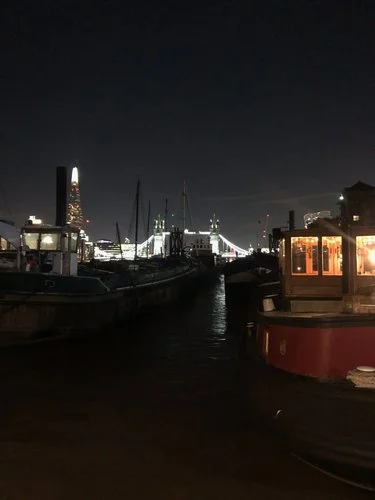
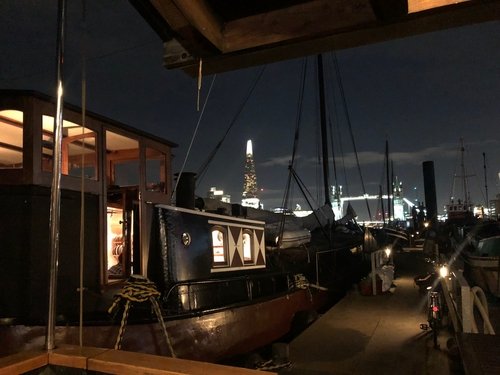
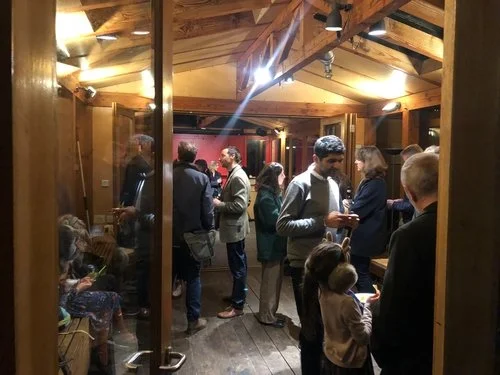
well, the long journey that began back in January 2006 is finally over. The Midland paperback was launched on Friday night from Pier House, the beautiful little community centre belonging to Hermitage Moorings, constructed on a pontoon just east of Tower Bridge.
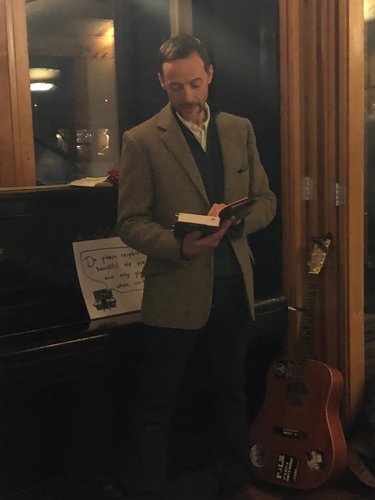
Friends and family gathered to eat sushi and raise a glass or three, and the incredible Harry Harris came all the way from Edinburgh to perform his songs Whale and Stag, which was really very special (see the videos above).
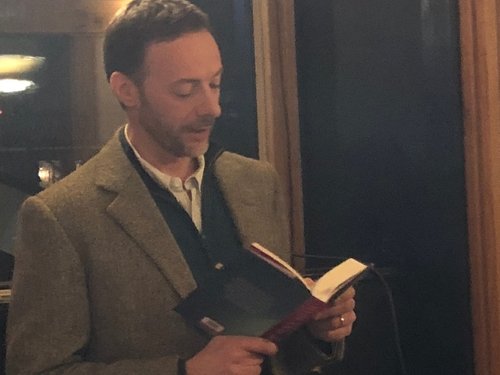
My wonderful editor Rachael Kerr (who’d blown out her own Burns Night dinner to be there!) gave a little speech and read out the glowing review we received on Friday morning from the Daily Mail, and I gave a couple of short readings from the Whale and Stag sections to dovetail with Harry’s songs.
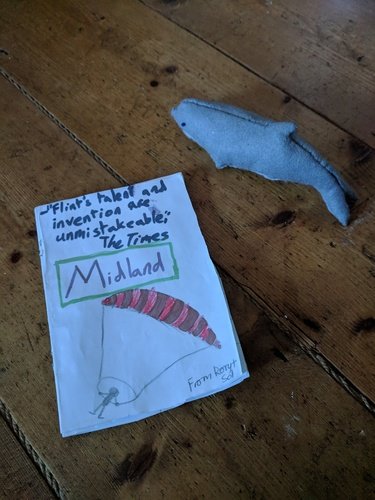
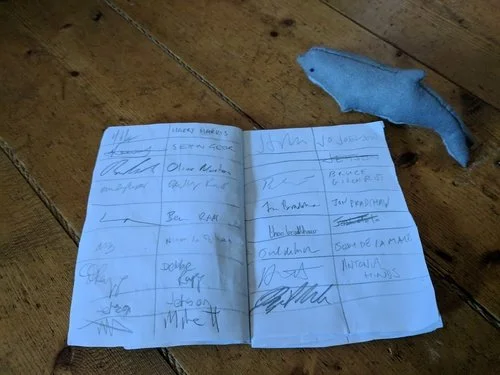
Oh, and my children gave me a version of the book that they’d made themselves, and got everybody to sign.
(The little stuffed bottlenose was made by my eldest daughter – it was my Christmas present!).
All in all the party was small but perfectly formed, rather like the book itself, if the somewhat amazing reviews that started coming in last week are to be believed. The publicity team at Unbound has organised something called a Book Blog Tour, which is a new one on me – this didn’t exist as a thing when I last published a book back in 2004. Reviews with various well-regarded book bloggers are placed during the weeks around launch, to help spread the word about the publication online. And these have been exceptional.
Tales before Bedtime said Midland was “absolutely stunning”. Emma’s Book Blog called it “a masterclass in storytelling”. The Literary Shed described it as “a masterpiece of control”. According to the Northern Reader it’s “A superbly written book, reflecting an impressive understanding of people and their motives.” And the aforementioned Daily Mail noted that “Flint writes beautifully and in defiant contradiction of character ‘journeys’ and neat resolutions.” Which I personally thought was very perceptive of them.
That was five out of five thumbs up from the first five reviews, three of which were also posted on Amazon, an incredible start to the novel’s life out there in the wide world.
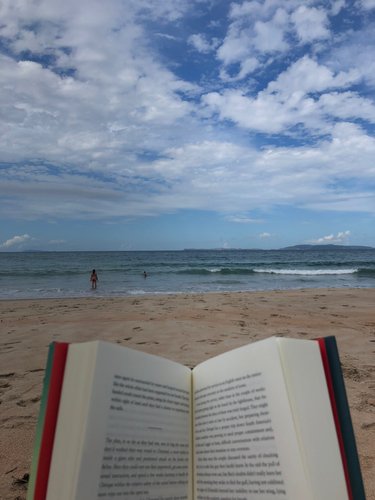
It’s even had its first read in the southern hemisphere: my next door neighbour, the musician Michael Hodgson, aka Sixteen Sunsets (whose album Misled Convoy is available on Spotify and who I have to thank for the photos of the launch posted above) took it on holiday to New Zealand over Christmas, and read it on the beach:
So, God speed, Midland. I wish calm seas and strong breezes to you and all who sail in you. Far may you journey, well may you prosper, long may you live.
What AI wants
A review of “Architects of Intelligence” by Martin Ford (Packt, 2018)
Towards the end of last year I was sent a review copy of a new book on AI. I read it over Christmas, and since it was pretty good I thought I’d do a little review of it here, as I’ve been pretty busy managing a growth spurt at Hospify lately, and haven’t published on my Medium blog for a while.
The book is called “Architects of Intelligence: The Truth about AI from the people Building It”, and as the title suggests it’s a collection of interviews, conducted by Martin Ford, whose recent book “Rise of the Robots” (which I haven’t read) won various plaudits including Financial Times Business book of the year.
When I received the book, I have to confess wasn’t overwhelmed with enthusiasm. I read a fair number of AI newsletters and listen to quite a few AI podcasts (TWIML AI is my favourite — shout out to Sam Charrington), and glancing through the list of interviewees it felt a bit like a collection of musings by the usual suspects — Yoshua Bengio, Geoffrey Hinton, Yann LeCun Demis Hassabis, Ray Kurzweil, Gary Marcus, Andrew Ng, Jeff Dean et al. While this is undoubtedly a list of extremely smart people, all of whom have excelled in their fields and have an enormous amounts to say, I did feel like I’ve already read or listened to plenty of interviews with all of them, and wondered what another set of “in conversation” transcripts could add. After all, AI is a technical field, and there’s a point at which general discussion about it loses its charm, and what you want from practitioners is a deeper dive into the nuts and bolts of the techniques involved (one of the things TWIML AI strives for, and often achieves), rather than yet another overview of the landscape.
However, as I worked my way through the 23 interviews in the book, it became apparent that Ford was doing something quite interesting. The big news in AI at the moment is of course the advances made in deep learning by many of the luminaries listed above — Bengio, Hinton, Hassabis, Ng, LeCun in particular. Ford groups these guys in the first half of the collection, interspersing them with philosophical covering fire from the likes of Nick Bostrom and Ray Kurzweil, the latter making the core point in his interview that “connectionism can emulate a rule-based approach, [but] a rule-based system really cannot emulate a connectionist system, so the converse statement is not the case.”
This is all great as far as it goes. Don’t get me wrong. I love deep learning. I first came across Hinton’s work (with Rumelhart and McClelland) in connectionism (i.e. deep learning and neural nets) as a post-grad back in 1992, and it blew my mind. I think that the work that’s been in recent years to implement it has been amazing, and it doesn’t need me to tell you that it’s been so transformative for computing in that it has re-energised the whole industry. I’ve even coded some deep learning projects of my own.
At the same time, however, as a philosophy and neurophysiology student, and I was (and remain) sceptical of claims that deep learning neural nets, which really only approximate how we think the brain works in the vaguest sense, are all there is to intelligence. After all, intelligence is not just about learning. It’s also about wanting. The philosopher I loved best as a post-grad was Gilles Deleuze, who described the abstract processes that underpin life (and thus intelligence) as “desiring machines”. Deep learning captures the machinic aspect of this tuple as well as any process we’ve been able to instantiate on a computer. What it doesn’t capture is the “desiring”. So far, that bit — the bit that the system wants, the thing that justifies its existence, causes it to act, and assesses its outcomes — is still provided — at every juncture — by the human beings that build the system. Until the machine takes over at least some aspect of that, “artificial intelligence” will remain a misnomer. What we’ll have, as we have now, is “augmented intelligence” or, “machine learning”, the term I prefer.
This niggle is the point at which “Architects of Intelligence” starts to gain purchase and subsequently gets really interesting. Ford has grouped the sceptics (by which I mean those who believe, as I do, that this is more than a niggle, but the whole crux of the problem), so just when you think the argument is done the voices of dissent begin to surface. The psychologist & technologist Gary Marcus is kind of their cheerleader, but there are many other folk here with strong hands on experience, particularly in robotics — Rana El Kaliouby, Rodney Brooks, Cynthia Breazeal, Joshua Tenenbaum — who point out, repeatedly and convincingly, the hard truth that deep learning, while being fantastic for pulling patterns out of vast data mines and finding signal in noise way beyond human abilities, is just not well-suited to generalising from smaller sample sizes. In the world of textual, voice or image analysis this isn’t a problem, at least not now we have the vast resources of the global internet to throw at it. But once you get out of server farms and into the physical world it’s a showstopper, as generalisation from small sample sizes is the way in which genuinely (as opposed to artificially) intelligent agents are able to extrapolate a desire-driven route through a world about which, in fact, they know very little.
The conceptual covering fire in this second half of the book is provided by Judea Pearl, who like Hinton was inspired by the work of David Rumelhart, and like Kurzweil has genuinely technical chops, but who provides some serious insights into the nature of probability and causal modelling (and thus desire, to continue with my earlier terminology), demonstrating a philosophical depth well beyond the somewhat excitable futurist extrapolations of his counterparts in the first half the book.
Ford summarises the point perfectly: “causation can never be learned from data alone.” In statistics, this is almost a cliché. “Causation is not correlation” is a phrase statisticians regularly repeat to each other (and their students) to remind themselves of the importance of not reading too much into raw data. But the cliché, as clichés so often are, is a flag pinned on the site of a profound truth. Not only is not causation not correlation, but they are entirely different beasts, one of which — any quantum physicist will tell you — we can only barely claim to understand. To quote Pearl:
>
“A child learns causal structure by playful manipulation, and this is how a scientist learns causal structure — playful manipulation. But we have to have the abilities and the template to store what we learn from this playful manipulation so we can use it, test it and change it. […] That is the first thing that we have to learn; we have to program computers to accommodate and manage that template.”
— Judea Pearl Neural nets take sample sizes of thousands or millions, and discover patterns in the data. Humans take a sample size of one and generalise patterns from that seed. This is the difference between learning and intelligence. We’ve built machines that exhibit the former. We’re a very long way from building them to exhibit the latter.
If you stick with it through all of its 500 or so pages, therefore (and I suggest that you do, and that you read the interviews sequentially), I think you’ll find as I did that far from being an ad hoc round up of the self-aggrandising thoughts of the current crop of machine learning geniuses, “Architects of Intelligence” is in fact a very dense and complete overview of the field and a great map of both its achievements and its very real challenges.
While it doesn’t have much technical detail, what it does have is genuine philosophical and conceptual nuance, and I came away from reading it assured of what I’ve been feeling for some time — that artificial general intelligence is much further off that many would have us believe, but that far from being a disappointment this in fact means is that the current excitement around deep learning is only the first in many such similar flowerings that are going to keep humanity busily engaged for the next few centuries at least, as we edge our way towards an increasingly profound understanding of what it means to build a mind.
Midland is out there… plus launch party details
Hi everyone,
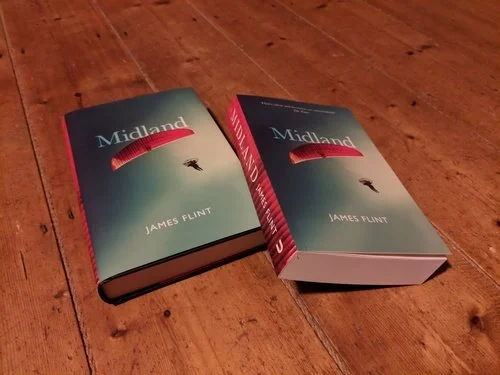
and the very best of the season to you all. As many of you will know, copies of the hardback of Midland have been mailed out in the last week or two, and so if you pledged for a copy you should have received yours by now. If you haven’t, do check your account to double check your address and follow up with Unbound if there has been a problem.
The books look absolutely fantastic; Unbound has done an exceptional job on the design and production of Midland; I really couldn’t be happier. The cover really captures the atmosphere of the novel, and looks beautiful to boot. It’s an amazing feeling to finally have the story that I started back in January 2006 printed and bound and out in the world.
It’s been an epic gestation – longer even than The Book of Ash, which I had to put on pause to write 52 Ways to Magic America – and Habitus, which took me seven years. I guess it’s about quality, not quantity ;-). Still, I do hope that I get the next book done in less than a decade…
A couple of supporters have already read Midland – big props to Ali M. and Heide D. for being first off the mark. Ali grew up in Warwickshire and Heide still lives there, so they can vouch for the local detail. Heide said she really enjoyed the book and Ali has left a great review on Goodreads, which you can check out here. If you’re reading Midland at the moment, please do leave a review when you’re done – Goodreads reviews will really help with sales when the paperback comes out in the new year.
The official publication date for that is January 24th, at which point the paperback (and digital edition) should be available in bookshops and via Amazon etc. To celebrate, we’ll be holding the Midland launch party on either Friday 25th January (or possibly Saturday 26th, but most likely the Friday – we’re just finalising the venue at the moment).
Those of you who kindly pledged for tickets to the party, please mark those dates in your calendars; I’ll be back in touch as soon as we’ve got the details confirmed.
What’s the matter with WhatsApp?
Given that I run a messaging platform, Hospify, specifically designed to offer people a data-compliant alternative to tools like WhatsApp, Messenger and Telegram when chatting in a health care context, it’s no surprise that I’m often asked: “What’s the matter with WhatsApp?”
So here it is: my cut-out-n-keep guide to the subject, in eight easy lessons.
1. Where it’s at
Under the EU’s General Data Protection Regulation, which got enacted in UK law back in May (just in case you’ve had your head under a rock all year), personally identifiable data held about other people by you as a user of a technology platform should be stored, physically, somewhere in Europe. Meaning that the servers have to be in Europe and only in Europe, not spread all round the planet, like WhatsApp’s are.
Why does this matter in health care? Because users of a health care messaging platform are likely to include doctors and nurses, and doctors and nurses tend to talk about patients. As soon as you mention a patient by name in a text message and add any details about their condition, then you’re holding personally identifiable data about them — and data of the most personal kind.
If you worked in insurance or marketing, you’d have to ask (and get a record of) the patient’s permission before you could send or store that information on the internet. But thankfully GDPR contains an exemption for those who work in health and care: they are allowed to communicate and store details about patients without asking express permission, as long as they’re doing it in the course of delivering their care.
To take advantage of this exemption, though, UK & EU-based health care professionals need to use a communications system that handles data in a way that is otherwise compliant with both GDPR and the information governance rules of their health care employer. WhatsApp is compliant with neither, purely on the basis of the geographical location of its servers.
2. Hand it over
The second problem is to do with accessing the information once it exists. WhatsApp messages are encrypted both in transit as they ping around the internet and at rest on WhatsApp’s servers, where they’re stored. But storing them like this creates big problems. If you’re a doctor and you’ve chatted with another doctor about one of your patients — to get some advice or a second opinion about their condition, for example — then you don’t own that data. Your employer, i.e. the hospital or surgery where you work, owns it instead, even if it’s on your phone. Your employer is therefore ultimately responsible for it, and — by law — has to be able to hand it over to the patient if the patient asks for it, which patients can do by issuing a fairly straightforward subject data access request.
As we’ve seen from cases like the 2017 Westminster knife attack, when WhatsApp refused to hand over the content of the attacker’s messages to the Home Office on the grounds that even it couldn’t de-encrypt them, getting access to WhatsApp messages is tricky. This creates a paradox. In the case of the patient, the law says that the hospital has to hand them over. But if they’re on WhatsApp it cannot hand them over, because without de-encrypting them it can’t work out which ones they are. So because a doctor talked about a patient on WhatsApp, and that patient issued a subject data access request, the hospital is now in data breach twice over: because the messages are being stored on a server outside of Europe (most likely at a WhatsApp server farm on the Eastern seaboard of the US), and because it cannot de-encrypt the messages and hand them over.
3. Snap happy
Another issue one is photos. Have you ever received a picture on WhatsApp? Have a look in your phone’s main photo gallery. The picture will most likely appear there, as well as in WhatsApp itself. This is because nearly everyone’s devices automatically backup such pictures to cloud services that are likely to be geographically-located outside of Europe, and often shared with other members of your family. Even if you switch this feature off, gaffs by Apple and others can mean it gets switched back on without your knowledge.
4. Notify me
Another inadvertent source of data breach is the home screen notification. You can switch notifications off for WhatsApp, but almost no one does — you want to know when you’ve got a new message, after all. The trouble is that the notification contains a snippet of that message, available for anyone within viewing distance of your phone to see. This potentially exposes sensitive patient data to prying eyes, breaks most employers’ “clean screen” policies, and is therefore another reason that WhatsApp doesn’t pass muster when it comes to health care information governance.
5. UnPINned access
It’s also not possible to set a separate PIN code or fingerprint lock on the WhatsApp app itself, which therefore relies solely on your phone’s security lock to keep intruders out. If your phone is stolen or you leave it on the train and you’ve left it unlocked for any reason — increasingly likely now that lots of phones offer to keep themselves unlocked for convenience when they’re connected to wireless devices like keyboards or headphones — then there’s nothing to stop someone getting access to your entire message history.
6. Conspiracy theories
Then there’s the question of what WhatsApp is really doing with your data. Earlier this year Google struck a deal with WhatsApp (which itself is owned by Facebook) to allow WhatsApp users to back up all their chats and photos to their Google Drive accounts without impinging the 15GB free storage limit set on those accounts.
Now, this seems quite an odd thing for Google to agree to, given that Google and Facebook are major league competitors for online advertising spend. Would Google do such a deal out of the goodness of its heart? Call me paranoid, but I don’t believe it would. Presumably it’s getting some kind of value out of storing all that content which, despite being encrypted, would still be rich with all kinds of associated metadata that the search giant could use to improve its profile and advertising of — yes, dear reader — you.
7. Secure doesn’t mean secure
All of which bring us to the thorny issue of security. People think that WhatsApp is really secure because all its messages are encrypted. But it turns out that it’s not that secure at all. A bunch of white-hat hackers called Check Point Research recently found that WhatsApp’s QR-code feature, which allows a user to route his or her account via a laptop or desktop computer for ease of access, contains a vulnerability that allows an attacker to intercept group messages, change the identify of the sender, alter the text of replies to the group, and send private messages that go public to a group when responded to — all of which open the app to abuse and compromise privacy.
8. WhatsApp is changing
Finally, did I mention that WhatsApp is now owned by Facebook? Back in June WhatsApp’s original founders Jan Koum and Brian Acton resigned from the board of the company in protest at Facebook’s plans to introduce marketing and advertising into their chat app — which they’d faithfully promised from the service’s inception would never be allowed. (They were serious, too — their resignations cost them around $1.5bn in forfeited share options; a hefty price to pay for sticking to your principles). What does this mean? It means that Facebook’s coming after the data you expose through WhatsApp in order to allow businesses to target you. And if the data you’re exposing is information about someone else’s health, then that’s a major problem.
To conclude…
Don’t get me wrong. WhatsApp is a great tool that delivers 65 billion messages a day to its 1.5bn users around the world with incredible efficiency. I use it to keep in touch with family and friends, and you probably use it too. But that utility does not make it appropriate for communicating in situations where one user has a legal and social responsibility to safeguard another user’s privacy, and that’s the case in health care.
Which is exactly why we built Hospify — a chat app with the utility of WhatsApp but without the vulnerabilities outlined above, that health care professionals and patients can use without worrying that they are inadvertently going to fall foul of the increasingly stringent data protection laws now in place in the UK and EU.
If you work in health care check it out — the basic service is free because there’s a premium version that people pay for, not because we sell your data!