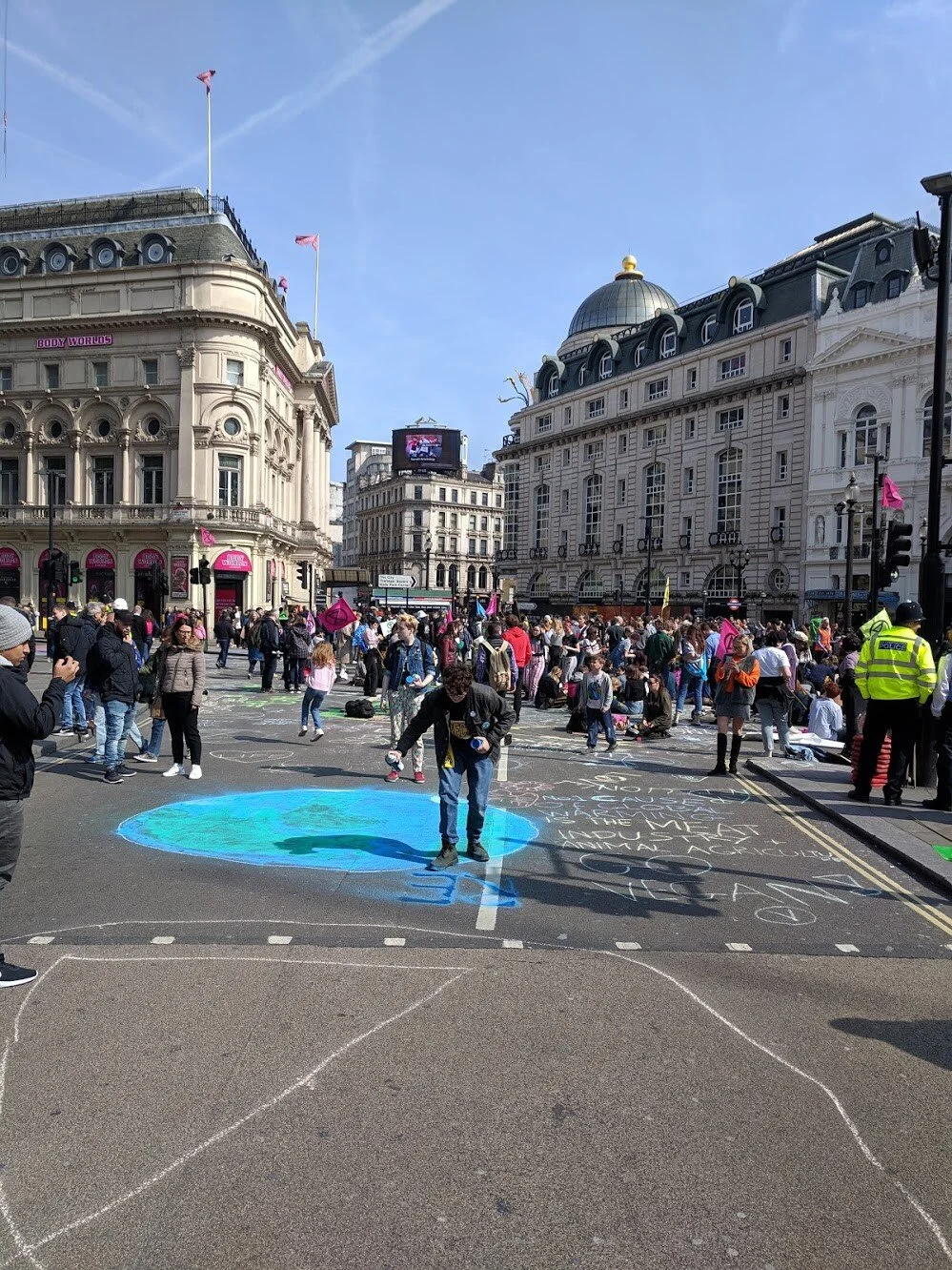
Extinction Rebellion protest, Piccadilly Circus, 15th April 2019 (JAMES FLINT)
Dear Extinction Rebellion,
I’m going to start by quoting from my new book, Midland. Because it’s relevant, and because I can:
>
“We’ve been trying to get someone to make a documentary about one of our EcoPath projects.”
“How have you got on?”
“I’ve been to see people at a few production companies.”
“And?”
“It’s extraordinary. This environment is front-page news these days. But unless it’s got a celebrity attached or you can get sex in the title, no one wants to know.”
“Sex, fame and property. That’s what it’s all about.”
“The whole thing’s been a colossal waste of time. This one guy, I went in to see him, and do you know what he said? He just glanced at first page of the outline and said, ‘Oh yeah, global warming, we’ve had hundreds of pitches like this the last couple of years. They’re like confetti.’”
“That’s encouraging.”
“So I said, well, if there’s so much interest in the subject, why didn’t you make any of them?”
Caitlin smiled. “I bet he liked that. What did he say?”
“I don’t know. I’d already walked out.”
“Brilliant. You’re going to go far in telly, Matthew. I can tell.”
This anecdote, told by my environmentalist character Matthew Wold, is drawn from life. I know this, because the life it’s drawn from is mine. It happened to me.
Back in the early 2000s I was an unhappy technology writer. I should have been over the moon. I’d just had my first novel published and been awarded a handsome advance. And I had cred as a journalist too, having been lucky enough to pick up a dream editorial job on Wired magazine’s UK edition during the first dotcom boom. That job had vanished when Wired ran into financial difficulties in the late 90s, but it had left me with a bunch of skills and contacts, a healthy portfolio of published articles, and that book deal. And this was before social media had damaged the publishing industry, so freelance work was pretty easy to come by… and you usually got paid for it, too.
So why the glum face? Reader, I was worried. The other day I was listening to Greta Thunberg talk about how, aged 11, she got depressed about climate change, and in 1999 that was me (but without the pigtails). What I was finding particularly disheartening was the mainstream media’s failure to take the subject seriously, and all but ignore warning after warning made by the world’s leading scientists. I wrote an article about it, Five Years, and I published it in mute magazine, a magazine which I had helped to found, and which therefore had a progressive editorial policy. I didn’t seem able to publish this kind of article any place else.
This was twenty years ago. Twenty years. Around twenty years before that, I have my first strong memory of becoming environmentally aware. This was as a result of a campaign to ban leaded petrol that was being promoted by my school. It was an issue had particular resonance for children. The impact of even tiny amounts of lead of the development of the brain was becoming well understood, and the political pressure to remove it from petrol — to which it was added to prevent a phenomenon called “knocking” — was mounting. I remember the leaflets and badges, and what a self-evidently good idea the campaign seemed. Why wouldn’t you want to take lead out of petrol if it was damaging children’s brains, and all it meant was a slight adjustment to your car that any decent mechanic could make?
I found out why not on a trip into my Dad’s office in Birmingham during the school holidays. Armed with a fistful of leaflets and my newly discovered eco-warrior attitude, I sallied out to spread the word among the solicitors, articled clerks and legal secretaries. Most took the literature and uttered soothing grown-up words of support and admiration for my principles and crusading valour. One of them, however, got quite upset with me.
“Oh, I couldn’t possibly do this,” she said dismissively. “I’ve just spent a fortune getting my car working properly. I’m not having anything else done to it!”
Her recalcitrance shocked me, and I still clearly recall it, and the feeling it gave me, 40 years on. At the time, in my naivety, I thought she was an outlier — how could anyone be that stubborn? But as I grew older I discovered that she was entirely normal, and that indeed most people reacted this way when presented with a choice that might inconvenience them slightly and yet be better for the environment, even though they didn’t always come out and say so quite as bluntly as she did.
Whether the decision being taken is whether to use a 5p plastic bag, take an unnecessary flight, clear an area of rainforest for a palm oil plantation, or build a new oil refinery, we all behave like this. The decision to do otherwise than economic inertia dictates generally feels like a total inconvenience. What it generally is, in fact, is a failure of imagination.
Being an adult, I’ve discovered as I’ve become one myself, is hard. You have to make choices. If, like that lady in the solicitor’s office, you have both a family and a job you’re likely in a situation where your car is a necessity. Without it you can’t get the kids the school, get to work, do the shopping. Yet another trip to the garage costs you time, money and a lot of strain and hassle. Why take the word of some ten-year-old that you should do that, because of something you can’t see, touch, taste or smell, something that never did you any harm?
This is why change on any major scale tends to take at least a generation. Although levels of lead were reduced and CLEAR campaign was wound up 1989, It wasn’t until 1st January 2000 that unleaded petrol was finally completely banned in Britain. The leaflets I’d helped hand out in 1981 took two decades to finish their mission (and they were only printed a decade after the chemist Derek Bryce-Smith first sounded the alarm back in the late 1960s).
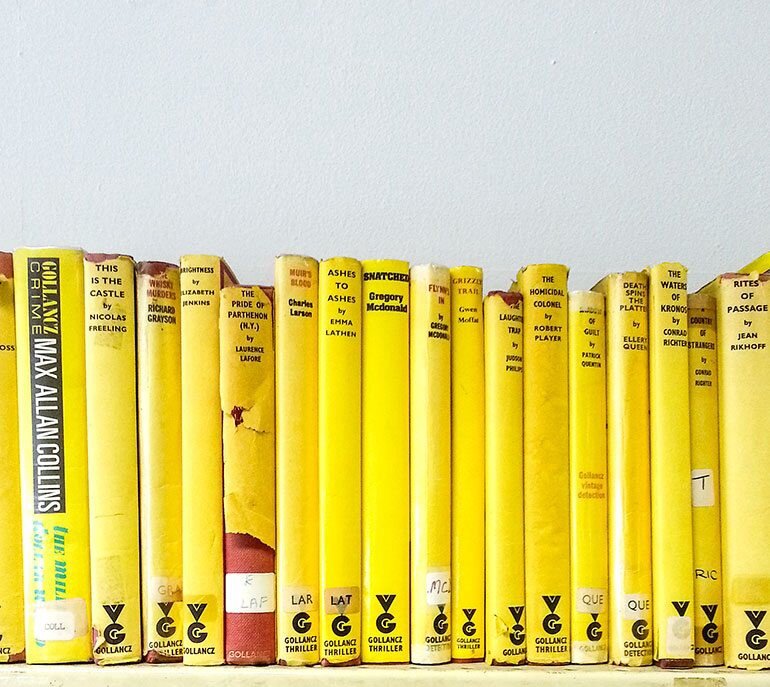
Gollancz yellow book jackets
Another moment of environmental awareness I had around that time came from science fiction. I’d discovered the genre in Stratford library, where my mother used to drop me off while she went shopping; bored by the contents of the children’s shelves I’d wandered into the adult section where my eye was caught by the sunflower yellow jackets of the Gollancz hardbacks ( that yellow is still my among favourite colours, and is the colour of my kitchen), which I started pulling off the shelves at random. Reading those books taught me to think about systems — social, geologic, climatic — on a planetary — or interplanetary — scale. Most of what I read I don’t remember now, but one story that stands out from about the death of the sea through over-pollution. I don’t recall the title or the author, just the conversation it relayed between a man and his son about how it used to be possible to swim in the sea before it became toxic, and the overwhelming feeling of existential sadness it engendered.
I went on from there to fall in love with the apocalyptic fiction of J. G. Ballard, Kurt Vonnegut and their ilk, writers who rang the bell of environmental doom as a way to examine the logics of human social psychology. I inhabited these stories as a teenager, probably more fully than I inhabited the physical world around me, a world from which I’d been forced to beat something of a retreat as a result of a bad car accident and the sudden degradation of my eyesight.
When I came to study economics, then, as a sixth-former, I couldn’t get past the discipline’s failure to price environmental externalities into the cost of doing business. (The assumption of the rational actor maximising utility and the simple linear equations of classical theory bugged me too, but that’s another story). At university, watching the first Gulf War break out on the TV in the student union, I remember being more concerned about the carbon footprint from all the burning oil wells than any other aspect of the war. When I heard a report on the radio that the Chinese were abandoning the bicycle and turning to the car instead, I was depressed for weeks (in fact, I think I’m still depressed about that). China’s famous devotion to two wheels instead of four had always given me, as it would have done H.G. Wells, hope for humanity. Now that hope was gone. This was long before I knew about the country’s terrible environmental record on other fronts: its decimation of the bird population during the Cultural Revolution to its destructive dam building, its terrible chemical spills, its penchant for coal-fired power stations… as I learned about those I periodically lost what little remained of any faith I had that as an individual that anything I did would do anything at all to slow our descent into a global environmental maelstrom.
Even when I worked at Wired, that exemplar of technological utopianism, I was worried about the environmental impact of computing, from the mining of minerals to the chemical footprint of processor manufacture to the electrical overhead of all those servers and screens, a concern we’ve now seen reach public consciousness thanks to the vast power requirements of the blockchain (an externality that is not priced in to Bitcoin, of course).
Wired had hippy roots too, though, and I was able to persuade my editor to let me travel to Russia’s Kola Peninsula to do a feature on the “digital curtain” of sensors being built across Europe to detect radioactive emissions from any future Chernobyls. A prime candidate was the reactor at Apatity, which was built to the same design. While visiting it, however, I also got to see first-hand the shocking environmental devastation caused by the aluminium smelter at Monchegorsk, which had dumped so much pollution into the atmosphere that for miles around the factory not only plants but even metals could not survive, and average human life expectancy in its dormitory town was reduced to 45.
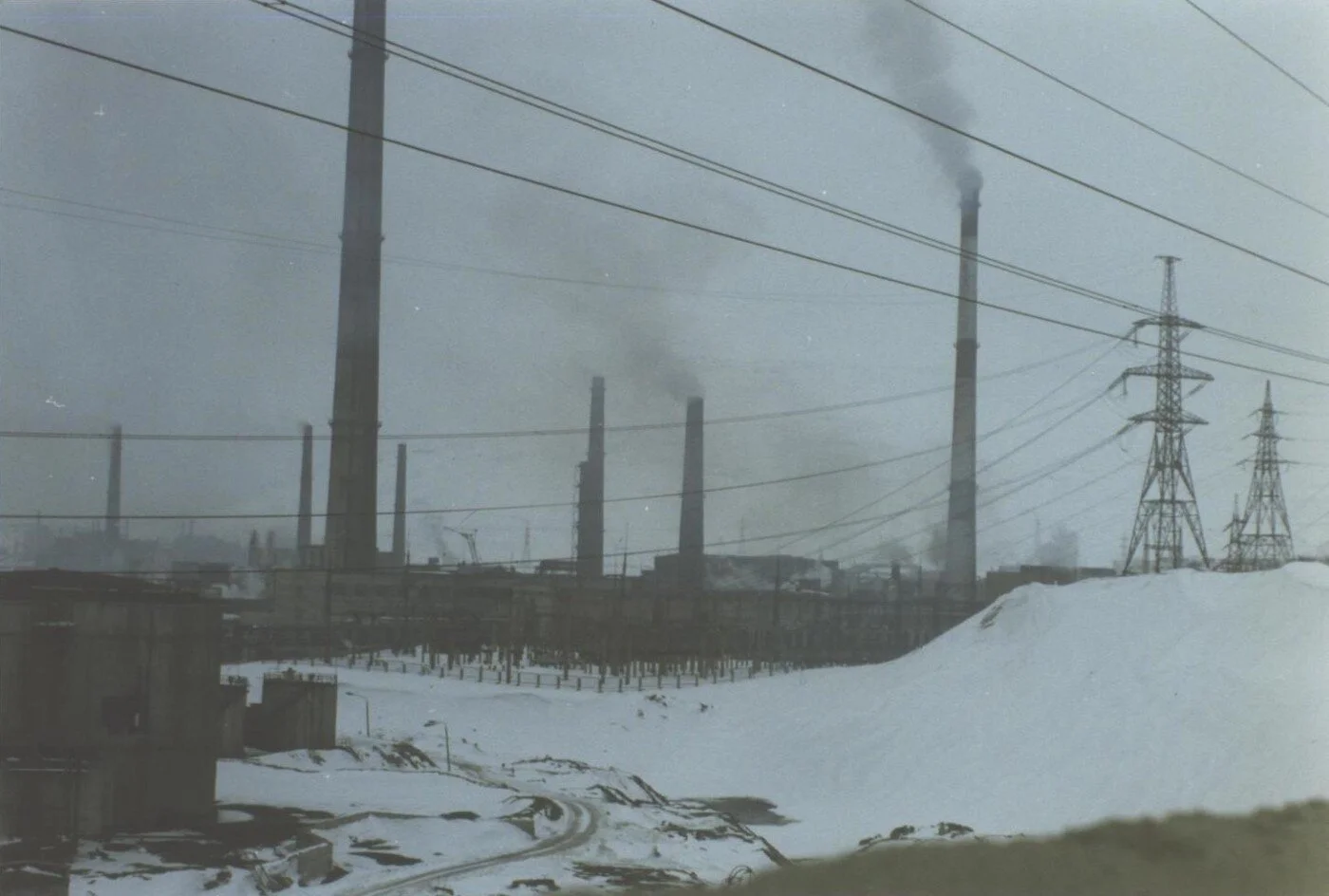
The Severonikel Kombinat nickel and copper plant at Monchegorsk, Kola Peninsula, Russia. (JAMES FLINT)
All these thoughts were channelled into the hyperreal world of technical-ecological connectivity imagined in my first novel Habitus, and — in a more structured fashion — into its follow-up, The Book of Ash, based on the true story of the sculptor James Acord’s to make art out of nuclear waste.
Ash was a direct outcome of that trip to Russia. In the wake of it I’d taken a long hard look at the digital revolution and asked myself, well, if computers are going to change the world, what’s going to power them? Wind and solar weren’t anything liked as developed as they are now and battery technology was still very ropey, for one reason or another fossil fuels weren’t a realistic option (all the talk at the time was of carbon trading and, also, “peak oil”), so that left nuclear. Could nuclear fill the gap? I interviewed James Lovelock, the author of the Gaia hypothesis. He thought so. Was he right? I didn’t know, and what writers do when they don’t know the answer to a question, is they write a book in order to find out.
My publishers were not as enamoured of this idea as I was. Indeed, they rejected my early drafts and I had to write another book — more mainstream, about the dotcom boom — to get out of my contract. By the time I finished that, boom had turned to bust, George W. Bush had kept Al Gore out of the White House on the back of hanging chads, 9/11 had happened, and the second Gulf War had begun. The world was being drawn into broad spectrum conflict again and environmental concerns were being swept aside. They wouldn’t be back on the mainstream media agenda until Gore’s film An Inconvenient Truth put them back there in 2006.
My nuclear book was eventually published in 2004 to a deafening silence, except in France, where I’ve always had more of an audience and where nuclear power is a somewhat bigger deal than it is here in the UK. As a work of fiction I was really pleased with it, but writing it hadn’t answered my original question about the cost/benefits of nuclear energy given the onset of climate change. Something had struck me, though, while I’d been researching it, and that was the difficulty of getting hold of coherent, properly sourced and non-politicised information about energy and climate in general.
Since I’d started the book the internet had gone completely mainstream and was even starting to make people series money, but in an early bellwether of the “fake news” problem that we’re very consciously living through now, this hadn’t helped the environmental cause. Much of the information found online was partial or plain false — “greenwashing” by vested interests was a growing phenomenon, and the net was turning out to be an easy place to push out misinformation of all kinds. One of the few sites with any kind of traceability and peer review was Wikipedia, which was maturing as an operation but still quite distinctly lacking on information on environmental issues in general.
Thinking I might have spotted a gap in the market and frustrated at the failure of The Book of Ash to excite even the faintest public debate, I decided to set up a site devoted to providing reliable, scientifically-sourced information on the subject. It would be called WikiClimate, it would be built on the open-source version of the wiki software that underpinned Wikipedia, and unlike Wikipedia it would be funded by advertising — but only from environmentally-friendly products and brands.
As a freelance journalist and novelist I lived hand-to-mouth and I had no free cash or savings at all. So much so that over the previous decade I’d suffered the humiliation of being investigated by HMRC twice because they couldn’t believe how little I earned while still managing to live in central London (I cycled a lot and ate a lot of home-made falafel). I did however have a financially-solid father who was delighted that I was at least trying to finally do something as sensible as start a business, even if the core idea behind it, given that he could barely operate a computer, made no sense at all to him.
He donated a couple of thousand pounds to the cause and showed me how to set up a company and register a trademark (he was a lawyer, and so knew about such things). With some technical help and donated server space from the carbon data supremo Gavin Starks, founder of Amee and the Open Data Institute, to whom I’d been introduced to by a friend of a friend, and the brand design genius of Damian Jaques, an old pal back from my days at mute magazine, WikiClimate was born.
WikiClimate logo, by Damien Jaques
So I now had a climate change website, but no content. My basic — and totally naive — strategy was “if they build it they will come”, but they weren’t going to come without any content there at all, so I started writing some articles myself and began to hunt down various opportunities for publishing bundles of relevant information. Before I got very far, however, the site got discovered, not by hundreds of climate scientists looking for an outlet, but by hundreds of porn spam bots engineered specifically to exploit the vulnerability of self-publishing sites like mine. Soon, all my energies were spent, not generating content, but deleting in-appropriate links and pages and trying to wrap my head around complex strategies for spam filtering and cyber-security.
It was obvious I needed technical help — and therefore money — so I started casting around for investors. This was hard: in the mid-2000s, the financial community was still reeling from the double whammy of the dotcom crash and 9/11, and it wasn’t at all apparent that digital media was going to be the economic powerhouse that it subsequently has become. There was no start-up culture or community to speak of and very little narrative to reassure early stage investors other than the recent horror stories from 1999. To cut a long story I short, I ran out of money and had to go and find a job.
In the way of these things, my experience with WikiClimate helped me to find one. A contact at the Telegraph had noticed what I was doing and had recommended me. The Telegraph website was growing fast and needed someone to handle the burgeoning online team and launch new products, products which were to include an environmental channel, Telegraph Earth.
The Telegraph wasn’t exactly my spiritual home — I’m a lifelong Guardian reader, with politics to match — but in those days it was a much broader church than currently and there were some excellent science writers — including Roger Highfield and Charles Clover — on the Features staff. I’m also a long-term believer that there’s only so much value in preaching to the converted: trying to take the climate debate to the sceptical breakfast tables of the traditional Telegraph readership seemed like a worthy challenge. I applied, my unusual mix of literary, journalistic, digital and environment experience made me a good fit for the position, and I got the job.
In the beginning, it went pretty well. Once I’d got my bearings in the new role, I launched Telegraph Earth on the website to some fanfare and much support from the paper; this, after all, was the year that Tory poster boy & PM David Cameron took a trip to the Arctic, so hugging polar bears was on message. We commissioned some interesting articles and columns and built some cool digital tools, including an online carbon calculator powered by data from the Amee project. It all felt pretty good and I convinced myself that we were contributing in a small but meaningful way to what seemed to be a growing awareness of green issues in society at large. But it was an illusion, a false dawn. Nothing of the sort was going on.
In my innocence, I’d assumed that the Telegraph was getting into climate stuff because it believed in the growing importance of the subject for its readers and was trying to grow that constituency within its existing ranks as well as attract a younger readership. But the truth was that the project had been dreamt up by the marketing department to attract the “green pound”, and when it failed to do that within a few months or so of launch, Telegraph Earth’s already limited budget got slashed to, well, to nothing.
Editorial agenda versus marketing agenda… in many ways they are the same; they’re both kinds of economically motivated self-promotion. But the detail of the respective motivation differs substantially. As an editor I took a long-term view, allied to my belief that the public opinion was changing — and had to change; that we, at the Telegraph, should help drive that change; and that in doing that we would, ultimately, find ways to make it pay. The marketing department, however, took the short-term view. They were capitalising on a trend for “eco” they’d spotted within the Telegraph’s existing demographic. For them, Telegraph Earth was a way to grab some of the money swirling round it as it swirled, and then move on. Theirs was the approach that prevailed.
I don’t offer this as a particularly cynical comment on marketing departments in general or the Telegraph’s in particular, though it can certainly be read that way (and please do feel free to avail yourself of the undisputed pleasure of doing that). I offer it more as a reminder that we’ve seen waves of climate enthusiasm wash through society before and seen them morph into exercises in bad faith before the ink on the banners was dry.
If had just been Telegraph Earth, then maybe that would have been okay, just one of those things. But the episode turned out to be an early victory for anti-science and reactionary forces in the Telegraph in general. As the paper’s management, in thrall to wave after wave of opportunist consultants, lost its grip on what had started out as pretty successful digital strategy, and as the company has subsequently began to lose advertising market share to Facebook and Google, editorial budgets were slashed and slashed again. Many of the best journalists were made redundant or forced out, Highfield and Clover included, and in their place climate deniers such as James Delingpole were promoted.
The quality of reporting in the paper declined across the board, with the result of course that the readership declined still further, and to fill the void the owners and senior management began to align increasingly closely with the gathering forces of UKIP and Brexit, with Boris Johnson as their highly visible — and highly compensated — mouthpiece. I was the editor of the Telegraph Weekly by that point, but even from that relatively privileged position my budgets were so tight and my few staff so stretched that I found myself powerless to do anything about it other than avoid publishing Johnson and Delingpole and put environmental issues on my front page as often as I could. But it felt increasingly hopeless, and when the news came through that the Weekly was to be shut down altogether — in what I now might wonder could have been a political savvy attempt to help disenfranchise the paper’s expatriate audience ahead of the Brexit referendum, if the paper’s C-suite hadn’t repeatedly shown itself to lack any kind of strategic foresight — I myself took voluntary redundancy, and left.
Midland is my howl of anguish at those years of frustration, the years when we all knew perfectly well about the realities of climate change but failed as a society to take them with the seriousness they deserved. Hence my tale set in 2006, on the eve of the financial crisis, in which middle class personal issues play out against a backdrop of growing financial and environmental debt, the latter illustrated by a motif of dying whales and poisoned seabirds and despairing activists and the transformation of the natural world into a mechanised contraption peddled — inefficiently — by men.
“What’s the biggest breakthrough in climate science since 1979?” goes the joke, the punchline been that there hasn’t been one, that we’ve known pretty much what we know now for the last thirty years. The difference now, of course, is that we’re starting to actually experience it here in the coddled West. Now it’s our weather that’s becoming unstable and breaking all records, it’s our property and populations that hurricanes and floods and fires are destroying, and our insurers and central bankers that are starting to wring their hands in alarm. And now, finally, the climate deniers are becoming regarded as about as crazy as flat Earthers and are starting to being denied the privileged access to mainstream media they’ve enjoyed for far too long.
And so Extinction Rebellion feels different too, feels like it’s being taken more seriously than climate protests of the past, but I thought that about the Kyoto Earth Summit in 1997 and then we had George W. Bush and the second Gulf War, and I thought that about An Inconvenient Truth and Telegraph Earth, and then we had the Trump administration and the distraction from making any sensible decisions about anything at all that is Brexit.
On the other hand, we are now being helped by our technology: wind and solar power have come of age and are beginning to be deployed at scale; batteries are bring electricity from everything from cars to grids; the Internet continues to evolve as a political tool and while it has created filter bubbles that have promoted ignorance and denial, it is capable of bursting such bubbles too.
The social context is changing, now, as well. The feelings I had as a younger person about environmentally damaging events do not feel weird and fringe any more. They feel normal. No one laughs now if, for environmental reasons, you carry your own coffee cup or don’t fly or cycle everywhere or stop eating meat or put solar panels on your house. They used to laugh, but now they catch your eye and nod and try to bond by saying they haven’t done that but they’ve made some other change because we all need to do something because it’s getting serious now and they’re worried about the world we’re leaving our kids and it’s just too overwhelming now to continue to ignore.
So now’s the time for protest. Because when protestors express the prevailing opinion, then protest works, the forces get focused, and things start to change. Working through acceptable channels, as I’ve tried to do in my lame-ass way and as many other more focused and more savvy and more capable journalists, film-makers, lawyers and activists than me have done for decades, has not been enough. Sure, it has helped. But now we are out of time.
Despite carbon credit systems and international agreements and promises and good intentions of every kind, our governments have not followed through and our economies have failed to price environmental externalities into the price of the goods, services and energy sources that we all enjoy. We either change our habits now, or many if not all of us and a good proportion of the species we share the planet with — particularly the ones we’re most fond of — are going to die. “Business as usual” needs to have these costs put on its bottom line. If that doesn’t happen through legislation, it needs to happen through disruption, until it’s cheaper and more popular for governments to enforce carbon-reduction policies than not.
Needless to say, this disruption must be carried out non-violently, with good humour and a smile. Right now, one of the great virtues of Extinction Rebellion as a movement is that it has managed to internalise that. The comparisons with the campaigns of Gandhi and Mandela are apt, and need to continue to be apt, as the movement must continue with strict non-violence, whatever the provocation. And it will be severely provoked as things — quite literally — hot up. And they’ll hot up in more ways than one. As I was walking past the protest in Piccadilly last month (see picture at the head of this letter), some delivery guy whose day was being disrupted was berating the protestors for being idiots, saying — bizarrely — that he was going to through an apple at their f***ing heads. It might start with an apple, but there will be points, when things start to bite, when it will be something a lot more dangerous than that.
These protests must remain calm, they must remain cool, however hot things get. If we don’t manage that, we are lost.
Good luck!
Jim