Tag: Midland

  • Midland Melody

    Audio Block
    Double-click here to upload or link to a .mp3.

    Learn more

    The Shed has been quiet for a while. This is because I’ve had my hands full of late with my new job, Head of Insight at a financial and business news start-up called  Curation Corporation, and cranking out stories on the future of technology every day has kept me away from blogging. But my 50% funding level is in sight, and if I’m going to hit that by Christmas (which would be nice), I need to get on it. So to that end I thought I’d write something about… my mother.

    Some of you will know that my mum, née Marie Cooper, is an accomplished pianist, who began her career playing for the BBC. And in one of those peculiar coincidences that life is so fond of chucking at us, I recently discovered that over forty years ago she too had been involved in a creative project with “Midland” in the title.

    Earlier this year my wife unearthed a recording of one of mum’s early sessions on the internet: performing “Midland Melody” with the BBC Midland Light Orchestra on the Light Programme, 7 December 1963, which would have been just two days before her 21st birthday.

    The clip is attached as a sound file, so you can hear Marie Cooper and her duet partner, Rosemary Brett Davies – with whom she played throughout her life and who later became my godmother – performing “Midland Melody” with the Harold Rich Quartet and the BBC Midland Light Orchestra, conducted by Jack Coles.

    Radio was different then. For one thing musicians were paid – in actual money, not just in airplay royalties or Spotify ad share revenues. The Musician’s Union was still a powerful force in the land, powerful enough to enforce something called the “Needletime” agreement which severely restricted the amount of records that the BBC was permitted to broadcast in any given period of time.

    In order to keep music flowing over the airwaves, the BBC therefore had to employ all variety of bands and orchestras to play live in their studios multiple times every day. Live performances were thus a staple of radio listening, and provided financial security to a thriving class of musicians up and down the country. You can read more about this era, and the role of the BBC Midland Light Orchestra in it,  here.

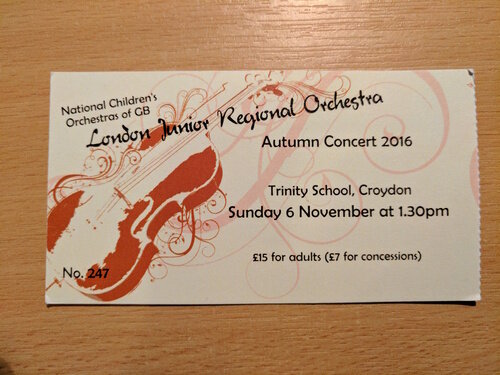
    Despite being taught clarinet and saxophone by one of my mum’s friends from this era, a wonderful woodwind player called Lesley Cawdrey whose son  Julian is now a leading flautist, I was never more than a middling musician. Whatever talent my mother possessed clearly skipped a generation – and landed with both feet in my daughters’ genes, both of whom are keen violinists. My eight-year-old is, embarrassingly, already a better player than I ever managed to be, and is as good as her grandmother was at her age. Just two weeks ago I took the whole family to see the concert which marked the end of her first year with the National Children’s Orchestra (ticket pictured below), so maybe she’ll go on to make recordings of her own in years to come.  

    NCO_ticket.jpeg

  • On Planning the Writing of the Business of Writing a Business Plan

    On Saturday I did an event. I was invited to speak at a cultural evening organised by an economist, and as the audience included people from both business and the arts – and quite a few with backgrounds in both – I gave a talk drawn from my experiences of shuttling between these two worlds. The text of the talk follows below; you can also listen to the presentation (which was recorded on the night) in the linked audio file.

    Audio Block
    Double-click here to upload or link to a .mp3.

    Learn more

    On Planning the Writing of the Business of Writing a Business Plan

    I confuse people. It’s my special power. I don’t mean to do it, but I do. I confuse all kinds of people, but the people I confuse most of all are the ones who work in HR, recruitment or executive search.

    These people, they’re sitting at their desks, happily minding their own business, putting everything they see into neat little boxes, and then they meet me and they have some kind of fit and have to go and lie down for a while. After that they usually direct my emails to spam.

    Why is this? Why do I have this effect on these people? You can give me your suggestions at the end, but I think it’s because I just don’t fit. I don’t fit into the little boxes so beloved of HR people, recruiters, and executive search professionals. And I don’t fit because I refuse to do just one thing.

    This started young. As a teenager I loved writing programs for my BBC Micro and wandering through graveyards smoking cigarettes and writing poetry. As a student I studied neurophysiology and designed experiments and read Wittgenstein and had my own band and took a play to the Edinburgh Festival. You could argue that I did too many things and so did none of them very well, and you might be right (the play won Turkey of the Year award). But I wanted to be a writer which meant, as far as I could see, understanding how lots of different human activities fit together to make a whole society. So it made sense to me to dig my hands into as many of these activities as I could.

    When the World Wide Web arrived in my early twenties, suddenly this breadth made perfect sense. The web was science and art combined. Technical form and expressive content became inseparable – to quote Marshall McCluhan, the patron saint of the Internet, the medium was the message, in a manner that had never been so completely true before.

    I became a technology journalist, evangelising this new realm, and at the same time I became a novelist, writing novels inspired by the changes happening in science and technology around me, and to me and my peers this combination seemed the most natural thing in the world. We were the future, and the future was now.

    But then the dotcom bubble burst and things got reconfigured. The creative explosion that had been the web got tamed and funnelled into a handful of major gateways: Google, Facebook, Amazon, eBay, Twitter, LinkedIn. That set a trend that continued through the 2008 recession and the economic stagnation that’s beset the global economy ever since, right into the new growth phase, that of the Internet of Things.

    As McCluhan predicted, what has value now is not the content, not the message, but the means of organising and transmitting it – the medium itself. When you summon a car from your phone to take you to the airport, you don’t care if it’s a Seat, a Volvo or a Merc. Because what matters to you, what you pay for, is the fact that it’s an Uber. That’s all that really counts.

    And thus science has pushed back on art. The geek inherited the earth, and sought revenge for generations of oppression by subjecting the quality of content to the law of large numbers and rendering it all but irrelevant. What matters now is the engineering efficacy of the delivery mechanism and the scale of that flow, not the detail of that which flows.

    Sensitive to this change, which was a pretty inevitable consequence of a system scaling up by an order of magnitude – from 100s of millions of users to billions – I changed too. I left a newspaper industry that was proving itself increasingly incapable of adapting to this new environment, extended various engineering stubs in my educational background – a handy legacy of trying all those different things when I was younger – and dived into the world of start-ups.

    All that time, however, I was still writing fiction. Working, in fact, on the book from which I’ve read to you tonight. Now it’s written I’m even publishing it in start-up style – through the crowdfunding publisher Unbound (and yes, I do want you to pledge for it – please take a flyer home with you tonight!).

    But when I’m out promoting my book or writing its blog, I don’t really talk about my tech experience, largely because I’ve always been told by agents and publishers and those in the industry that it’s not really relevant. And when I’m job hunting or talking to investors I don’t mention my fiction. Again, largely because I’m continually advised by those pesky recruiters and so on that it will be a distraction, and put people off.

    But why? Why should it put people off, in either direction? Why should novel writing and running a business be seen as antithetical? My thesis, the thesis I’m going to put to you tonight, is that they are have more in common than people realise, that experience of one in fact informs, helps and supports experience of the other, and that the habitual denial of this comes down to the simple fact that the triumph of engineering has codified the job market to the point where if you don’t fit into a box that’s been pre-labelled by an abstracted, algorithmic process you cannot get either funding or employment. A job market that, despite calls for evidence of “creativity” and “leadership” on every single job description in reality wants nothing of the sort, and wants instead to make Uber drivers of us all.

    But enough of that. As I say, this is a positive postulation, not a negative rant. A thesis, not a critique. So: I put to you the proposal that books and businesses are very alike, and as evidence for this I present exhibit A: the business plan.

    I’m guessing that most of you are familiar with this form. The company abstracts, the product descriptions, the unique selling points. Team profiles, total addressable market, target market. Six year financial projections. Growth curves. Competitive analysis. All powerful stuff.

    But as Field Marshall Helmuth von Moltke famously said, no plan survives first contact with the enemy, and this is as true for the business plan as for the military strategy. Key team members leave (or, in the case of the military, get blown up). Legislation and trade agreements change. Competitors prove to be rather more nimble in anticipating and outflanking you than you anticipated. Legal fees mushroom out of control as you’re hit with a patent infringement suit. Your CFO is found lining his pockets with company funds. Customers spurn your flagship product but flock in great numbers to the thing you built as an afterthought – or they just don’t flock at all.

    Random shit happens. And if you put all those possibilities in your business plan, it would be unreadable – not to mention longer than War and Peace. No one wants this. Your employees don’t want it. Your advisors don’t want it. Your investors don’t want it. None of them have time to read it, apart from anything else. What they want most of all from your business plan is a great story. A story that excites them. A story they can believe in. A story that, above all, they can retell to others when they have to justify why the hell they invested in you or allowed themselves to be hired by you. So what is your business plan, really, but one gigantic fiction, a story that will be responsible for convincing people to put their money and/or careers on the line?

    And what this story tests, what it provides proof of, is not whether your target market is the size that you say it is or if you are going to hit cashflow breakeven at the end of Year 3 – everyone knows this is all highly unlikely. What it tests is whether or not you can sell.

    Because the business plan is a sales pitch. Can you sell your business to investors, partners, employees? Can you sell a story good enough to hook them in? If you can, if you get them to commit their cash and resources, then even if they know nothing else about you and don’t believe a single curve or infographic in whatever document you’ve dropped on their heads, they now know this. They now know that you can sell, because you’ve just sold them on your plan, and that means that whatever else happens – and as we’ve already established, random shit will – you’ve got more than a snowball’s chance in Silicon Valley of selling something to the one person that really matters: the customer.

    And it’s the same with writing a book.

    Obviously a novel is all about telling a story. That goes without saying. But stories have to be sold before they can be written, and the first person you the writer needs to sell your story to, both investor, employer and employee, is yourself – you have to come up with an idea for which you think it’s worth sacrificing years and years’ worth of other opportunities, of parties and TV watching and quality time with your children, perhaps even your entire career. And you need to understand too, as CEO of the project, that what you’ve sold yourself is just a fiction, a shadow of a story, a plan that must change as reality strikes.

    Because the book will change as you write it. The story you start with is not the story with which you’ll end up. Stories are dynamic. Your characters evolve as you write them – as they grow, so do you. As a result they will behave in ways that you cannot anticipate when you begin. And it is absolutely crucial to fiction that you allow this process to happen. If you don’t the story will feel mechanical, the characters and dialogue will feel dead on the page, and the reader will not feel involved in the world of your novel. Which means they’ll be unconvinced, bored, and won’t suspend disbelief. In other words, they won’t “buy it”.

    So in its actual writing, writing a novel is like running a business. You have a plan, a great story, but it’s just that. In the execution of that plan, things will change – and the plan has to be flexible enough to allow that. My first novel, Habitus, was written over seven years. I didn’t mean for it to take that long, but it did. My third novel, The Book of Ash, took ten years, if you include the three years I had to take out in the middle to write my second novel, 52 Ways to Magic America, and the entire completed version of the book I had to throw away before I worked out how to get it right.

    My fourth novel, Midland has taken another ten. During that time I’ve got married, renovated a house, had two children, seen my father pass away…  I’m not the same person I was when I started it. I’ve changed, the book has changed, and the book has changed me as I’ve written it – just as an entrepreneur who builds a successful business is changed by that experience and all that it involves. But because I’ve got better at these things, while my first three books had dozens of plans, plans after plans after plans, Midland had just one plan, sketched out on a single side of A4, that stayed pretty much exactly the same throughout that entire decade.

    This journey of personal growth, of self-discovery, is a big part of the reason that we do things. It’s basic empiricism. We experiment and put ourselves in crisis in order to learn, to find out about how the world works and what we’re really made of. Those discoveries will change us – and maybe, if we discover something really big or really resonant or really influential, they’ll change the world a little bit as well. Make a dent in the universe, as Steve Jobs famously said.

    I wrote The Book of Ash to discover what I thought about the nuclear industry, in the hope that I could develop some kind of firm opinion about nuclear power (I’m not sure I succeeded in that, although I’m very happy with the book that resulted). I wrote Midland to discover what I thought about my father dying as I became a father myself, in the hope that I could make some kind of map of the challenges of midlife that would help me better tackle these challenges – and perhaps help others tackle them too.

    Along the way I hoped to make a living, of course. And in that way writing a novel isn’t just like a business, it IS a business. There is a target market, a real one – different for sci fi, and chick lit, and literary fiction, and historical. Your characters are products – products of the times that you’re writing in, and the time that the book’s set, but also part of the book’s packaging, part of its marketing, part of its sell. They have to feel real and true to their milieu, but also have to appeal to the customer – the reader – who lives very much in the now. Your competitors are not only other novelists but also films, and Facebook and families – all the other calls that your potential reader has on their very valuable and very limited time. You’ve got to give them a damn good reason to ignore all those things and settle down to spend twenty hours or so with you.

    So once you’ve pitched the book to yourself and gone and written it, you’ve now got to pitch the result of all that effort to the reader – and it better be a damn good pitch as well, else you’re not going to get very far and your ROI will be nil.

    And this is perhaps the biggest challenge in writing, or in running a business. You can’t be one person. You have to be two. You have to be both the producer, the executive, the creator, and in almost the same breath be the salesperson, the marketeer, the evangelist. Even if the first bit is going horribly wrong, the second bit always has to be confident, breezy, solid as hell. This is very hard for writers, most of whom are natural introverts, to do. For entrepreneurs, the challenge is reversed. Natural extroverts, selling is the easy bit for them. Settling down and maintaining the focus to deliver what they’ve promised, that’s what they find really difficult. It’s why so many entrepreneurs get sacked by their own boards once the business is going. And why writers were traditionally locked in back rooms by the film studios.

    Thanks largely to the communications revolution you can no longer expect to survive for very long on one half of this equation. Entrepreneurs and CEOs are under the spotlight like never before, constantly having to reinvent themselves and their companies as leaner, fleeter outfits snap at their heels, while writers are expected to market themselves like never before. There is just so much content out there now. Publishers won’t even pull you off their slush piles if your manuscript isn’t accompanied with twenty thousand followers on Twitter or your own YouTube channel. Why should they? Their own business plans have been put into crisis by contact with the Internet, and they can no longer afford to take anything that feels like a risk. Your story is the story that sells them on your book. The book’s story, on its own, is no longer enough.

    This is why I find it so mystifying when I’m looking for work or pitching my business that recruiters and investors don’t want to hear about the fact I’m a writer. Because the business of writing is in fact a fantastic training in all the skills needed – both sales and execution – for managing a business at any level. Books are about people, businesses are about people, and the two halves, to my mind at least, make a whole that is very complete.

    Having said all that, of course, as we all know the chance of finding success with either book or business is incredibly slim. You have to be crazy to even try and do either. Crazier still to do both. And maybe that’s the real reason I don’t get along with HR people, recruiters, and executive search pros. They do have a box for me after all. Unfortunately, it’s the box labelled “mad”.
  • On becoming an object of study

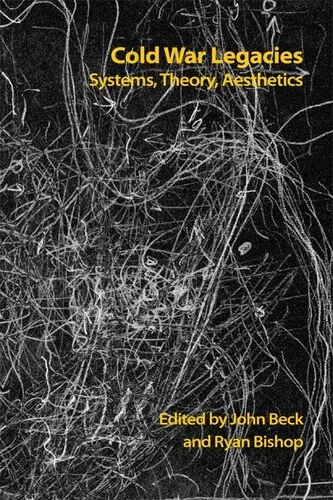
    It’s official. I’m now an object of academic study – or at least my last novel, The Book of Ash, is. This honour has been bestowed upon me by scholar Dan Grausam, whose paper on Ash has just been published by Edinburgh University Press in a collection titled Cold War Legacies: Systems, Theory, Aesthetics.

    ColdWarLegacies_cover.jpeg

    The paper is based on a talk Dan originally prepared for an Arts Catalyst event back in 2014, an event I attended, putting me in the unusual position of being both subject and audience and affording me the singular pleasure of being able to both ask and answer questions about myself. (Obviously I do this in private all the time.)

    Before I invite accusations of indulging in public displays of intellectual onanism, I should probably point out that I was not the only item on the agenda that day. The event showcased a whole range of engagements with the atomic and was in its way a progenitor of the Arts Catalyst’s “Material Nuclear Culture” summer programme which I’ve mentioned in this blog before.

    Partly thanks to that talk by Dan I was invited by Ele Carpenter, curator of both the 2014 event and this year’s summer programme, to participate in the latter by interviewing author Julie Salverson at the Arts Catalyst HQ in London’s Kings Cross earlier this month.

    Salverson is a well-regarded Canadian playwright and librettist. Her new book Lines of Flight is billed as an “atomic memoir” but to my mind is more a meditation on the nature of apology and guilt. It starts out with the role that Canadian uranium mining played in the Manhattan project and thus the bombs dropped on Hiroshima and Nagasaki and moves on to Japanese responses to the bombing and other countries’ response to Japan’s own war crimes during WWII, all filtered through Salverson’s own relationship difficulties and the abuse she suffered as a child.

    The approach is unusual but it works, and I found the book very powerful. Salverson begins with her attempts to help members of the  Dene Nation  – the aboriginal community of Déline, Canada – both communicate and come to terms with the damage done to them by the radioactive and cultural legacy of wartime uranium mining.

    Beyond the facts of the situation Salverson’s self-examination of her liberal humanitarian motives is forensic but unremarkable; we’ve been here before. The book really comes into its own when she follows a Dene delegation to Hiroshima and records its attempts to apologise to the Japanese for the role the community’s uranium extraction played in the damage caused by Fat Man and Little Boy.

    Here things rapidly complexify. Previously well-designated moral boundaries start to splinter as both Salverson and the delegation are forced to confront the different functional role that guilt and responsibility play in Japanese culture alongside Japan’s own behaviour in the war, behaviour that stems from its classification of other races as sub-human and which includes not only the harsh treatment of prisoners of war (well publicised through films such as  The Railway ManBridge over the River Kwai, and  Merry Christmas, Mr Lawrence) but the systematic rape both of the  city of Nanking  and of the hundreds of thousands of “comfort women” imported from around the Pacific rim to staff brothels for Japanese soldiers.

    Salverson’s journey into night culminates in the Boschian nightmare of Unit 731, a monstrous human experimentation facility set up by the Japanese in Manchuria whose existence I have to confess was previously unknown to me, but whose activities match and even exceed the horrors perpetrated by the notorious Nazi  Dr. Josef Mengele. I won’t go into detail, not least because I don’t think I can bear to; if you feel able to learn more there is a wikipedia page on the subject  here.

    Suffice it to say that up to 250,000 people, mostly Chinese, were experimented upon and killed in Unit 731 in the most hideous fashion imaginable. But even still the morality of the war does not become clear, at least in relation to the dropping of the atomic bombs, as instead of being tried for war crimes the researchers involved in the Unit and others like it were secretly given immunity by the U.S. in exchange for the data they had gathered on the extremes of human suffering.

    Attempts to get Japan to make a formal apology for these crimes have proved as tortuous and labyrinthine as attempts to get the US to apologise for Nagasaki and Hiroshima (let alone apologise for or admit to the exoneration of those responsible for Unit 731), and Salverson’s attempt to map some kind of landscape of sense of it all leads her into a hall of mirrors like that constructed by J G Ballard’s bomber pilot in his haunting short story The Assassination Weapon (also incorporated as a chapter into the novel  The Atrocity Exhibition), which I first came across aged 16 and which remains perhaps the single most evocative piece of fiction I have ever read.

    To Salverson’s credit she doesn’t try to formulate an exit from this “trap for time”, as Ballard described it. Instead she follows a line of flight that leads her inwards, into her past, into her fraught relationship with her alcoholic parents and abusive grandfather, and ultimately into a zone of acceptance in which she feels able to stare without emotion at her own neuroses and the horrors of the twentieth century and put them in some kind of objective context.

    In this way Lines of Flight shares something with Haruki Murakami’s towering classic  The Wind-Up Bird Chronicle, and left me feeling much the same way as that book did. Do check it out if you can. It makes for a thought-provoking – and uncomfortable – read.

  • Ursula Le Guin hits the publishing nail on the head

    This week’s news that  Ursula K. Le Guin  is to receive one of the greatest accolades that can be awarded a living writer and have her work published by the Library of America cheered me immensely. By happy coincidence I’ve been working my way through the Wizard of Earthsea books this year, and just last week read her classic of political science fiction, The Dispossessed.

    But the  New York Times piece  that covered the story also alerted me to something I’d not seen before: this video of her acceptance speech for the National Book Foundation’s Medal for Distinguished Contribution to American Letters at the National Book Awards on Nov. 19, 2014.

    According to the Times she spent six months writing this six minute speech – and it shows. It’s a beautifully succinct and well-targeted broadside at contemporary publishing, and it directly captures the reasons for the existence of Unbound as a publisher – as well as the reasons that I’m publishing Midland through them. 

    If you’re at all interested in the state of fiction and intellectual freedom in the digital age, please watch it. And if you haven’t done so already, please pledge to support a book that is being written and published in defiance of these economic exigencies.

  • A Radioactive Round Table (And Some Heavy Metal)

    IMG_4753.jpeg

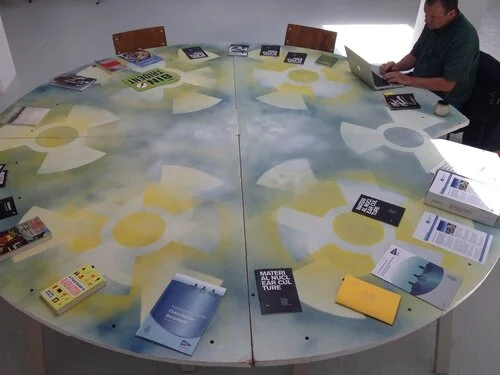
    On the way down to this year’s Port Eliot Festival I stopped off in Plymouth to check out the Arts Catalyst’s Material Nuclear Culture exhibition in the  Karst Gallery. This is part of a summer schedule of events in which I’m peripherally involved, and as I was passing I thought I’d drop by to take a look around. What I didn’t know was that I’d be greeted by the ghost of an old friend. The exhibition included a recreation of the round table created by  James Acord, the inspiration for Jack Reever in my last novel,  The Book of Ash.

    A self-styled “nuclear sculptor” whose work addressed the issue of the long term storage of nuclear waste, Acord created this table in the 1990s  to host round table discussions between nuclear scientists, engineers, artists and environmentalists in the Hanford nuclear reservation in Washington State. Polarised as they were by nuclear technology, these people as a general rule never met let alone conversed with one other, and Acord saw it as part of his artistic process to bring them together so that they might have the opportunity to see each other’s points of view. 

    The actual table he built survives only in photographs but it has been painstakingly recreated for the exhibition and was used to host a contemporary discussion between artists, curators, submariners and members of the Submarine Dismantling Advisory Group and Nuclear Submarine Forum in Plymouth in June. If you’d like to see my own “round table” contribution to Material Nuclear Culture, it will take place in London on Thursday, September 1, when I’ll be in conversation with Julie Salverson, author of the nuclear memoir Lines of Flight. Details  here.)

    After the exhibition it was on to the festival, about half-an-hour’s drive east of Plymouth over the Tamar Bridge. Lord St Germans had decreed it would be the best Port Eliot Festival ever (see  my last post), and it was. I heard rumours of 10,000 people onsite, by far the largest crowd the event has drawn to date, and the weather was perfect: not too hot, not too cold, sunny days and skies filled with blustery cumulus holding back the rain until the final curtain had fallen. 

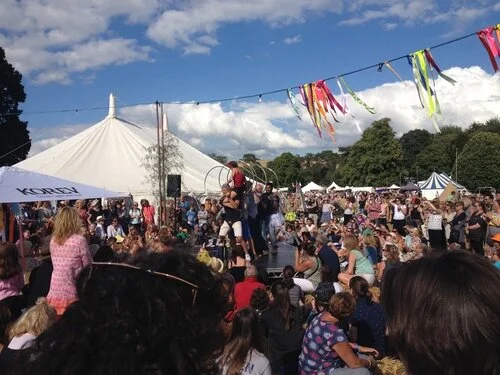
    To give you a flavour of what it was like here’s a shot of a cabaret act in front of the Park Stage…

    IMG_4763.jpeg

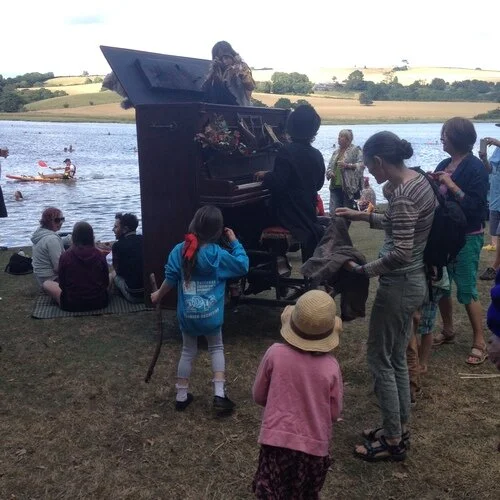
    … and another, down by the estuary (this piano is on wheels and is being simultaneously cycled around by the pianist while a small girl periodically pops out of the top to accompany him on her fiddle).

    IMG_4768.jpeg

    My own reading went pretty well, despite taking place at 10 a.m. on Friday during the only rain of the weekend. Big thanks are due to  Matthew de Abaitua  (buy his books, they’re great), who sat stalwartly in the wet encouraging other punters to brave the elements and give me a listen. 

    Other personal highlights included listening to fellow Unbound author Paul Kingsnorth read from his new book Beast, and catching the amazing Japanese noise rock band  Bo Ningen  late on Sunday night. If you get a chance to see them, go. They are transcendentally awesome. 

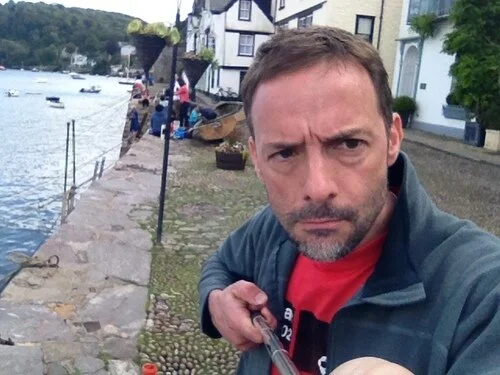
    On the way home I stopped off to see an old pal of mine in the picture postcard town of Dartmouth, where the kids went crabbing on the quay while I tested out my big new purchase of the holiday: a selfie stick. 

    This is how you use it, right? 

    IMG_4781.jpeg

    I’m hooked. Expect more pix like this, coming soon to a blog near you…

  • So long Lord St Germans and thanks for all the fests

    CNV00013.jpeg

    Sitting down this morning to write a Shed post about my forthcoming reading at next week’s Port Eliot Festival, I ran a search so I could include a few salient details about the event. What I didn’t expect was for the search results to be headed by the Telegraph’s obituary for Lord St Germans, aka Peregrine Eliot, aka Perry, the festival’s co-founder and host and – I’m proud to be able to say – my friend.

    Midland would not have been written without Perry and his wife Catherine Wilson, aka Lady St Germans, aka Cathy [pictured together, above]. They invited me to the inaugural Port Eliot event back in 2004, around the time  The Book of Ash  was published. When that novel failed to earn me any kind of a living and I had to take a job at the Telegraph to support my young family, their belief in literature and repeated invitations for me to return to the festival every year helped burnish my determination to keep working on the book however little time I had, and however difficult it was.

    For three years I even ran a venue at the festival – the film tent – where we hosted such luminaries as Mike Figgis, Kevin Allen and Rhys Ifans. We even ran a short film competition for films made on-site during the fest itself, though that nearly hit the buffers when the slightly staid tech crew I brought down from Birmingham to help contributors edit their footage nearly left in outrage after seeing a leather clad gay S&M cabaret act whip each other in broad daylight on the lawn in front of the main house.

    CNV00021.jpeg

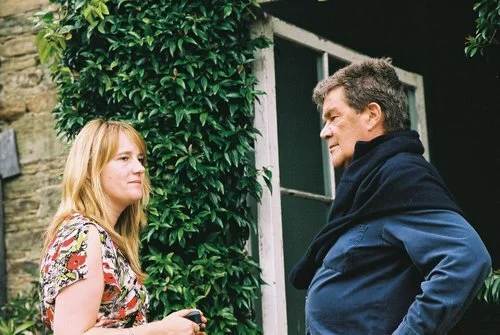
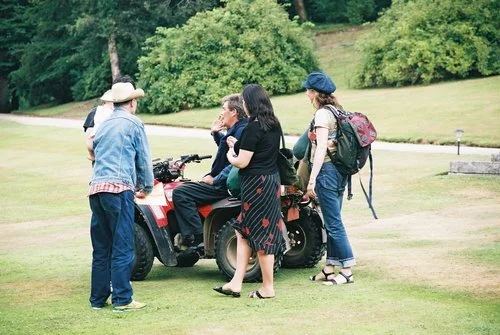
    Perry found this kind of upset hugely amusing. He’d seen it all before of course – many of his favourite stories concerned the excesses of the Elephant Fayre, the Port Eliot Festival’s predecessor, whose antics made ours seem genteel by comparison. And after all that’s what the festival was – and is – all about: juxtaposing people and art in unexpected and challenging ways. Through rain, shine, success and disaster he cruised through the ground in his slippers or astride his quad bike [pictured, 2004], beaming at everyone, encouraging us all, drinking deep from the wellspring of energy he’d created.

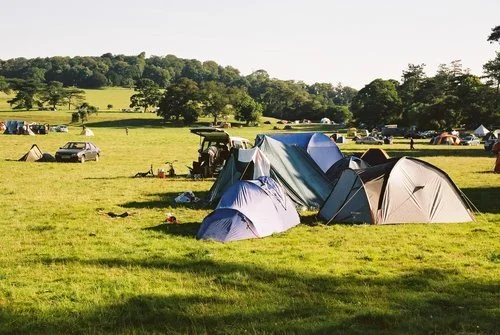
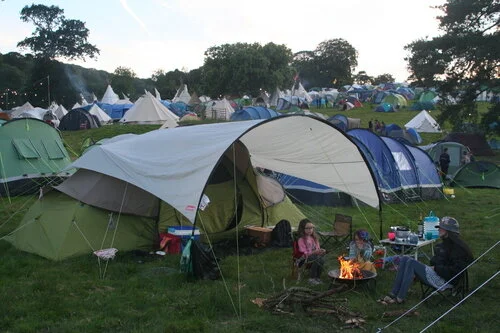
    I think it sustained him, kept him going through multiple health issues, operations and transplants. He was a doer, Perry was. He wanted to make things happen, see resources used. During the long, frank discussions we had when he and Cathy invited us to visit soon after my father died, he told me that for a long time after he had inherited the Port Eliot estate he’d felt it was a weight around his neck, dragging him down, and for many years he’d tried to escape its crushing burden. But in the end he found that the way to deal with the burden was to open it up, to make it available to others, to share it, which is precisely what he did with the Elephant Fayre, and latterly, with the Port Eliot Festival [which grew quite a bit between 2004 (below top), and 2015 (below bottom)].

    CNV00094.jpeg

    IMG_7402.jpeg

    Midland itself, a novel about families, came partly out of those discussions with Perry. My wife Robyn and I were with him the awful Sunday morning when the police came to the door to give him the news that his son Jago had died. It’s the only time I’ve ever witnessed a parent being told of the death of their child, and I hope it is something I never have to see again – it truly is the worst thing in the world. I remember Perry physically crumpling as if hit in the chest by a crushing blow – the comparison no simile but a literal description. But despite the overwhelming grief that he felt, within minutes he was up and dealing with the situation, preparing the house for the arrival of extended family, making sure that all the cogs kept turning, that the rusty, crumbling but still magnificent machine that is Port Eliot cranked on.

    Within a year Robyn and I were asked back to visit, which is when Perry helped with wisdom and insights in the wake of my own father’s death – an event that happened to coincide with the birth of my first child, so an epochal time for me. And he and Cathy kept inviting us back, every year since then, to read the next instalment of Midland at the festival. Each year I’d joke with Perry that I didn’t think I’d ever finish it, and each year Perry would tell me to keep on going, that in the end I’d get it done. And he was right: in the end I did. He and Cathy pledged for a copy just a month or two ago, as I knew that they would, because that’s the kind of people that they both are: generous, and loyal, and passionate, and true.

    So, yes, a week on Friday I’ll be reading from the (almost) finished manuscript of Midland in the Walled Garden at Port Eliot at 10 a.m. If you’d able to join me I shall be dedicating the reading to Peregrine Eliot, safe in the knowledge that many of my co-performers will make the same gesture for similar reasons, and although Perry won’t be standing, unobserved, beneath the boughs of the nearest shady tree quietly listening, or zipping around on his quad bike making sure that the campsite has water and that the Park stage has electricity, he will in fact be everywhere, all the time, all at once, personified by the festival that was, and remains, so much an expression of his and Cathy’s extraordinary personalities.

  • First Midland artwork sold!

    Midland-PIC09.jpeg

    Hello Midland posse –

    My shed has been a little quiet of late, largely as a result of the Brexit referendum. If you’ve been following me on Twitter or Facebook you’ll know I was a passionate Remainer, and making my opinions felt about the greatest constitutional crisis since the Second World War has taken precedence over blogging about my new novel.

    However, despite the imminent break-up of the UK, the collapse of the EU, and the rapidly approaching onset of the apocalypse as described in fellow Unbounder Paul Kingnorth’s novel  The Wake  (which I now realise is in fact a work of predictive non-fiction), life must go on and, indeed, good things have been happening.

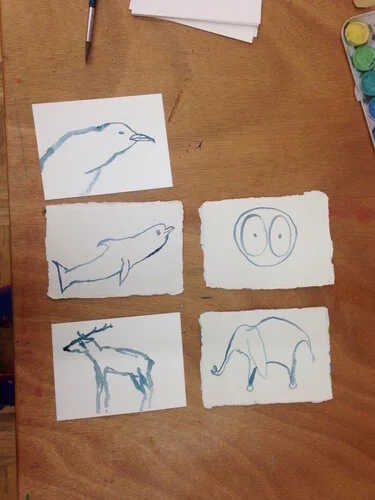
    Chief among these is that the first pledge for Midland’s five original artworks has come in. Drawn and donated by the extraordinarily talented  Francis Upritchard, these beautiful sketches will decorate the book’s five sections: WhaleGullEggStag and Elephant.

    Francis lives a short walk away from me in Hackney but is originally from New Zealand and indeed represented New Zealand at the Venice Biennale a few years back. Her drawings usually fetch around £900 each so the Midland sketches are a bargain at £550 a pop, and I’m very excited that one of them has now sold – taking my funding total up to an impressive 37%.

    There are still four pictures left so if any of you are budding art collectors (or know someone who is), grab them now while you have the chance: Francis’s work will be appearing at the prestigious  Frieze Art Fair  this coming October, at which point the value of her work is only like to go up.

    In other news

    • Filmmaker and Midland supporter Andrew Kötting (who kindly provided the DVDs for my £150 pledge level) has plugged Midland on his blog. In return I’d like to draw your attention to his new film project EDITH based around a walk from Waltham Abbey to St Leonards-on-Sea via Battle Abbey.

    • I’ve been invited back to read from Midland at the Port Eliot Festival this year, and will be on stage on Friday, July 29th. If you to happen to be going, do drop by for a listen and a chat.

    • On Thursday September 1st at 6 pm I’ll be in appearing at the Arts Catalyst in London in conversation with Canadian playwright and theorist Julie Salverson. We’ll be discussing all things nuclear, with particular reference to her new book Lines of Flight: An Atomic Memoir, and my last novel, The Book of Ash.

    To wrap things up, some news about Midland itself. I spoke to my lovely editor Rachael Kerr this morning who has just finished reading the draft of the book that I finished in France in February. She’s given me the thumbs up on the new material, the new structure and the new ending. We’ve set out a schedule for me to do the small amount of additional work that we both feel is required to make sure the story is properly resolved, and I’m going to be getting to work on that over the next couple of months. So we’re very nearly there!

    Have a great summer, everyone.

  • How does it feel to be a publisher?

    That’s what this post’s about. Exactly that. Because I’m not publishing Midland, and nor in fact are Unbound. Unbound are just enabling this book to be published.  The publishers of this book are you – by which I mean the 140 of you who’ve pledged so far, at a rate of about 1 per day, and who collectively have got the book to a third of its funding target. 

    That’s right! We’re at 33%. A major milestone.  And it’s all down to you

    You are the publishers of the future. Not just of Midland, but of many other books, albums, movies… because this is how it’s going to be now, increasingly, in the arts. The old ways are gone. Even “traditional” publishers aren’t traditional anymore, and won’t touch writers unless they come with hugely compelling online marketing packages and thousands of followers on Twitter.

    And alas, I don’t have thousands of followers on Twitter. I don’t have a hugely compelling marketing package or a urge to make comedy films of myself looning around in the hope that they’ll go viral on YouTube. What I have is a quarter of a century of writing experience and five books under my belt, including this new book that I really believe is the best piece of work I’ve yet done.

    And – and this is  my secret weapon  –  I have you.

    So here’s the thing, which maybe wasn’t quite what you signed up for: you’re publishers now, and if you want Midland to be published, you’re going to need to help me spread the word and tell your friends. I’ve all but run out of people to email, so I need you to go out and find a friend who loves fiction, who also wants to be part of the future of the arts, who wants their name in an exclusive first edition of a new book… and get them to pledge too.

    If each of you manage to find just one person to do that… well then we’ll be  66%  of the way there, won’t we. And if  they  all find one person, well, then we’re done. I can do the final draft of the book, we can all get our limited edition hardbacks and ebooks, and Unbound can print the paperback edition that will go into the shops. 

    Now, I hear you say,  that’s all very well Jim, us being publishers and all. But we haven’t even seen the book yet. How are we supposed to go out and sell it to our friends when we haven’t read it ourselves, and can’t put our hands on our hearts and say that it’s good?

    I hear you. I do.  With responsibilities come rights.  I get that. So here is a special offer, that I’m only making to the 140 people who have pledged so far. If you’d like to see the book as it stands, the complete latest draft, and get a full preview in advance of the print-ready edition, I will email it to you as a PDF.  I think you deserve that for the faith you’ve already shown in the book. You, after all, are my publishers. So if you’re interested just drop me an email or message me @jamesflint and I’ll get you that PDF. And only you –  you members of the very special Midland 140.

    It’s not the final version, it needs a copy edit at the very least, and it is not yet as polished and smooth as I intend it to be. But I’m pretty sure the story’s all there and as long as you swear on the memory of your childhood pet that you won’t share it with anyone else and – if you like it – that you’ll do your level best to get one other person to pledge, I’ll send it over. Because this is how it’s supposed to work now.  This is the power of the network. I get 140 people to pledge, they all get one person to pledge, and those pledgers in turn all get one person to pledge, and the project is funded.

    What could be simpler?

  • My Dad, the Midlands and Muhammad Ali

    IMG_4645.jpeg

    My Dad was quite the man about town in Birmingham back in the 1970s. A go-getting solicitor (no, it’s not a contradiction in terms), in 1973 he’d been Chairman of the National Young Solicitors Group of the  Law Society, a member of the  Lunar Society, and a founder member of something called the  International Advisors Group. Both of these involved much socialising, in addition to which he attended all kinds of civic and industry events in order to meet potential clients and drum up work for his firm.

    This meant endless lunches and dinners, and although Birmingham back then wasn’t quite comparable to 1960s Madison Avenue, there are a quite few parallels (primarily alcoholic ones) between Don Draper’s Madmen lifestyle and the one my father lived.

    Sometimes I used to think he went out to dinner for a living, and indeed, a few days before he died in 2008 he did say to me that his biggest regret as a father was having spent so many evenings away from home building his business when my sister and I were young.

    This should have cued a teary moment of nostalgia and regret, but although it has made me determined to be very present in the lives of my own children, actually my sister and I rather enjoyed the evenings Dad was out, as we got told off less and our mother generally let us sit up and watch Dallas. (Something which, in case you’re wondering, I wasn’t heartless enough to point out to my father as he lay on his deathbed.)

    There were other fringe benefits too. All the driving Dad did to all of those dinners was converted into Smurfs, which were given away at petrol stations and would appear at home at random intervals. Often there were more exotic freebies too, given away by generous hosts: propelling pencils and penknives and credit-card sized solar powered calculators (those last were amazing pieces of tech for the era, the equivalent of getting a free smartphone today).

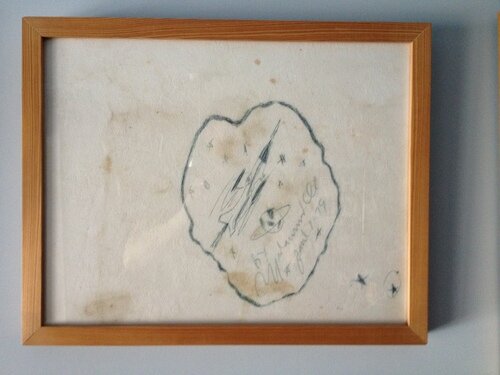
    But nothing compared to the evening that Dad showed up with a picture that had been drawn by Muhammad Ali.

    Ali had come to Birmingham to take part in an exhibition match with Jimmy Ellis, and during his three days in the city had attended a dinner held in his honour. All the West Midlands’ great and the good were there – it must have been one of the years’ hottest tickets – and my Dad had been invited.

    I’m not sure if he’d actually been sitting on Ali’s table, but he had been close enough to observe the champ at close quarters and spot that he’d spent most of the meal sketching something on the tablecloth alongside his plate.

    Ali was of course one of the most famous people in the world then, perhaps the most famous if you were ten, which I was. No doubt feeling guilty that he was there enjoying himself while his deprived young son was stuck at home (watching Dallas), when the meal was over and the plates were being cleared Dad sidled over and had a look to see what the boxer had been drawing.

    Amazingly it was a little picture of a Dan Dare rocket ship flying past a ringed planet. The champ had even signed and dated it. The organiser of the event had seen it too, and asked if my father would like to take it home for me. Which is how I come to have a framed picture by Muhammad Ali, biro on linen with original gravy stains, hanging above my desk right now. I’ve included a picture of it so you can see.

    And that is the story of my Dad, the Midlands and Muhammad Ali.

    Then a few years later the old soak got to spend an entire charity dinner sitting between David Bowie and Iman. And that really DID piss me off. Didn’t get me a bloody autograph from that one, did he?

  • Heads up on a Midland reading and a Midland documentary

    bbj-Jun6th-a6-front.png

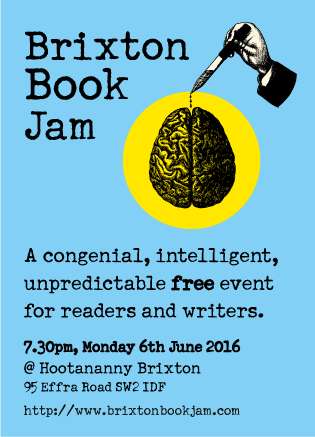
    If you’re free on Monday evening and feeling the need to step out in south London, then why not come down to the Brixton Bookjam at the Hootananny in Effra Road, SW2? I’ll be on stage reading a short extract from Midland and answering questions about the book, and a whole bunch of other writers will be presenting their work as well, including Stella Duffy, Anna Mazzola, Dennis Monaghan, Alex Marshall, Zelda Rhiando, Steve Mullins, Daniel Ruiz Tizon, Jim Gleeson, Seraphina Madsen, Lloyd Shepherd and Dorcas Pelling. 

    Full details at:  http://www.brixtonbookjam.com/

    If you don’t like Brixton, hate readings, live too far away or just can’t be bothered, then you could console yourself for being stuck at home by listening to Helen Castor’s lovely little documentary series about the Midlands, “England: Made in the Middle” that ran on Radio 4 all last week, and which is still available on the BBC iPlayer, here:  https://www.bbc.co.uk/programmes/b07d34rr/episodes/player

    By tracing a path from the ancient kingdom of West Mercia through to the Industrial Revolution, and taking in great literary figures such as Shakespeare, Samuel Johnson and D.H. Lawrence along the way, Castor (pictured; photo by Chris Gibbions),  argues a convincing case for what we all already knew: that the Midlands is where England, indeed the whole modern world, was actually invented. There’s some great stuff about Robin Hood, the Lunar Society and Erasmus Darwin in there too. All in five 15 minute episodes. You could listen to the whole lot while you’re doing the washing up!

    More info here:  http://www.madeinmanchester.tv/

    Meanwhile the rest of us will be getting drunk in Brixton…