Category: Fiction

  • Book Quiz: What do “Game of Thrones”, “The Shipping News” and “The Other Boleyn Girl” all have in common?

    *** SPOILER ALERT *** SPOILER ALERT *** SPOILER ALERT *** SPOILER ALERT *** SPOILER ALERT ***

    Okay folks, just warning you. If you’ve pledged for Midland – or plan to – and you don’t want to find out about the relationship at the heart of the book, then STOP READING NOW.

    Otherwise, read on. Midland is not a thriller; personally I don’t think it matters whether or not you know how it ends before you start reading it. It’s not that kind of book. But the choice is yours.

    So, if you’re still with me, back to our quiz. What do George R.R. Martin’s Game of Thrones – A Song of Ice and Fire, E. Annie Proulx’s The Shipping News  and Philippa Gregory’s The Other Boleyn Girl  all have in common? And, for that matter, Ian McEwan’s  The Cement Garden, Donna Tartt’s  The Secret History, Virginia Andrews’s  Flowers in the Attic, John Ford’s ’Tis Pity She’s a Whore, John Irving’s  The Hotel New Hampshire, Lawrence Durrell’s  The Alexandria Quartet, Matthew Gregory Lewis’s  The Monk, Vladimir Nabokov’s  Ada or Ardour: A Family Chronicle, James Ellroy’s  White Jazz, Jeffrey Eugenides’s  Middlesex, Helen Dunmore’s  A Spell of Winter, Marion Zimmer Bradley’s  The Mists of Avalon, and Arundhati Roy’s  The God of Small Things  all have in common?

    Or, for that matter,  William Shakespeare’s  King LearHamlet  and  Pericles?

    You’ve surely guessed it by now. The answer is, of course, incest. All these books are, in greater or lesser part, about incest in one form or another. Often called “the last taboo”, the topic is threaded through literature right back to its origins in religious mythology (the Greek and Hindu myths are of course shot through with it, not to mention the Bible). It has fascinated us for millennia, has been forbidden by most societies for about as long, and like most things that have been forbidden for a long time, it is currently being reexamined by modern society.

    Because like most cultural phenomena, incest has shades of grey (um, not fifty shades, thankfully – a book that if you noticed I did  not  include on my list). The plot of  Midland  is coloured by one of those shades, in the form of a rare and little understood condition known as Genetic Sexual Attraction.

    Here’s the science bit. GSA, as it’s commonly referred to, is thought to occur when biologically-determined assortative mating drives are not dampened by the learned kin recognition constraint known as the  Westermarck effect. The condition particularly affects siblings and half-siblings separated at, or soon after, birth. Should they meet again later in life the sense of mutual recognition can be quite overwhelming, and may manifest as a powerful sexual connection. Once the individuals concerned have experienced this intimacy, they can find it all but impossible to form subsequent successful romantic attachments.

    I don’t want to write a long essay on GSA here. I haven’t made an academic study of the condition. My interest as a novelist is less in the specifics of the condition itself than in the shock waves it can send through the lives of those even peripherally connected to it.  Midland  is my attempt at capturing such an event; it is my essay on the unexpected consequences that GSA can have, and it also contains my thoughts, such that they are, on its moral dimensions.

    For more information on GSA, Wikipedia is a good place to start. There is a  private online support group  for those affected by the condition, and the  After Adoption  clinic in Manchester has specialised GSA counsellors. One of them is featured in the YouTube clip from the documentary  Incest: The Last Taboo, which I’ve included above.

    For more information… well you’re just going to have to wait for the book to arrive. The faster it’s funded the faster you’ll get it, so please tell your friends to come and pledge for a copy!

  • Shakespeare’s shadow

    Over Easter I was back in Warwickshire visiting my mother, who still lives a country mile from the house in which I was born. Her nearest corner shop is the village stores in Wilmcote, a five-minute drive away, and the shop stands right opposite the family farm of Shakespeare’s mother, Mary Arden. This is now a very slick “living museum” filled with blacksmiths and falconers and cooks and musicians, and is a real favourite with my two daughters, who love the powerful sense it provides of stepping back in time.

    In the video above you can see them on the farm learning to herd geese to market, which would have been a common sight in Shakespeare’s day – so common that geese were provided with little cloth booties to protect their feet as they scurried, honking enthusiastically, down the hard stony lanes.

    Last week saw the 400th anniversary of Shakespeare’s death, of course. You know that something is a big deal when an entire episode of Countryfile gets devoted to it, and the sight of Adam Henson driving a flock of sheep down Sheep Street to illustrate the Bard’s connection to the wool trade gave me nostalgic pangs for my home town that I don’t often get, especially when a montage of local shop fronts showed the sign of the Vintner, a bar in which I used to drink.

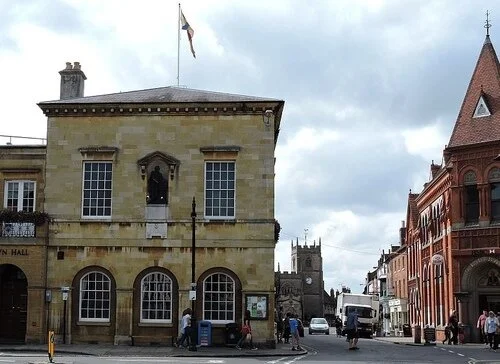
    The Vintner features in Midland, and one of the climaxes in the book takes place just opposite, on the corner of Sheep Street, directly overlooked by the statue of Shakespeare that was presented by David Garrick at the time of his Jubilee in September 1769 and which is set into a niche in the first floor facade of the old Town Hall.

    (I don't have my own photo of this so I've filched this from here, with apologies)

    (I don’t have my own photo of this so I’ve filched this from here, with apologies)

    The decision to stage that scene beneath Will’s watchful gaze was a nod to the influence he’s had on the book and indeed, on me. Growing up in Stratford-upon-Avon, wanting to write, it was impossible to escape Shakespeare’s influence. He was one of the main reasons I became a writer in the first place. What greater role model, what better local hero, could I have had?

    My parents were big fans of the theatre and involved with the Shakespeare Birthplace Trust, which brought it all even closer to home. My music teacher played in the theatre orchestra; when my mother decided to surprise my father by commissioning a portrait of my sister and I it was to local artist John Collins, a theatre set designer, that she turned. For several weeks Mum whisked us off on secret missions into Stratford, where we sat for John amid jumbles of props in the back of the RSC paint shop, a chaotic, Bohemian environment suffused with the pungent stench of oil paint. When my parents needed to let out a property they owned they let it to actors, including – if memory serves – a young Iain Glen, now one of the stars of Game of Thrones. When they needed to rent a house for a period they moved us to one that had just been vacated by Jeremy Irons, in Stratford for a season. While I was at University my father’s firm of Birmingham solicitors, Duggan Lea & Co., merged with the firms Bettinsons and Shakespeare & Vernon and the new entity adopted the name Shakespeare’s.

    Shakespeare was therefore a part of scenery of my childhood, somewhat less exotic than EastEnders, which I watched avidly for clues about the London life I was so desperate to live. The fact of him was simultaneously inspiring – this is what some kid from Stratford had managed to achieve – and demoralising – how could you even begin to measure yourself against a talent so prodigious, especially after it had been magnified and elevated by the efforts of an entire industry?

    My undergraduate degree complete I made a bid to start a life in the United States. After a precarious year living on my wits in New York studying music and working on the novel that would eventually become Habitus I won a place to study Philosophy and Literature at the New York School of Social Research. Alas, the funding to pay for it never came through and I found myself back in the UK instead, taking an equivalent, rather more affordable (and as it turned out quite excellent) course at the University of Warwick.

    My bid for freedom over, here I was back in Shakespeareland. The funding hadn’t worked, the novel hadn’t worked, the music hadn’t worked; there seemed little else for it but to go back to my roots and start again. Looking for some new perspectives I read the sonnets for the first time, an experience that changed my understanding of both Shakespeare and of poetry. Each one a Byzantine nugget of thought, self-reflexive and involuted as actual consciousness, taken together they painted a portrait simultaneously completely alive and tantalisingly incomplete, and they changed my understanding of what language could achieve.

    Never one to do things by halves, around the same time I began going out with an RSC actress, a relationship that would dominate my twenties. She did several seasons with the company, first in Stratford, then on tour, then at the Barbican. At one point she understudied Titania, and she got to play the part for real when the lead was taken ill, which gave me the opportunity to fulfill a major male fantasy – that of delivering flowers to the stage door on the night of my girlfriend’s headline performance.

    I was writing hard by this point. Habitus was taking finally shape and thanks to that girlfriend (still a great friend, and currently Midland’s most generous pledger) I was exposed to a great deal more Shakespeare, in particular the history plays, than I would probably have got around to seeing on my own. But I still hadn’t found any real point of creative engagement with the playwright. 

    Because where is Shakespeare’s language now? Our culture is drowning in words but where are they used to express pure psychological and existential states as they are in the mouths of Shakespeare’s characters? In novels sometimes, yes, but not that much since Joyce. In plays sometimes, too, but not that much since Beckett. Hardly ever on screen, where facial expression and cinematography have replaced language as the mechanism for capturing and communicating psychological nuance, with occasional notable exceptions such as Dennis Potter or Quentin Tarantino. The tide of realism that swept over the late twentieth century has led us away from the Shakespearean form. Perhaps only rock, rap and hip hop have swum consistently in the other direction, the lyrics of Bob Dylan, David Bowie, Dr Dre, Eminem among the few places where language still gets to play as it did in Shakespeare’s day.

    So it wasn’t really till I’d written another two novels and was taking a screenwriting course at London Metropolitan University that I found myself, for the first time since I’d tried (and failed) to stage King Lear as a schoolboy, thinking about Shakespeare’s plays from the inside. I put aside the bard’s scintillating linguistic surface for a while and started to think instead more about the structure of his plays. I had made several attempts at trying to write screenplays trying to fit the three-act structure that was all the rage among screenwriting gurus at the time but couldn’t get the dynamics to work in a satisfying manner, and it was by going back to Shakespeare and looking at his five act arcs that made me begin to feel that the three act formula – really four acts, with the long central act split by a mid-point – was actually missing a beat.

    It was at this moment that I began to write Midland, conceived from the outset as “novel in five parts” in order to allow myself to interrogate that structure and try to uncover the dynamics that powered it. And so what I think of now as my Shakespearean novel began to take form: set in and around the villages that he and I both ran in as children, transfixed by love doublings and misunderstandings borrowed from Midsummer Night’s Dream and Twelfth Night, overshadowed by the death of a patriarch not unlike Lear, struck through with the mercantilism of The Merchant of Venice, and strewn with the weeds and flowers of Warwickshire like all the Bard’s work – as catalogued in a little book called Shakespeare’s Garden that my father had given me as a boy and which I’d dismissed as boring and put aside, unexamined, for decades, until suddenly one day it was the thing I woke up most needing to read.

    So happy birthday, happy deathday, dear William. Only 52, and look at all you did in that time. Though one thing’s for sure: a play takes a lot less bloody words than a novel – it was a good move to stick to iambic pentameter, given that you were working only with candle and quill. Thank you for all the insights, the imagery, the props and the girlfriends, the keys to the structure of thought. You didn’t cast a shadow, you let in the light, and my writer’s life will have been well lived if I’ve managed even in a small way to help carry your torch.

  • Tony Nolan and the Panama Papers, or, How we’ve been bored into submission by the global “elites”

    I warn you, this is a boring post. However, if you can stay with me to the end I promise you crack cocaine and hookers and other, more subtle pleasures. Really.

    Are you with me? Good. We are, as  George Osborne  is so fond of saying, all in this together. So here goes.

    Like most miserable suckers (AKA taxpayers) I’ve been following the fallout from the  Panama Papers  leak this last week with some glee. Here at last was incontrovertible evidence on a scale sufficient to excite the attention of the mainstream media of a financial injustice not just prevalent among the so-called global elites but actually de rigueur, a functional part of what it means to be wealthy these days. 

    I first came across this kind of behaviour when I was running the Telegraph Weekly World Edition, which served the British expat community. The paper had an Offshore Finance section that was mainly concerned with advising Brits working or retiring abroad on how to handle their financial arrangements. We didn’t write too much about offshore tax havens other than Jersey and Guernsey, but we did carry quite a bit of advertising by firms operating out of these islands, as well as out of more distant ones. 

    Because of this I was serially approached by various people keen to educate me on the finer points of difference between tax avoidance and tax evasion, and offering to place “free” articles in our pages extolling the virtues of the former (along with the benefits of their services). Despite our tiny budgets and desperate need for fresh copy these were advances I was generally happy to reject, although the fact of them alerted me to the fact that there was something of an industry here.

    Around about that time I began to notice increasing coverage of tax avoidance scams in Private Eye, which I’ve read regularly ever since I used to filch my Dad’s copies to peruse the cartoons as a boy (a great start to any political education). Soon almost every issue seemed to have new coverage of the kind of personal dodges so thoroughly documented in the Panama Papers, as well as the kind occurring on a corporate level and made familiar by the light recently thrown over the tax affairs of Google, Facebook, Vodafone and the like, stories that the Eye was thumping the tub about literally years before they appeared above the mainstream parapet. 

    These dodges were both completely outrageous and utterly routine, and yet they were being almost completely ignored outside of the Eye’s back pages. I wanted to try write something about them to try and help redress the balance but had left the Telegraph by this point. So I duly worked them into the pages of Midland.

    Here’s my Warwickshire businessmen, Tony Nolan explaining the tax structure of his company NolCalc Limited to his son Sean (if you’ve been hanging out in my  Shed, you may have read this before in the  supporters-only extract I posted on March 14):

    “If we lose money, we don’t pay tax, and we can even claim rebates on the losses. So everything has to be structured to look like it’s well in the red, while actually remaining solidly black. NolCalc Limited is a UK company, and pays tax here in the UK. But it’s really owned, not by me or my investors, but by an outfit called Motherboards International BV, a Dutch company registered in Rotterdam. But Motherboards International doesn’t own itself, either. It’s owned in turn by two companies called Summit Silicon NV and Third Bay NV, both of which are based in Curacao.

    “The way it works is that Curacao companies loan money, and I’m talking about lots of money, to the Rotterdam company, which has to pay interest on the loans. This interest can be lopped off its tax bill in Holland, as interest is a tax-deductible expense, and the loans are big enough that these deductions wipe out pretty much Motherboards International’s entire tax liability. Motherboards International makes its profits by loaning money to NolCalc Limited, along with inflated fees for ‘financial services’, where the process is repeated: the interest gets deducted from the UK tax bill, and the fees suck up any profits that are left, effectively taking that money out of the country and away from the dreaded claw of HMRC.

    “To oil the wheels there’s another company, NolCalc Research, which is based in the UK but which is an unlimited private company and so doesn’t need to publish its accounts. Most of the people who think they work for NolCalc are actually employed by NolCalc Research. NolCalc Limited subcontracts most of its work to NolCalc Research, which supposedly charges its services back to NolCalc ‘at cost’ so it doesn’t make a profit or a loss. But those fees are massively inflated too.

    “The result of all this is that NolCalc, which should be hugely profitable, in fact makes a substantial annual loss and so pays no tax at all – in fact as I mentioned before it even earns rebates on some of its expenses from the Exchequer. So it makes money from the government – which means from you, because you’re paying for it, out of your income tax. Or you would be if you actually had a job.

    “And so it goes on. There are lots of added complications, most of them blind alleys designed to confuse the various regional tax authorities and make it as hard as humanly possible to track where the real profits go and who owes what tax on them where. But what you end up with is mass of wiring, like a bomb. Cut a wire to solve an issue in one country and you can suddenly find you’ve made yourself liable for all sorts of back taxes or fines in another. Of course there’s an army of people on hand to make sure that this doesn’t happen, all dependent on the continued operation of the machine for their eye-watering fees. Machine’s probably not even the right word. It’s more like some gigantic fucking fungus, eating itself at the same time as devouring anything in its path.

    “I started it running, but I don’t control it. The lawyers and accountants have that honour. In theory it’s made me rich but I risk losing a fortune in tax every time I put my hand into my pocket. To break free from it I really need to leave here and live abroad at least half the year, which is exactly what my so-called advisors would like me to do.”

    Like Felix Dennis, who bought up much of the Warwickshire farm I worked on as a teenager in order to turn it into woodland, Tony Nolan has a dream of recreating  a native forest in the English Midlands. With his customary style Dennis, a true maverick who as far as I can tell operated according to a genuine moral code – albeit an idiosyncratic one that sanctioned indulgence in crack-fuelled orgies with multiple prostitutes – made sure that his forest was bought and owned by a UK-based trust to which he left the larger part of his fortune in order to ensure that the forest he has planted survives in perpetuity. 

    Nolan has similar long-term aims, but has not bought his land in a similar way. Because of the manner in which he’s been ensnared by NolCalc’s complicated tax history he has been forced to buy his forest via further offshore companies. The moral of the story is that one offshore tax dodge begets another, and another, and another… ad infinitum, unless something legislative is done to break the chain. 

    Of course not many people can be bothered to followed this kind of narrative at this kind of level of detail (although maybe there are a few more now as a result of the Panama Papers), and that of course is the point. Tracing money in this way is hard, tedious, boring work. It doesn’t (supposedly) sell books, which is no doubt another of the many reasons to laud both Unbound, a publisher with a business model that allows it to risk publishing novels containing this kind of content, and to laud you readers for pledging for them. And the tediousness of it all is precisely what has allowed the “elites” to get away with it for so long – they’ve basically bored us all into submission, and as a result made off with cash that should have gone into boring things like hospitals and schools instead of forcing our grandchildren to pay five times the price of every piece of them via terrific wheezes like  PFI  and PFI2.

    Fortunately worker bees at the likes of Private Eye and the International Consortium of Investigative Journalists are out there boring themselves stupid for the sake of you and me and those grandchildren. I got a grip on the whole land ownership scenario thanks again to work done by the Eye, this time in the form of its  online map of properties in England and Wales owned by offshore companies. The map is a marvellous tool: an investigative story in itself, a mine of further such stories, and a weapon for shaming the Government into actually doing something about behaviour that has cost all but a very few of us so very much. 

    Do check it out and run a few searches on areas that you know. You may find the results depressing, you may even find them shocking. Now that the Panama Papers have come out I don’t think you’ll find them boring, though. And when you read this kind of stuff in Midland, I hope you won’t find that boring either, now that you know what it’s really about.

  • April Fool’s Day in Canary Wharf

    April Fool’s Day joke… I finished the new draft of Midland today and sent it in to Unbound. 

    And the joke is… it’s not actually a joke at all! It really happened, and it happened after noon so it wouldn’t have counted as an April Fool’s joke anyway. My actual delivery deadline was yesterday, but what’s a day after ten years of toil?

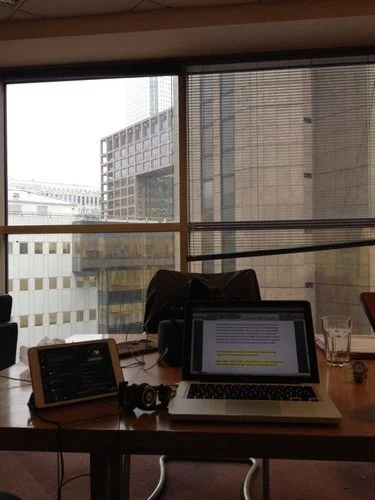
    A fair chunk of this draft has been written at a desk I’ve been using, courtesy of start-up pals Birdsong, in Canary Wharf.

    Here’s a pic:

    Canary_Wharf.jpeg

    That’s 1 Canada Square you can see through the mist, top and centre.

    By coincidentally I was working in that tower when I started writing my first short stories around 25 years ago. I had a job working as the postboy on the features desk of The Independent newspaper, back when it still was a newspaper and back when there was still post.

    Canary Wharf resembles Jean Luc Godard’s  Alphaville  now, but back then there was little apart from that tower and the small cluster of largely empty office buildings around it. The rest was a giant industrial wasteland of empty lots and abandoned docks, studded with cranes and laced with old railway lines. I used to stare down on it in between shoving letters into the journalists’ pigeon holes and teaching the executives how to use the new-fangled network of Apple Macs they’d just had installed, replacing the mainframe Atex system that had been in use in their previous office by the Old Street roundabout.

    The view reminded me of the zone in Tarkovsky’s  Stalker, one of my all time favourite films, and it inspired me to write a short story,  The Nuclear Train, the narrative of which connected this landscape with the flat in which I was living in Islington, and which backed onto the railway line that was used at the time (and still may be, for all I know) to carry giant drums of nuclear waste (a fact that also inspired the classic 80s conspiracy thriller  Edge of Darkness) down to the docks for sea-bound transport to Sellafield.

    In 2002 The Nuclear Train was made into a short film for Channel 4, and you can watch here on  Vimeo. Director Dan Saul’s animation looks as beautiful today as it did then, and perfectly captured the strangeness of a landscape that has now long-sinced vanished beneath clusters of high rise office blocks and apartment buildings. Even the building I’m writing this in will soon be gone. Barely thirty years old, this summer it’s to be demolished and replaced with a brand new 80 storey building, which is why I have a free desk – because everyone here is in the process of moving out and there’s temporary space to be had by those who have no desire to stay long.

    So here I am again in Canary Wharf, 25 years on, writing stories in the zone where the new displaces the old. It’s a place we all find ourselves in sooner or later, and if you pondering that, then why not put ten minutes aside this weekend and watch the  film.

  • Midland and the Anthropocene

    Happy Easter everyone. To mark the day, a traditional time of renewal and rebirth, I thought I’d share some thoughts.

    As I posted to Twitter a couple of weeks ago, I recently read Oliver Morton’s marvellous book  The Planet Remade. Ollie was my editor back when I was a tyro journalist working on Wired UK, and we still keep in touch. He works for the Economist now, and his books on Mars and photosynthesis are both excellent. But The Planet Remade is something really special.

    The book elaborates the pitfalls and potentials of geoengineering the Earth’s climate, a subject in which Oliver is something of an expert having reported on it for many years. He argues that mankind has in fact been engaging in geoengineering for some time: by releasing vast amounts of greenhouses gases through the burning of fossil fuels, obviously, but also (and more purposefully) by “speeding up and rerouting” the nitrogen cycle by fixing nitrogen into synthetic fertilisers on an industrial scale.

    I’m not going summarise the book here; all that matters for this post is that it elegantly describes those human activities sufficiently pervasive and impactful upon the environment to have created an identifiable “layer” in the geological record, and thus to have (arguably) kicked off a new geological period: the Anthropocene.

    What’s this got to do with Midland? Well, Midland – like  Habitus  and  The Book of Ash  before it – is a novel that tries to map some of emotional dynamics taking place as humanity tries to deal with this.

    A country boy who moved to the city, the relationship between the natural and the technological has always preoccupied me. It has informed all of my writing since I wrote my first half decent poem aged 17, penned one night as I sat up manning the corn dryer on the local farm where I worked during my teenage summers. And it still does – those same concerns and that same farm feature in Midland, as in the extract I recently posted to the Shed (only accessible by pledged supporters).

    If you’ve read Habitus these concerns are quite explicit – the hyperreal techniques I used in that book, inspired by Ovid’s  Metamorphoses  (and Kafka’s  The Metamorphosis), allowed me to have the characters quite literally transform into the symbols they had begun to represent.

    In The Book of Ash I fictionalised the story of the nuclear artist  James Acord  because I could address these concerns through his life and work. Interestingly, Acord’s art – along with the work of  Simon Faithfull  and  Olafur Eliasson, other artists whose work I find very inspiring – is being included, posthumously, in a forthcoming exhibition on the Anthropocene  to be staged in Ostend later this year to coincide with World Ocean Day.

    Midland begins with its characters confronting nature as a sublime force, nature as overarching “other”. This is the sublimity of the Romantics, which Alex likes to think he experiences in the first section of the book, Whale (see the extract on the  Midland homepage), and which his environmentalist brother Matthew has devoted his life to trying to protect.

    The book ends with Alex starting to look on the earth’s environment in a different way: as always mediated by the human. It’s an understanding symbolised, not by the  whale lost in the Thames, but by the  giant mechanical elephant  brought to London by the Royal de Luxe theatre company in 2006.

    When I started the novel back in 2006 I very consciously chose to bookend it with those images, as it seemed to me that they captured something essential about the locus of change in the times that we’re living in. The book’s narrative was then developed as a kind of filigree or tracing of an imagined topology charted as one symbol morphed into the other in London’s carnival of spectacle over a period of around five months.

    It was a technique I adapted from one developed by the French writer  Raymond Roussel  around a century ago. Roussel would begin with two almost but not quite identical sentences – one to start and one to end the work – and then try and find the tale that connected them, hoping to capture something meaningful in the locus of the narrative arc thus described (the mathematical term itself features in the title of his most famous such novel, Locus Solus).

    Roussel’s works are brilliant but weird (or, rather, brilliantly weird). Though not much read in his lifetime – fortunately for him he inherited a fairly large fortune and was able to self-fund his work – his writing later became a big influence on the  Surrealists,  Oulipo  and the poets of the  New York School. The writing style of Midland has little in common with that of Roussel’s books (though here I am crowdfunding my novel, so maybe I have more in common with Roussel than I think. Hopefully I won’t overdose on barbiturates in a Palermo hotel room when I finally run out of money, as he did). But what it does share is the ambition that by exploding the moment between two images a wider truth can be captured, like a holographic fragment of a much larger picture. And when I read The Planet Remade it brought three decades’ worth of concerns about what we are doing to the Earth and how that is changing our society into sharp focus for me. It was, if you like, the best description I’d read of my book’s (and my books’) context. This was the story a particular arc of which I was trying to describe.

    We live at a moment in history when mankind’s very success has rebounded on it, disorienting us and rendering us rudderless and confused. Midland tries to capture something about the subjective experience of being alive, of what it’s like to try to make sense of your life, at this time. The Planet Remade presents a much more objective account of what this moment is and what it means.

    Do read them both!

    And have a great Easter.

  • Why I wrote Midland…

    Just a quick post to alert you to a piece I’ve written for the Telegraph about the origins of Midland. It’s a slightly simplified version of the story of course, there are other originating factors too (some of which I’ll be talking about over the next few weeks here in the Shed) and there was only limited space in the piece. But it covers off nicely my father’s influence on the writing of the novel and the way that my time running the Telegraph Weekly World Edition fed back into it too.

    Here’s the link, in case you haven’t seen it already:

    https://www.telegraph.co.uk/expat/news/how-expat-life-inspired-the-tale-of-a-prodigal-son/

  • The Midland playlist

    Well, I’m safely back in London having survived mice and fire and have a complete draft of Midland on my computer. It needs another pass I think but before I attempt that I’ve taken the opportunity to step back a bit, do some other work that’s been clamouring for attention, and have a think about things like the Midland playlist.

    Writing a book over ten years and juggling it with a full-time job, young children and the general plethora of minor distractions that take up so much of our time is no easy task. One problem is just keeping it all in your head. The story evolved so much since I began and went through so many drafts, that remembering what I’d written and where I was in terms of the story dynamic was a major challenge when days, weeks or even months could slip by between writing sessions. But this technical issue was easier to deal with than the more subtle emotional one of quickly trying to recapture the precise mood I was trying to convey in a scene the last time I’d been working on it maybe a week or two previously. This difficulty was made more acute by the fact that I was often having to work in short bursts late at night or very early in the morning and so was tired and time-pressured before I even began.

    One thing that really helped with all this was creating a playlist of tunes to go with the book. I originally got the idea from listening to the parallel movie soundtracks Pedro Almodóvar used to put out, the music not from the films themselves but that he was listening to when he wrote their scripts.

    I started out with tracks that put me into an appropriate meditative and writerly mood, but over time I found and added tunes that really seemed to illustrate a particular strand, atmosphere or character, and which I could use to help me key into that feeling whenever I needed to. I must have listened to the songs on this list thousands of times over the past decade, and I’ve made a Spotify playlist so I can share them with you.

    In theory it should pull into this page in the slot below, but if it doesn’t work here’s the link: 

    The tracks are listed below with a line or two about what they meant to me in terms of Midland. There’s a couple that aren’t on Spotify; where I can I’ve offered a Spotify-available alternative. The Midland references won’t all be clear to you yet, but will become more so when you get your hands on the book. Over the next few weeks I plan to release a few advance excerpts here in the Shed which should help connect up the dots a bit. Please note, these excerpts will be exclusive to pledging supporters only! You’ll only be able to see them if you’ve signed up for an ebook at least…

    Okay, so here’s the list.


    Fyrsta – Ólafur Arnalds

    I feel a bit like I was the first person to ever discover Ólafur Arnalds, but of course I was actually about the last, given that he wrote the music for Broadchurch (a series I still haven’t seen) before I ever came across him. But that’s the kind of very personal music he makes – he puts you right there in the room with him, and makes you feel that it’s just you and him and, a lot of the time, that it’s just you.

    This piece opens of his album Living Room Songs, which he apparently knocked up in his living room in a week, hence the title (I think his living room has not yet been permanently annexed by rampaging children, like mine has). Fyrsta has the same poise and self-reflecting air of domestic isolation that I was striving to achieve throughout Midland; in many ways I was trying to write a book that left the reader feeling as this music makes me feel. Once I discovered it, quite late on, some way into year eight, I probably listened to it every single time I sat down to work on the book.


    Whale – Harry Harris

    Another latecomer to the Midland party, but one that like the Arnalds quickly dominate the project. I came across Harry Harris when I heard him play in the basement of a pub in Stoke Newington at a gig my daughter was also performing in (as part of the most excellent Hackney School of Folk). I was blown away by Harry’s voice, guitar-playing and songwriting prowess and the next day I dialled him up on Spotify. I couldn’t believe it when I found he’d written not one but two songs with the same titles as sections from Midland, which could indeed have almost been written specifically to go with my book.

    I got in touch with him and asked if I could use Whale for my Unbound promo video, and thoroughly excellent bloke that he not only said yes but let me have it for free. I think you’ll agree it makes the video, and do go and listen to the full version on Spotify. Even better, sign up for the Midland pledge level that includes his wonderful album Songs About Other People CD, or pledge for tickets to the Midland launch party. Part of your pledge will be for Harry’s fee, because he’ll be playing live for us that night. It’s going to be a very special evening.


    Dig Me A Hole – Dawn Landes

    This lovely ballad could have been lifted from Joni Mitchell’s classic album Blue. Landes perfectly captures the particular melancholy of city living that can strike people that have moved there after a childhood spent in the countryside – I’ve experienced it myself many times. In Midland it always captured for me the moment when Caitlin, on a self-destructive cocaine binge following the death of her father, leans off a seventh floor balcony in East London and stares at the carpark below, imagining she can see a hole opening up in the patches of tarmac just waiting to swallow her up.


    Überlin – R.E.M.

    Strange one this. I’ve never been an R.E.M. fan and in fact I’d hardly listened to them until I came across this song. Initially it was the video that captured me, a slightly self-conscious concoction by Sam Taylor-Wood and her then boyfriend (now husband) Aaron Johnson in which she shoots him dancing through the streets around Brick Lane and Hackney Road, streets that I’d been tramping myself for twenty years or so and in which a few scenes from Midland are set (see Dig Me a Hole, above). Something about the dance just really got me. It’s so arsey in so many ways, but the way Johnson uses his body is incredibly compelling, at least I thought so. I watched it over and over, and by the time I eventually got bored of it the song had got firmly under my skin. It captures something essential about the “young man in the city” experience, reminds me of how I wanted life to be when I first came to London, and I ended using it as a touchstone for Emily’s early experiences in the capital as she tries to make her way as a journalist.


    Theme from S-Express – S’Express

    This song was part of the soundtrack to my life as an undergraduate, and features directly in Midland. It’s on a tape Alex plays to Caitlin the evening he tries to seduce her. The action takes place in 1989 and I needed a tune that amplified the both the sexual tension between them and the era in which the scene was taking place. This was it.


    Flotsan n Jetsam – Laura Veirs [not on Spotify]

    A quirky little tune this, and hard to track down; it’s not on Spotify, although plenty of other stuff by Laura Veirs is. I came across it on one of the Comes with a Smile collections from early 2000s and have loved it ever since (in fact there are three tracks on this play list from that collection, which probably reflects the fact that it came out in 2005 and I was listening to it a lot when I started writing the book in 2006).

    The guitar work on Flotsan n Jetsam is particularly special. It’s a song that really reminds me of what it was like to be a teenager growing up in Warwickshire, all the pseudo-seriousness and self-conscious passion that sometimes spilled into real seriousness and passion when you least expected it, generally for reasons beyond your control. Waiting for life to begin, and not understanding that it already had. In Midland it’s very much the soundtrack to Matthew and Caitlin’s ill-starred love affair – both sides of it (I don’t want to give too much away here…)


    Wild is the Wind – David Bowie

    Oh don’t. Just don’t. Especially after the recent death of the Man Who Fell to Earth himself. I actually tried to learn to play this on the guitar when I was seventeen, which taught me pretty quickly that I couldn’t sing and I was never going to be able to play guitar. In contrast to most of the other ballads and love songs on this playlist this is hugely overwrought, massively lush, and speeds up absurdly as it draws to its ridiculous climax. Yet it is at the same time it is genuinely heart-rending and absolutely perfect – typical Bowie, managing to master the hyperbole and put it to work. It illustrates for me how Matthew sees his relationship with Caitlin, describing both the space of his emotions and the solipsism of that space, the sense that he’s in love less with her than with the idea of being in love with her. It’s a self-deception that will lead him to a very dark place.


    Everything Ends in Spring – The American Analog Set

    More bereft melancholia, lost love and nostalgia. Are you seeing a pattern here? This is another song that, like Fyrsta, captures the whole of Midland for me, a signpost to the overall feel of the book and the kind of story I wanted to write. Because this is what life is like, right?


    Blooms Eventually – Pulseprogramming

    I love this song. At the time in my life when I was experimenting with digital filmmaking I made several wedding videos for close friends, and I used this as the soundtrack for one of them. It helped me get into all the love relationships in the book, but the one I think it best relates to is that of Luggie and Bea, on their mission to build a life together in south America.


    Dogs – Pink Floyd

    Very different to everything else on the list, this. I was a huge Floyd fan when I was growing up, then didn’t listen to them for years, then started listening to them again (only with Roger Waters, ahem) when I started working on Midland, partly as a kind of guilty pleasure, partly because their music was so knitted into my teenage years in Warwickshire that I only had to put on Animals or Dark Side of the Moon (two of the first four albums I ever possessed, on C90 cassettes that a friend’s older sister taped for me) for every detail of that time to come flooding back. I can still smell the room in which I was given those tapes as I write this, still feel the hard plastic cases and see their handwritten track lists.

    I chose Dogs for the playlist because I wanted something that captured the much harder strand of business and money that runs through Midland. In fact I’d say that money and debt are the book’s real themes, not love at all, which flies in the face somewhat of the music that makes up the majority of the tracks on this list. All my books have been about technology in some way, and the technology in this one is finance. Dogs for me communicates the nature of that world – the world of Tony Nolan, Alex and in particular Alex’s amoral banker pal Freddie Winston – or at least the nature of it as seen through teenage eyes.


    Ease Down the Road – Bonnie “Prince” Billy [not on Spotify]

    The “Prince” is too cool to put his stuff on Spotify (his beard doesn’t stream properly), and so you’re just gonna have to get this some other way. Over the past decade or so I’ve started to really like “story songs”, and found myself listening to more and more folk and country as a result. Bonnie “Prince” Billy is a modern master of the form and I’m a big fan, though I saw him once in concert and he was absolutely terrible, really boring and uninvolved, which was weird. Maybe he was just being cool. I think he spends a lot of time being cool.

    Anyway this song, with it’s spikey little tale of sexual betrayal, really belonged to an earlier incarnation of Midland, when outright infidelity formed the core of the plot. That changed in the end, but this song continued to resonate, maybe because it communicates to me something about the way Matthew feels about the actions of his brother, Alex. 


    There is a Light That Never Goes Out – The Smiths

    Another song that’s directly referenced in the book. Matthew listens to it before going on his big date with Caitlin, because Matthew would, wouldn’t he? That’s the kind of teen he is. There’s also a harsh dramatic irony hidden within the song’s lyric, but you’ll just have to wait till you read the book to find out what that is…


    O Mio Babbino Caro – Gianni Schicchi

    Tacky I know but what the fuck. Puccini was a genius, this was his peak, it has good claim to be the greatest song ever written (a stupid competition I know), so why shouldn’t it inspire me? It’s probably the record I’d save for the desert island if I could only save one, and it is for me the moment when Caitlin is alone in the dining room with her father’s body. The little aria I’ve written for her isn’t a patch on Puccini’s, but I can’t read the damn thing out loud without welling up, as I did a couple of years ago on stage at the Port Eliot Festival. I hope it does the same for you when you get to it.

    I really like the Magda Kalmár performance, which I have on CD, but couldn’t find it on Spotify so I’ve listed this Mirella Frenl version instead, also lovely.


    Stag – Harry Harris

    Number two by Dalston’s greatest living singer-songwriter, and although it describes a very different kind of encounter with a stag than the one that Matthew has, it still helped bring that section of the book alive for me. I stole a line from it too, Mr Harris’s description of the stag being “the colour of bonfires”, and put it in my text and then riffed off it a bit. Apologies Harry. Imitation is the sincerest form of flattery, they say…


    We Never Change – Coldplay

    Annoying though Chris Martin undoubtedly is, he has written some great songs (as well as a larger number of extremely turgid ones). This to my mind is in the former category, and tells me about my characters when they’re in the twenties, still full of hope and excitement about the pure possibility of life and relationships, still high on the idea that it’s all going to be so straightforward and simple. What’s so good about the song is the way in which the same words that express that hope and simplicity at its start are, by its end, undermining themselves, as the singer becomes aware that they’ve become hollow but repeats them anyway, unable to let what they represent go even though he knows the idealistic dream they describe is just that – an idealistic dream.


    The Beach – Nick Cave and Warren Ellis

    The Beach is taken from Cave and Ellis’s soundtrack to the film of Cormac MacCarthy’s The Road, surely one of the most depressing books ever written, and not my favourite of his novels. But the book and the film aren’t a reference for me here. It’s the title of this track and its elegiac tone that got it onto my playlist. For me it speaks of the beach in Brazil where Caitlin seeks but does not find her lost half-brother, as well as the South American section of the book in general.


    The First Time Ever I Saw Your Face – Maria Taylor [not on Spotify]

    Countless versions of this extraordinary love ballad have been recorded; many of them are on Spotify; nearly all of them destroy the song through over orchestration. It’s like pouring warm water on a snowflake – the delicate beauty of the lyric immediately disintegrates and you’re left with nothing at all. Maria Taylor’s version is totally stripped down and minimal, and all the more powerful for it. The nearest I could find on Spotify was this one by Alice Groves, which is very similar and not half bad, though she still milks it a bit – totally unnecessarily, as the words do all the work.

    Why did I choose this? Because it’s the ultimate love song, really, and while there are several love stories in Midland, for me this song captured the emotional spark at the heart of the two that really drive the plot. Like the Puccini it’s an obvious choice when you’re looking for something to strike an emotional chord. But like the Puccini it’s obvious for a reason – the reason being that it’s a masterpiece.


    And that’s it. I hope you enjoy listening to these as much as I have, and I hope too they’ve whetted your appetite for Midland when it eventually arrives.
  • The untimely death of Tom Thumb

    Folks, I have a sad, sad story to tell. Really sad. Brace yourselves.

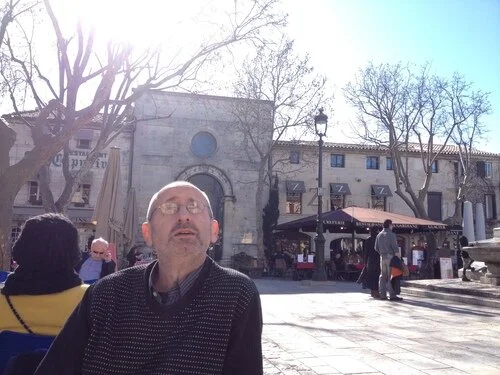
    It was all going so well. As related in my last post following the fire and the release of Tom Thumb I spent last Sunday afternoon in Aigues-Mortes with my friend and the French translator of “The Book of Ash,” Alfred Boudry.

    IMG_4539.jpeg

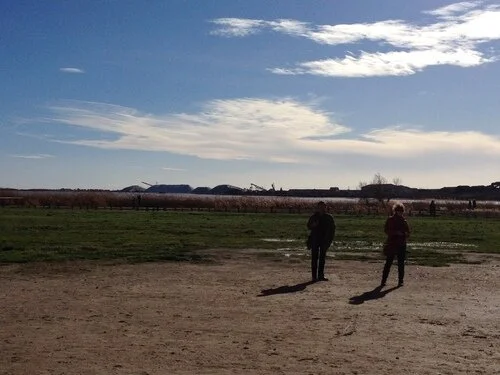
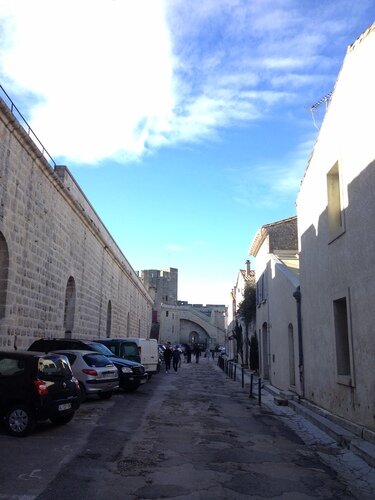
    Aigues-Mortes is an interesting place. It sits in the middle of salt marshes, and has been a centre for salt production since the Neolithic period. Baleine salt (the one with the whale logo) comes from here. Those big heaps you can see on the horizon in this picture? That’s salt.

    IMG_4547.jpeg

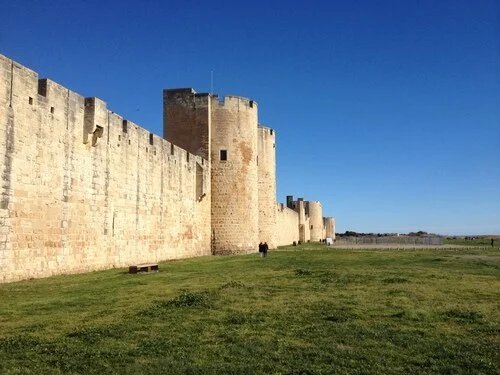
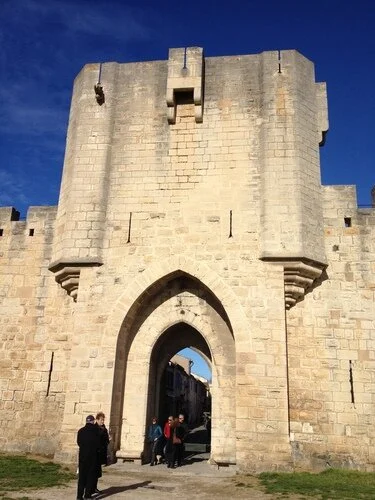
    The town itself is a fortified jewel, its first tower built by Charlemagne in 791 and the subsequent walls and turrets completed by Louis IX and his son Philip the Bold in the 13th century, who used it as a garrison and launchpad for two major crusades. A bit later, in the 14th century, it was used as a prison for the Templars. Alfred himself was involved in telling the story of this slice of history: as a student he took part in huge dramatic re-enactments, audiences out by the salt marshes, lots of guys in Crusader-garb charging around and scaling the walls, until he got too close to some of the horses and discovered an asthmatic allergy so severe that he had to be stretchered off for real.

    IMG_4545.jpeg

    IMG_4546.jpeg

    IMG_4543.jpeg

    Nothing so exciting happened the afternoon we visited. We just drank mint tea in the square and wandered round the pretty streets for a couple of hours. Then it was back to the now cleaned-up résidence and, for me, back to work. Having lost a bit of time and quite a lot of energy to the fire I needed to crack on with Midland.

    This I did, in an atmosphere even more peaceful than previously now that my neighbour Pierre, his room trashed, had had to go home. The second night after the fire, however, I was woken around three a.m. by the sound of the humane trap I’d set going off, followed by a fair amount of rattling and squeaking.

    Ha, I thought. I’ve already recaptured that pesky Tom Thumb. But I was too tired to get up and do anything about it, not least because I hadn’t organised anything to transfer him into. So I went back to sleep.

    But when I got up in the morning the trap was empty, the cheese in it all gone. I forgot to take a picture of it, but it was a simple design – a long narrow mesh cage with a bait-loaded trigger at one end that released a powerful spring-door which closed off the entrance at the other.

    How that mouse had managed to eat the cheese, release the door and escape I had no idea. Had he squirmed his way out of the side of the door, pushing back against the spring until it was open a crack? It did look just about plausible. Or had he eaten the cheese so carefully that the trap, disturbed but not sprung, had only released itself once he’d exited? It was impossible to know.I reset the trap and got on with my work and didn’t think much more about it. Whatever had happened it must have freaked out little Tom because I didn’t see anything of him or Hunca for the next few days, though the occasional scrabbles I heard behind the skirting boards betrayed their continued existence. Presumably they’d discovered Pierre’s room, shut off complete with all contents – including quite a bit of food – pending the arrival of the loss adjustors from the insurance company.

    IMG_4559.jpeg

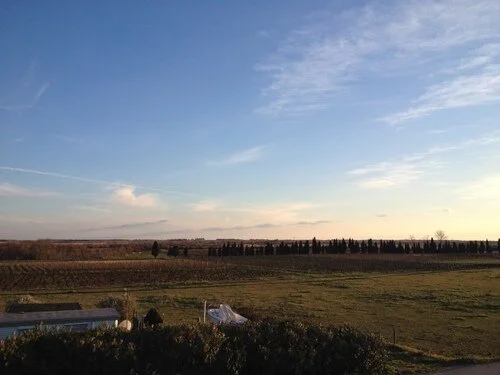
    Towards the end of my final day I went out for my customary run down by the nearby Grande Motte canal, the one that leads, straight as an arrow, all the way to Aigues-Mortes. It was a particularly beautiful afternoon, the light like a golden filter over the marshes. I took this picture from the window by my desk, then got up to change into my running kit.

    IMG_4562.jpeg

    That’s when I saw Tom Thumb sitting on the floor by the fridge. I tiptoed closer but he didn’t move, crouching motionless like he had the first time I’d caught him. So I bent down and picked him up and popped him in the plastic basket I’d prepped since the night he woke me up, so that if that he’d sprung the trap again I would be ready.

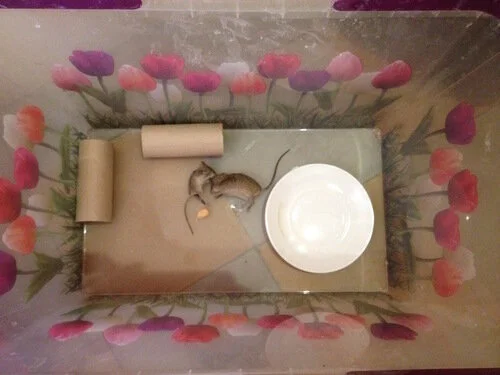
    He didn’t protest and just sat where I put him. There was something wrong with him, for sure. I gave him a cashew nut and some water, put an empty loo roll for him to hide in if he felt like it, and went out for my run.

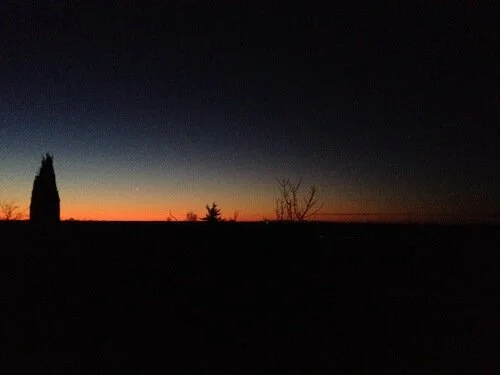
    I ran straight into the setting sun as it threw the most intense maroon cast over the landscape, just like the photo I included from thirteen years ago in my first post. I was in a good mood. The end of the book was very very close, the new material and new structure I’d put into place the previous week seemed to be working, and the Midland funding campaign had now reached 10%. Despite the fire, the retreat had been a success.

    Then I got back to my room, unlocked the door, and came into find that Tom Thumb had crawled inside the cardboard tube and died there.

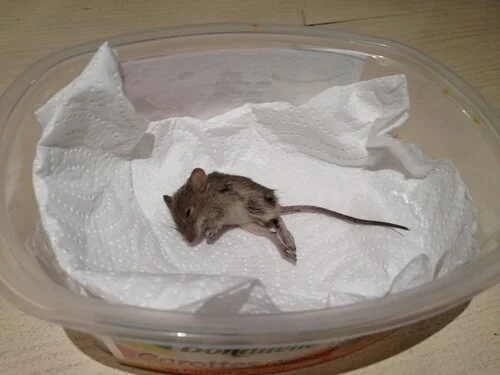
    I took him out and put him in a plastic food container so I could take a look at his body.

    IMG_4565.jpeg

    There was clearly quite a deep wound on the back of his leg, which looked healed and yet was flecked with fresh blood. Had he been caught by the trap’s door as it came down, and died from the injury? It seemed quite likely. But the wound looked old, and I’d noticed him pushing his leg out to one side as he’d run about the week before. Still, I couldn’t think of another explanation for his just suddenly keeling over like this, and I was very upset by it. My little résidence pal, who just a few days ago had been nibbling on cashew nuts I’d put out for him and running up my trouser legs, had been killed by my over-complicated efforts to care for him. If I’d just put him outside when I’d first caught him instead of trying to catch Hunca too, then he’d be alive now, if lonely. I put him in the fridge and worked late into the night, then went to bed, feeling very unhappy.

    I woke up before dawn still thinking about him. Needing to get as much work done as I could before packing to go home I got up, made some coffee, and opened the shutters. It was still dark outside but there was the most vivid view of Venus over the marshes, lit to incandescence by the sun rising behind it.

    IMG_4567.jpeg

    I switched on my computer and cracked on with my edit for the next couple of hours, looking up occasionally to chart the progress of the morning as it broke across the Petit Camargue. Fresh coffee was eventually required and when I went across the room to make it I had another surprise. There was Hunca Munca, sitting motionless on the kitchen floor, not far from the spot where I’d found Tom Thumb the night before.

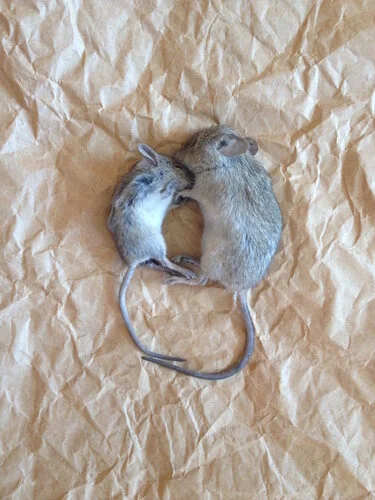
    It was almost as if she’d come to look for him. But she was clearly sick too. She didn’t move as I approached and I picked her up as easily as I had her partner and popped her in the plastic just I as I had done with him.

    This wasn’t about getting hit by the trap. These little mice had clearly eaten something they shouldn’t. Had they been in Pierre’s room, and made ill by residues from the fire? Or had they made their way into the roof space, where we’d put poison down for whatever it was we’d heard moving around up there, and eaten that? The poison may well have acted as a decoagulant, explaining why Tom’s old wound had reopened. Perhaps it had been them in the roof all alone, the plasterboard amplifying the taps of their tiny claws like the skin of a drum? It didn’t seem possible, but I remembered having mice in the roof of my house in London some years before, and thinking at first they were rats by the extraordinary noise that they made.

    Fire or poison I just didn’t know, but Hunca was fading and was not looking like she’d recover. I took Tom from the fridge and put him in the basket beside her so she’d at least know where he was, and she lay next to him while I shut down my computer, packed up my stuff, and tidied the room.

    IMG_4573.jpeg

    Hunca passed away at two minutes past twelve, literally as I closed the clasps of my suitcase. I was absurdly upset. I felt almost like I’d just lost my own children, and flung tears around as I gathered my last few belongings and organised some of kind of hasty mouse funeral.

    IMG_4577.jpeg

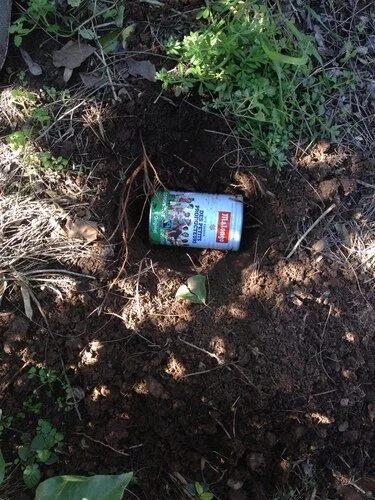
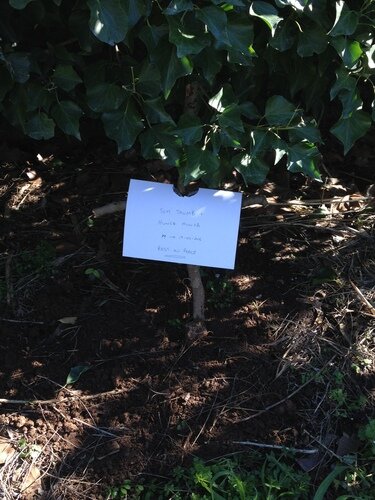
    So my final hour at the résidence was spent burying Tom and Hunca in a shady spot in the corner of the little Au Diable garden. I put them in a metal coffee canister, wrapped in the paper wrap from a baguette and sealed in with a message about their contribution to my book in case one day, in years to come, someone digs them up. I made them a makeshift cross out of a couple of sticks to mark the spot and as a final token put the last cashew nut I’d given them, the one they’d been too sick to eat, on the top of the small mound of earth that now covered them. And then I got in the car and made the trip to Montpellier airport, feeling devastated by the loss.

    IMG_4580.jpeg

    IMG_4582.jpeg

    IMG_4586.jpeg

    Crazy really. Two mice, who would almost certainly have been poisoned or trapped non-humanely within a few days of my leaving in any case. I think what upset me most was the whole tiny tragedy of unintended consequences, the remorseless playing out of a disaster despite so many heartfelt efforts to achieve the contrary result. And what was very strange, and particularly disorientating, was the peculiar way in which this little saga with the mice mimicked in miniature the very plot mechanic I’d come out to France to write out – the climax of Midland.

    I’m going to say no more about it because I don’t want to spoil it for you, but if you enjoyed and were moved by this tale of Tom Thumb and Hunca Munca, I think you’ll enjoy and be moved by my book.

  • Fire at the Résidence! (Including: The fate of Tom Thumb…)

    Things have taken a somewhat dramatic turn here on my supposedly calm and productive writing retreat. Yesterday, Saturday, after a successful first week that got me pretty much to where I wanted to be with regard to progress on Midland, I spent the morning doing yoga and catching up on various bits of online admin. After lunch, the other writer here, Pierre, took off in his car to spend the afternoon looking round the nearly town of Arles, and I went to the supermarket to pick up some supplies (including a humane mousetrap for the pursuit and capture of Hunca), intending to come back and do a couple of hours writing before going over to my publisher’s house for dinner.

    I knew something was wrong as soon as I unlocked the main door on the ground floor. The Au Diable headquarters does not generally smell of burning, nor is the hallway generally hazy with smoke. As the smoke wasn’t too thick nor the smell too strong, I went up the stairs to investigate, and discovered to my horror that the smoke was coming in a steady stream, almost like a waterfall, from the top of Pierre’s door. 

    I tried the door, which was locked. There was a fire extinguisher on the wall behind me, so I lifted it down then unlocked my room and checked there was no fire in there – which there wasn’t – while I worked out what to do. 

    As it happens, I had been in a near identical situation once before, when I was a student. I came back to my college room one night – located on the top floor top of the building it was in – to find smoke coming out from behind my neighbour’s door. I’d been out all night, it was about 5 a.m., and I wasn’t sure if she was in there, so I grabbed an extinguisher and shouldered the door open. She’d left her gas fire on with a 1970s super-fire-risk foam-cushioned easy chair placed strategically in front of it and then gone out for the night. By the time I got there the chair was merrily ablaze and I managed to get inside and feel on the bed to make sure she wasn’t in it before being forced back by the smoke and running off to raise the alarm. Just being exposed to the smoke for those few seconds gave me lung problems that lasted for weeks, and despite feeling quite heroic at the time I subsequently learned that what I had done was a bit dumb. Smashing open the door on a fire, as we all now know thanks to the movie Backdraft, can massively fuel a blaze with oxygen and make it much worse, much faster than it otherwise would have been – sometimes explosively so.

    I thought about this as I looked at Pierre’s door. I had an extinguisher, and the smoke didn’t seem that bad just yet. I knew the room’s layout and knew therefore that I would be able to spray the kitchen area from the door, if indeed that was the source of the fire. So I chanced it, and tried to kick open the door. 

    Perhaps luckily for me the door was tougher than the one on my student neighbour’s room, and try as I might I couldn’t smash it open. Thinking again about backdrafts I went into my room, grabbed the noticeboard with the various emergency numbers on it along with my computer and a bottle of water, and hustled outside so I wouldn’t get trapped if the fire did break out of Pierre’s door. 

    I was shaking quite a bit by this point, and I found it quite hard to key in the numbers on iPhone keypad. Worse, when I did manage to make a call – first to Peggy, the manager of the Résidence, then to the fire brigade – the calls were connecting but I couldn’t hear the person on the other and I had to guess that they couldn’t hear me. Figuring that I was just going to have to deal with the situation myself I went back upstairs to try and smash the door down by using the fire extinguisher as a battering ram, but thick black smoke was now streaming out from all sides of the frame and it was obvious that the small window of opportunity I might possibly have had for one man action had by this firmly closed. Opening that door, especially since I knew for sure there was no one in there, would now be a crazy thing to do.

    I went outside again and tried some other numbers with no more joy than previously. So with more shaking hands and lots of swearing at fricking predictive text algorithms I sent a text to my publisher to tell her what was happening in case that had a better chance of getting through.  Then, just as I was beginning to think that there was a real possibility that the whole building might burn down before I managed to summon help, a truck turned down the track towards me from the direction of the farmstead up the way.

    I ran towards it and flagged it down and in my crappy French told the guy behind the wheel what was happening. He called the fire brigade then lent me his phone to call my publishers. Finally, thank god, help was on its way. Now, however, came the worst part. Standing outside the building not having any real idea about how bad the fire was and completely powerless to do anything about while wondering how busy the fire brigade was this Saturday, how far they had to come, and if they’d actual be able to find us anyway given that the nearest road with line markings on it was about three kilometres away was really not a whole bundle of fun.

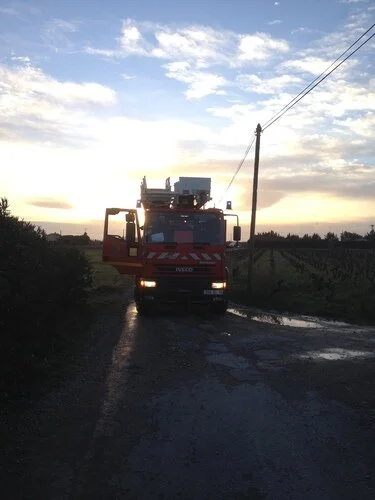
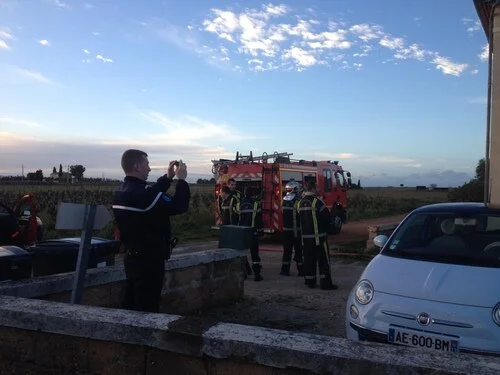
    I’m not actually sure how long we stood there. Maybe twenty minutes, maybe half an hour, but then they showed up. And when they did they showed up in style: two fire engines, two support vehicles, two police cars, the works, riding in out of the sunset like the fricking cavalry. It was great.

    IMG_4531.jpeg

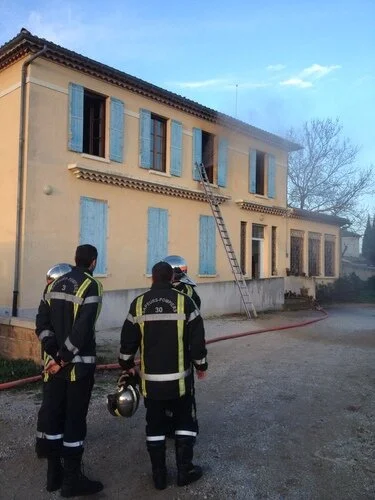
    Even better one of the firemen was actually a totally hot (geddit?) firelady, who put a ladder up against the side of the house then completely unnecessarily inched along the 12 inch wide parapet in order to climbed in through MY bedroom window, which gave me excellent insight into the reason women seem to go weak at the knees the moment some butch guy in a bright yellow helmet shows up with a really long hose.

    IMG_4535.jpeg

    Anyway, uniform fetishes aside, team fire instantly took charge of the situation, smashed down Pierre’s door in precisely the ruthless and efficient manner I’d completely failed to manage earlier, and pointed their spigots at the source of the problem: a short-circuting Nespresso machine, which because it had been sitting next to a toaster and on top of a microwave which in turn sat next to a hob built into sideboard over a fridge, had created a kind of Nespresso-toaster-microwave-oven-fridge monster of the kind that serves breakfast in hell.

    Soon the fire was out and everything was under control. The monster had been dispatched back to the ninth circle of Hades, the fire was out, the cops were taking selfies, and it all looked like was going to be ok, if rather wet and very dirty.

    IMG_4532.jpeg

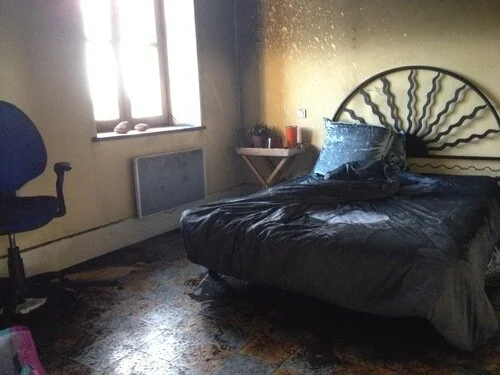
    Or as ok as it can be when a fire has just gutted the room next to yours in a building in the middle of nowhere. Which isn’t really that ok at all, especially when the one silver lining – my brief crush on hot firegirl – got stubbed out like a discarded Gauloise when I discovered that the reason she’d climbed in through my bedroom window had nothing at all to do with any desire she may or may not have had to give me a mild sexual frisson but was solely about being able to open my door from the inside so that she could turn my entire room into a chimney for the purposes of venting the foul, black, plasticky and no doubt highly carcinogenic smoke more quickly from the building’s interior, so sparing the lungs of her colleagues the kind of fate mine had suffered at college but in the process coating everything in my room, from my bedding to my bread basket to the bloody notes for my bloody book in a sticky black residue.

    Huh! I mean how thoughtless can you get?

    I got off lightly of course. Poor Pierre turned up at the moment of peak pompiers, got out of his car, turned white as a sheet at the sight of the smoke pouring out of his window, and stayed that way as he discovered that everything he’d brought with to the retreat, including his laptop, was now landfill.

    IMG_4552.jpeg

    IMG_4554.jpeg

    And talking of landfill, the moral of the story is, don’t drink fucking Nespresso. I’ve always thought those shitty little machines with their horrible dried out barely-better-than-instant coffee and completely unnecessary throw-away one-time-only plastic cartridges designed for people who are two fucking lazy to put a spoonful of coffee into a fucking cafetiere or one of the million-and-one other perfectly excellent reusable coffee making solutions that have been on the market for decades (not to mention their nauseating ads by an actor who shall remain nameless – George Clooney – and who I’d otherwise generally rather admired), were the devil’s work, and now I’ve looked the devil they conjure in the eye I know it to be true. SO DO NOT USE THEM. (Actually, I think this particular one was a MagiMix brand, but those cartridge coffee machines are all as fucking evil as each other, as far as I’m concerned.)

    Annnnnyway, there was clearly going to be no writing for Jim or Pierre that night, or the next day. The staff of Au Diable had by now descended from their various homes, and in between the gathering and consuming of a bottle of wine and a bottle of Ricard (to steady the nerves, you understand), plans were being hatched to find us poor homeless writers alternative accommodation for night, to get an electrician to isolate the circuits in Pierre’s room so that power could be returned to the rest of the building, and to get some kind of cleaning SWAT team onside asap.

    After fortifying myself with Galician rosé I packed an overnight bag and did some damage limitation on the contents of my room, which included making a decision about what to do with Tom Thumb (remember him?) who was still being held captive in the plastic basket in my kitchenette. His digs were already pretty squalid and now, thanks to the smoke, were really not very nice at all. Feeling that it wasn’t very fair to leave him there while I waltzed off to more agreeable accommodations, and not wanting him to freak out any cleaners who might appear and discover him the next day, I picked him up by the scruff of the neck again – to much angry squeaking on his part – and let him go. Which he did, immediately vamoosing beneath the fridge presumably in search of Hunca Munca.

    Satisfied that I’d done the right thing I spent the night at my publishers and came back the next morning to try and make things a bit more shipshape. Around midday a husband and wife dynamic cleaning duo duly arrived and performed the most astonishing cleanup operation I’ve ever seen. They came in, surveyed the scene, went outside, donned white disposal protective overalls of the kind that would be handy during an Ebola outbreak, then proceeded to clean, not my room or Pierre’s room or the trashed hallway, but the picnic table in the garden.

    This they then set with the most wonderful array of breads, meats, wines and cheeses, including smoked duck rillettes, raw milk chevre, and a pâtê the name of which I was told I must never forget but which I’ve already forgotten, and invited us all to lunch. Not a squirt of Cif was dispensed, not a surface wiped, until we had all enjoyed an excellent and restorative repas in the warm February sunshine. When we’d finished they sent me away to go do some sightseeing in nearby Aïgues-Mortes (about which more in a later post) while they got on with the job in hand. I returned at about five p.m. after a very relaxing afternoon doing not very much to find the cleaners gone and Peggy just about to lock the place up.

    “Perfect timing!” she said. She took me up to my room and it was transformed. Absolutely immaculate, fresh linen on the bed, kitchen sparkling, the whole place literally spotless and two pots of homemade jam placed as a gift for me in the fridge. How they’d done it I really don’t know, as the smoke residue was really hard to clean off. But they had and so, here I am, back at my desk after dinner, computer set up, Internet on, and ready to get back to work in the morning. Forget German efficiency. If this is French efficiency then this is the version I want.

    Which leaves just one loose end to tidy up. Because I suddenly thought, as I set up the humane mousetrap this evening having seen that Tom Thumb was already back on pasta patrol, if I was a mouse, i.e. Hunca, and my husband, i.e. Tom, was being held captive, what would I do, little mouse that I am, to create a turmoil big enough to ensure that Tom got released?

    And I thought, well, little mouse that I am, I could do a lot worse than short-circuit the wires on some crappy coffee machine when everyone had gone out for the afternoon…

    Shhhheeeitt?!?!?! Have I just been completely outplayed by a fricking field mouse? I don’t know, but as I was writing this one of them set off my trap and somehow got the cheese out without getting caught inside.

    I could be in the presence of some kind of higher state of rodent consciousness here. Be afraid. Be very afraid…

  • Tom Thumb has been captured!

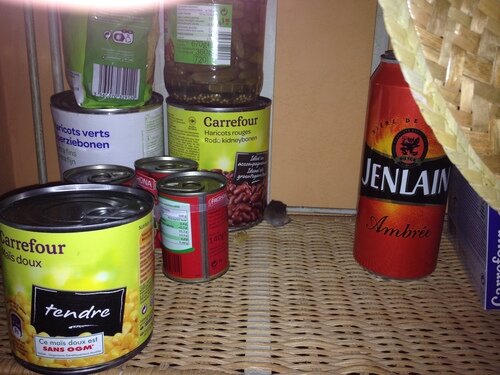
    There have been important developments in my relationship with the mice here in the Au Diable Vauvert writers’ Résidence, after I was woken (again) a couple of nights ago by the bizarrely loud sound of Tom Thumb trying to gnaw his way into a bag of pasta. 

    I got up to investigate and when I switched the light on and removed said bag from its shelf, instead of running away Tom sat there absolutely stock still, either because he:

    1. Was frozen with fear

    2. Was hoping that by staying very still I wouldn’t see him (not a bad strategy with many predators, whose eyes are often tuned to movement rather than subtle variations in colour)

    3. Wanted to be caught!

    IMG_4518.jpeg

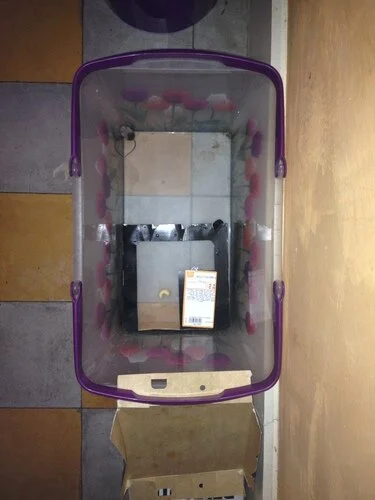
    The result of this strategy was that I did indeed catch him. Just picked him up by the scruff of the neck and popped him in to the plastic basket used for the recycling:

    That, as I say, was a couple of days ago. I’ve put an empty cardboard box, some food and water, and some rolled up bits of paper in there for him to make a bit of a nest out of and he seems ok, though clearly he’d quite like to get out (he does periodically try and leap up the side of the basket, but it’s just a few centimetres too high for him to scale).

    But I’m now in a quandary. The plan is to catch Hunca too, reunite them, and put them out in the garden together. But of course I can’t catch Hunca (humane mousetraps have yet to be located in the local town). I’ve set up a kind of trap (a tipped over bucket with some cheese at the bottom, the idea being I’ll be around when she’s in there and so able to scoop her up), but she keeps nicking the cheese when my back’s turned.

    And as a result I’m starting to feel bad about keeping Tom in captivity. What if:

    1. I can’t catch Hunca. I don’t want to split them up and release Tom to the garden alone. Should I just let him go and wait for humane mousetraps?

    2. Tom is actually Hunca, and there’s a nest of mouse babies in the wall space (I’ve pulled the fridge out, cleaned up the astonishing mess they’ve made behind it, and found the Tom & Jerry style hole they have indeed carved in the skirting board), and the babies are slowly starving to death because she’s not there to feed them?

    3. I catch both of them, put them in the garden, there are babies and they slowly etc.?

    I don’t see a win here. I’m beginning to think I should just let Tom go and leave it to the publishers to sort out when I’m gone. Which will probably involve calling the local pest controller who will put poison down. And then there will be no romantic way out for Tom and Hunca and any babies they may or may not have.

    Of course, I may be completely wrong about this. There may be many more than two mice. The whole damn place might be infested with the little varmints (I have heard a worrying amount of behind-skirting-board scurrying), and it’s just that I’ve only ever seen two at once. In which poisoning would too good for the little horrors.

    Arrgh. What should I do? Please advise.

    Oh, by the way, in the midst of all this I have been getting on quite well with the book…